
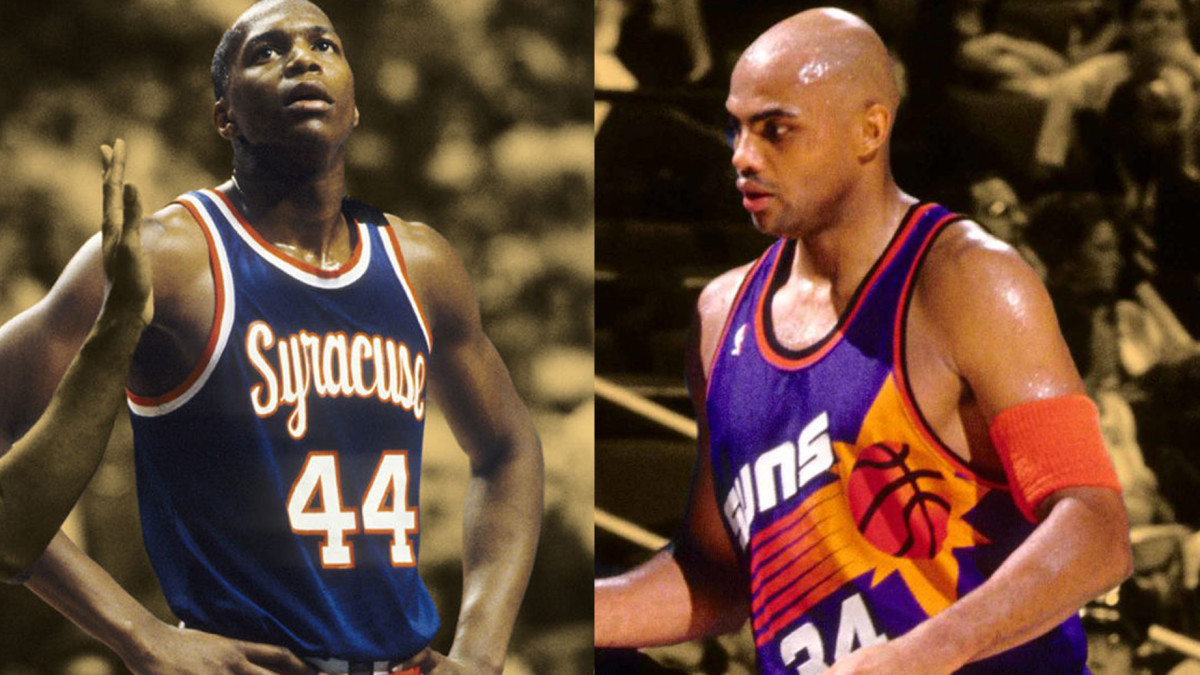
There were plenty of giants in Charles Barkley’s path during his NBA career — players who bruised bones, shattered backboards and made their names in the thick of 1990s basketball wars. Chuck, a six-foot-six rebounding machine with the heart of a heavyweight and the mouth of a boxer, never shied away from confrontation.
But among all the legends he locked horns with, there was one name that didn’t just command respect but sparked fear. Derrick Coleman.
A rare breed of power forward
When Coleman entered the league in 1990, comparisons were swift and loud. Karl Malone. Barkley. Elite forwards who dominated the floor. But D.C. was different — he was a 6-foot-10 who could attack the paint as well as shoot from distance. The kind of player who made one question if the game was beginning to change.
Advertisement
“Derrick Coleman was one of the few guys that I ever said that guy scared me right there,” Barkley said. “If that guy had got his stuff together, they would have had to change the rules. That guy had it all, he could shoot 3s, he could post up, he was ambidextrous. That guy, I said, ‘Woah, this is a handful right there.'”
At a time when power forwards lived in the low post, Coleman dared to stretch the floor. He could fade away from either shoulder, fire from the top of the key, and punish undersized defenders with raw power in the block. Derrick had all the tools.
During his best years with the New Jersey Nets, Coleman averaged 19.8 points and 10.6 rebounds per game — numbers that mirrored the production of contemporaries like Chris Webber and Shawn Kemp — and in the 1992–93 season alone, D.C. posted 20.7 points and 11.2 rebounds per game, placing him among the elite power forwards in the league.
Yet unlike Malone or Barkley, whose careers surged upward with relentless drive, Coleman’s arc swerved unpredictably. Injuries dogged him, and so did criticism. Talks about Derrick’s commitment, attitude, and conditioning followed him from city to city.
Advertisement
But even through all the noise, Coleman’s career averages of 16.5 points and 9.3 rebounds over 15 seasons stood as proof of his consistent productivity, even when his off-court battles threatened to overshadow the work he did inside the lines. The Mobile, Alabama native’s lone All-Star appearance came in 1994, but his presence loomed larger than a single accolade. He wasn’t a one-hit wonder. D.C. was a player who could’ve redrawn the map of modern basketball if everything had lined up.
Coleman’s fading out
Derrick’s journey began at Syracuse University, where he dominated the college scene and solidified his reputation as a future star. It came as no surprise when the Nets selected him with the first overall pick in the 1990 NBA Draft. And almost immediately, Coleman lived up to the hype. His rookie season was a showcase of versatility and power, and by the end of the year, D.C. was holding the NBA Rookie of the Year trophy.
Advertisement
In his sophomore campaign, the 6’10” power forward turned the volume up. Averaging nearly 20 points and 10 rebounds per game in 1991–92, Coleman was a nightly double-double threat. The Nets, powered by a young core that included Kenny Anderson and the newly added Drazen Petrovic, began turning heads.
By 1993–94, they were legitimate playoff contenders. Coleman earned his first All-Star selection that year, forming a dynamic one-two punch with Anderson and anchoring a team that had finally found a rhythm.
However, the Nets, struggling with front-office instability and coaching turnover, couldn’t build a consistent winning culture. Tragedy struck with the death of Petrović in 1993, a loss that shook the foundation of the franchise. And Derrick, battling injuries and frustrations, never quite regained the spark that had made him such a terror early on.
“Derrick Coleman, I said, if this kid ever gets it together, but he went to a Mickey Mouse organization too,” Barkley said.
Advertisement
His later years saw him bounce from the Philadelphia 76ers to the Charlotte Hornets to the Detroit Pistons, flashes of brilliance appearing in brief moments but never stringing together a lasting impact. The promise that once hovered over Coleman never fully materialized into sustained greatness.