
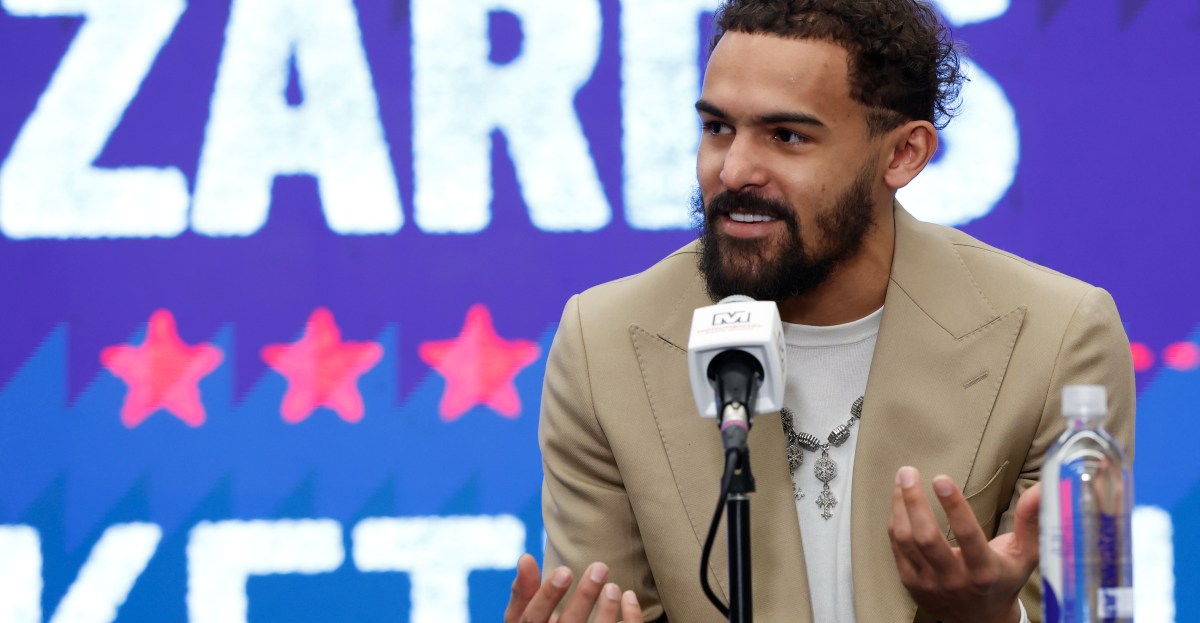
The Atlanta Hawks made the first major roster move of the NBA season last Wednesday – agreeing to a stunning trade to send All-Star point guard, Trae Young, to the Washington Wizards in return for a meager package of CJ McCollum and Corey Kispert. No draft assets changed hands in the deal.
McCollum is a reliable veteran scorer, with a career average of 19.5 points per game in twelve-and-a-half seasons in the NBA. He is in the final year of his current contract and will be an unrestricted free agent in the summer. Kispert, meanwhile, is a solid catch-and-shoot threat in the first year of a four-year, $54 million rookie extension. He is under contract through the 2027-28 season with a team option for just over $13 million in 2028-29.
With Young being photographed in his new threads over the weekend, and McCollum and Kispert suiting up for the Hawks in their win against Golden State on Sunday, Young’s time in Atlanta is officially – somewhat surreally – over after seven-and-a-half seasons, four All-Star appearances, an assist title, and, of course, one, glorious Eastern Conference Finals run back in 2021.
Young leaves an indelible mark on the franchise. After trading for him on draft night back in 2018, he appeared in 520 games (regular season and playoffs) in a Hawks uniform and leaves as the franchise leader in three-pointers (1,295) and assists (4,837). A walking double-double, he is the only player in NBA history to average 25+ points and 10+ assists per-75 possessions through the first seven seasons of their career.
It’s going to take some time to get used to seeing him in a different jersey.
While Young accomplished some great things in Atlanta, it did seem like this was the best time to move on for both parties, and it’s a credit to both Young and the front office that they were able to find an amicable resolution to what was undoubtedly a difficult situation in pivoting away from the former face of the franchise.
Young is in the final guaranteed year of his contract, and he has a player option for approximately $49 million for next season. He was extension eligible over the summer – and it was rumored that he was in search of a maximum contract – however after the Hawks refrained from offering him an extension ahead of training camp, whispers regarding his long-term future in Atlanta started to surface.
At media day back in September, Young was asked about whether there was any ‘disappointment’ about not getting an extension done in the offseason, saying:
“Um… I don’t know about the word disappointment. I mean, maybe. For me, I’m so focused, I’m more happy about the team we got heading into the season. For me, I’m blessed bro, I wasn’t stressing about anything, if something happened, it happened. If it didn’t, I still got time. Obviously, everybody knows what my situation is going into the future so for me, I’m focused on this team, I’m focused on right now, I’m blessed, I’ve got a great team going into the season – one that I mean you can’t really say I’ve had so, I’m even more excited about that. Who knows what the future [holds] for me, but right now I’m here, I’m present, like me and coach have been talking about, so I’m excited about it and ready to go.”
After adding Nickeil Alexander-Walker and Kristaps Porzingis over the summer, there was a lot of excitement surrounding the Hawks entering the 2025-26 season. Many – including myself – expected the team to compete for a top-four seed in the East, with the most optimistic projections giving them an outside shot at a return to the Conference Finals.
Unfortunately, the roster that so many were drooling over during the summer never got a proper chance to mesh. After a bumpy, 1-3 start to the season, Young was injured in the first quarter of their following game against the Brooklyn Nets, causing him to miss the next 22 games with an MCL sprain.
Atlanta were forced to reimagine their identity in Young’s absence, relying on staunch defense and a more egalitarian offensive attack to rally during this stretch with Young on the sidelines.
Jalen Johnson emerged as a full-fledged star*, Nickeil Alexander-Walker – Young’s replacement in the starting lineup – took on his expanded role with aplomb*. Onyeka Okongwu and Vit Krejci caught fire from three and started to play some of the best basketball of their careers. Dyson Daniels, who had gotten off to a crummy start to the season after signing a four-year, $100 million contract extension in the offseason, seemed more engaged and began to play with more verve.
The Hawks won 11 out of their next 16 games after Young’s injury before hitting a rough patch in December, going just 2-4 to begin the month as their All-Star point guard geared up for a return to action.


With Young back in the lineup for the game against Charlotte on December 18th, Atlanta hoped his return would spark the offense, and help the team get back in the winning column. Yet, despite Young’s immense offensive talent, the age-old question regarding his game has always been about his ability to survive on the defensive end of the floor, and in that regard, he failed to hush any doubters.
The Charlotte Hornets lit Atlanta up from beyond the arc in Young’s return game, shooting 24-49 (49%) from beyond the arc en route to a 133-126 victory. Young played just 20 minutes, with Atlanta allowing a miserable 1.46 points per possession with him on the floor.
After sitting out the following game against San Antonio, Young suited up against the Chicago Bulls on December 21st, with Atlanta giving up a whopping 152 points in a slim, two-point defeat.
Though Young was masterful on offense in that one, scoring 35 points on 10-for-16 shooting (7-for-9 from three) to go with nine assists and only two turnovers in 26 minutes, the defensive woes continued, with Atlanta allowing 1.40 points per possession with him on the floor. It’s telling that despite an otherworldly offensive performance from Young, Atlanta only outscored Chicago by two points in his minutes.
While the Hawks were competitive in their next three games (all with Young active) against Chicago, Miami and New York, all three ended in defeat, and when the Hawks ruled Young out for the Oklahoma City game on December 29th with a quad contusion, the writing appeared to be on the wall.
All in all, the Hawks posted a 122.5 offensive rating* with Young on the floor this season, however their 129.3 defensive rating** with him on the floor was quite damning, and clearly a pressure point for the front office as they evaluated their options going forwards. Ultimately, they didn’t feel it was in the best interest of the franchise to keep Young through the rest of the season, and risk letting him walk for nothing in the summer, which led them to explore their options in the trade market.
*Nine points per 100 possessions better than their offensive rating with him on the bench, and a mark which ranks in the 92nd percentile relative to other five-man lineups this season per cleaningtheglass (which does not account for garbage time)
**A stunning 15.6 points per 100 possessions worse than their defensive rating with him on the bench, and a mark which ranks in the first percentile (yep) relative to other five-man lineups this season per cleaningtheglass (which does not account for garbage time)
Young shared the following message to his Twitter on Friday morning when the move became official.
Hawks GM, Onsi Saleh, shared this statement following the trade:
“On behalf of the Hawks franchise, I’d like to thank Trae for how he embraced the city of Atlanta and represented the Hawks during his time here, on the court and in the community. Over more than seven seasons, including four All-Star appearances, he cemented himself as a fan favorite and one of the great players in our franchise’s history. We wish Trae and his family all the best.”
“Adding CJ McCollum, one of the NBA’s most prolific shooters and a respected veteran, along with an established young veteran in Corey Kispert, will strengthen our team on the court and in the locker room, and we retain flexibility for future opportunities to continue building our program.”
While much of the national conversation surrounding this move has understandably gravitated towards the superstar that departed Atlanta last week, there hasn’t been a lot said for the players who came the Hawks way in the deal. Both CJ McCollum and Corey Kispert made their Hawks’ debuts in Sunday’s win against Golden State, with McCollum notching 12 points and four assists in 24 minutes, and Kispert chipping in with two points, three assists and a steal in 14 minutes.
Wes did a great breakdown of McCollum’s game that you can find here, but I’ll discuss both McCollum and Kispert below.
McCollum is a 6’4” combo guard with 12 seasons of NBA experience under his belt. For his career, he’s averaged 19.5 points, 3.8 assists and 3.6 rebounds per game on 45/40/80* shooting splits in stops in Portland, New Orleans and Washington.
Though McCollum doesn’t put much pressure on the rim, shooting just 55.8% on 3.4 rim attempts per 75 possessions for his career, he is proficient from the mid-range, and is a high level three-point shooter both off the dribble and off the catch. This season, he ranks 21st in three-point percentage (38.6%) out of the 60 players who have attempted at least 6 threes per game.

McCollum isn’t a particularly dangerous one-on-one scoring threat but is good at getting to his spots out of the pick-and-roll, ranking in the 90th percentile or better in pick-and-roll ball handler scoring efficiency in two out of the last three seasons including this one. McCollum is also a steady playmaker with a high IQ, who rarely turns the ball over – averaging just 2.1 turnovers per 75 possessions for his career.
Defensively, McCollum is a bit of a liability, having ranked in the 22nd percentile or lower in defensive EPM in four out of the past five seasons. Still, the 34-year-old is a reliable veteran with enough experience under his belt to understand what’s needed from him from night to night. While I don’t expect him to step into the starting lineup anytime soon, he’ll be able to supply leadership, shooting as well as a bit of secondary creation off of Atlanta’s bench going forwards.
Onsi Saleh had the following to say about CJ McCollum at yesterday’s presser:
“With CJ, between his ball handling, shot creation, he is a vet, and he’s a leader too in a lot of ways. Like, he’s going to speak when there’s something to be said and also just his playstyle. I think he makes players better around him. I think he makes the game easier for some people. It takes pressure off of guys. If we need a bucket, he’s also someone that can create for himself. That was kind’ve a need for us as well, but now you have multiple guys that can do that instead of just a couple. So I just think, his shooting, his playmaking, his ability to play pick-and-roll. He’s really good at all those things and his leadership is a big component.”
Kispert is the lesser known of the two players that came in from Washington but given that his contract runs through the 2027-28 season (with a team option for 2028-29), he’ll have a chance to carve out a role for himself here in Atlanta unless the team decides to include his contract in a future trade.
A career 38.2% three-point shooter, Kispert is a player who’s been on my radar for some time now, and I’m excited to see what he brings to the table over the next few weeks – though I wouldn’t rule out the possibility of Atlanta attempting moving on from his contract at the trade deadline (of course, depending on the market).
For Kispert to be successful in Atlanta, he’ll need to prove that he is more than just a shooter – as his rebounding, playmaking and defensive skills haven’t necessarily popped over his first four-and-a-half seasons in the NBA. Over 60% of Kispert’s career field goal attempts have come from beyond the arc, though he’s also been a surprisingly good rim finisher (albeit on a low volume of attempts), shooting 73.9% on 2.7 attempts per 75 possessions.
At 6’6”, 224 pounds, Kispert has a decent frame for an NBA player, but he has struggled defensively in his career, ranking in the sixth percentile or lower in defensive EPM in each of the past four seasons. While it’s worth noting that it’s tough to truly assess Kispert’s defense on a Washington team that’s been consistently terrible on that end of the floor, he isn’t a very active defender (low steal, block rates) and doesn’t rate very favorably in Bball-Index’s ‘perimeter isolation defense’ metric.
He’ll have to prove he’s worth keeping around, making over $13 million a year for the next few seasons, but it’s going to be interesting to see what kind of role he plays moving forwards given how competitive the battle for wing-minutes projects to be.
Onsi Saleh said the following about both Kispert and McCollum at yesterday’s presser:
“With Corey, there’s a toughness. He can attack closeouts. He’s a hell of a shooter as we all know, but there’s more to it. He’s a physical player, gets to the rim, athletic player.”
“Again, they [both] just fit how we’re trying to play too in a lot of ways, again we’re really fortunate to have [both] these guys. They’re just really good dudes – I’m sure none of you have heard anything bad about those guys. They’re just studs as human beings and they fit the culture that we’re trying to build.”