
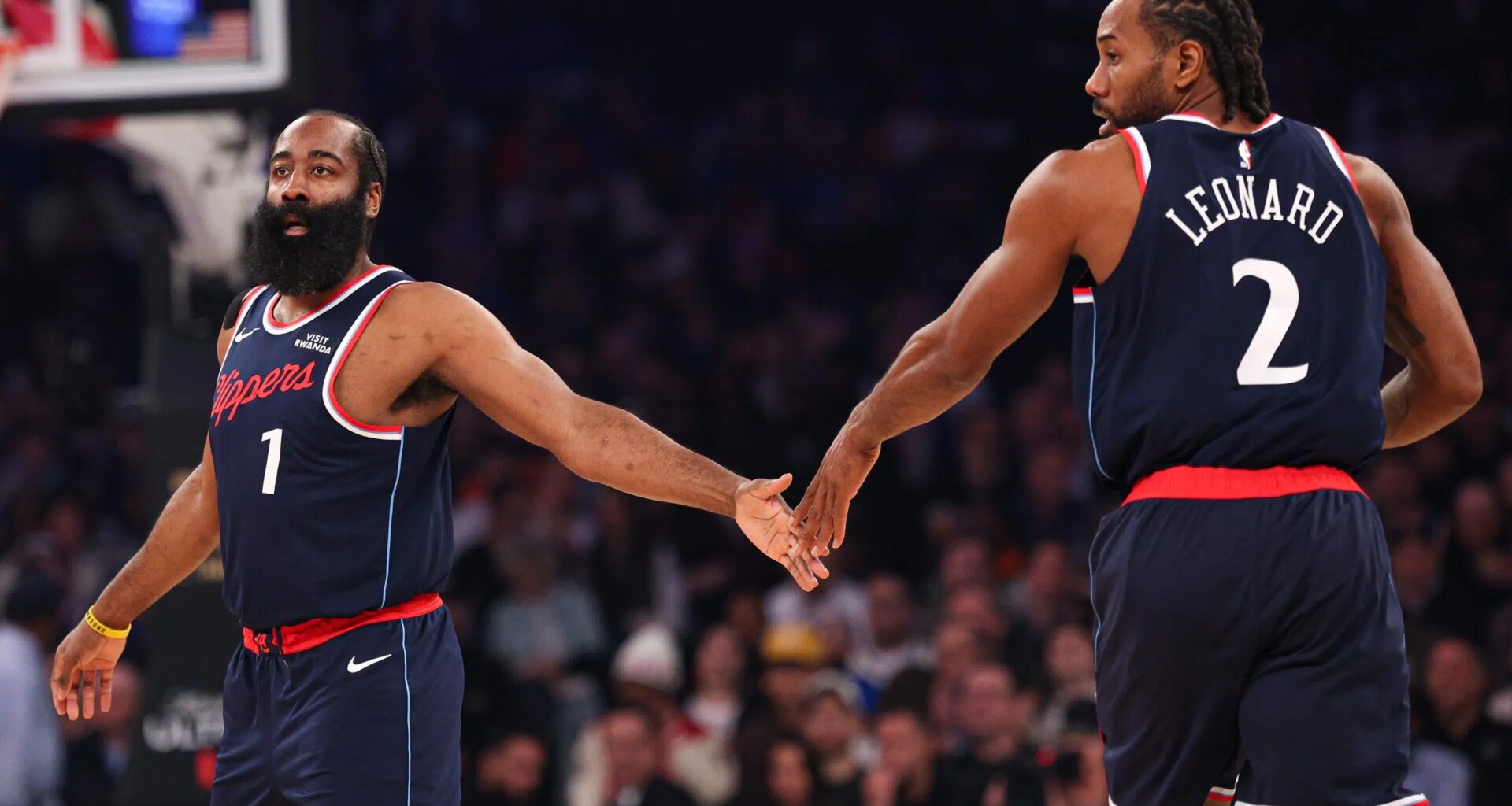
For a brief moment early this season, it seemed logical to wonder whether the Los Angeles Clippers were a broken project that couldn’t be fixed and should be blown up at the trade deadline.
However, the Clippers’ recent win streak has clarified that they will be buyers ahead of the Feb. 5 NBA trade deadline.
Why the Clippers Were Never Likely to Sell
Even during the darkest stretch of the season, there were no real signals that the Clippers were preparing to tear things down. Ballmer has consistently emphasized competitiveness, and the front office has never embraced short-term losing as a strategy. That philosophy hasn’t changed.
Lawrence Frank reiterated that the Clippers under Steve Ballmer will never try to tank. They’re attempting to field a competitive team every single year.
— Joey Linn (@joeylinn_) May 5, 2025
Leonard remains central to the franchise’s identity, and Harden has reportedly shown no interest in asking out. Unless one of the two superstars explicitly requests a trade — an unlikely midseason scenario — Los Angeles has little incentive to sell for marginal draft returns.
Now that the Clippers have stabilized and climbed to 11th in the West, just five games behind the eighth seed, the idea of selling becomes even less realistic.
Is Buying Actually the Right Move?
The more interesting question isn’t whether the Clippers will be buyers — it’s whether they should be. From a franchise standpoint, the answer leans toward yes.
For the Clippers, it means protecting the franchise’s competitive identity. Ballmer’s era has never been about tanking, and there is little incentive to start now — especially with future flexibility still aimed at the 2027 and 2028 free-agent classes.
Staying competitive matters. It keeps the locker room engaged, reinforces a winning culture, and gives fans a product worth believing in — all without closing the door on long-term plans.
So it’s less about whether the Clippers will buy — it’s whether buying actually makes them competitive.
At the moment, Los Angeles is heavily dependent on Kawhi Leonard and James Harden. Both rank inside the top 16 in points per game this season, making them statistically the most productive duo in the league.
Clippers are the only team in the league that have multiple players in the top 16 in points per game.
10th: Kawhi (28 PPG)
16th: Harden (25.6 PPG)
Best duo in the league. pic.twitter.com/FiT8nbS5VB
— BGN Hoops (@BGNHoops) January 9, 2026
When one of them is missing, the Clippers struggle to generate consistent offense. When both are healthy and in rhythm, however, the ceiling of this team changes. The key is balance: improving the roster without sacrificing the flexibility the front office clearly values.
Kawhi Leonard’s Form Changes the Equation
This streak has reminded everyone what the Clippers are like when Leonard is healthy and dominant.
The forward is not only scoring effectively and dictating matchups — Kawhi is back at his best, strengthening the team’s defense. With Leonard playing at an MVP level, the Clippers become dangerous, not because their team is flawless, but because their best player can still tip the balance in a series.
Kawhi Leonard is averaging a league-best 33.9 PPG over the Clippers’ 7-2 stretch 🤯@Brian_Martin examines how Kawhi’s scoring surge is driving L.A.’s push into the Western Conference postseason picture ahead of tonight’s matchup against the Nets at 7:30pm/et on NBA League Pass.… pic.twitter.com/P2ypTipMBi
— NBA (@NBA) January 9, 2026
That reality alone explains why selling makes no sense. Teams don’t voluntarily sell when a player like Leonard is performing so well.
Statistically speaking, Kawhi Leonard is playing at the level everyone knows he is capable of, but even better. He is having his highest scoring season, leading the league in free throw percentage, all while leading the league in steals per game.
Leonard’s impact goes beyond statistics. In the last two weeks, his defensive presence has been one of the main drivers of the Clippers’ improvement. Passing lanes disappear. Mistakes are punished. The Clippers need Leonard to be available, to be a difference-maker, and to have authority. Lately, he has been all three.
Potential Trade Deadline Targets to Watch
The Clippers can trade their 2030 and 2032 first-round picks and attach swap rights in 2031. John Collins’ $26.5 million contract and Bogdan Bogdanovic’s $16 million deal provide the necessary salary-matching tools.
Collins’ recent resurgence complicates the picture. His improved three-point shooting has helped stabilize the offense, making him both one of the team’s most valuable contributors and its most logical trade chip.
Any deal involving Collins would need to preserve spacing around Leonard and Harden. Otherwise, the Clippers risk fixing one problem while recreating another.
Some names to monitor could be:
Jonathan Kuminga: A high-upside wing who fits a positional need, especially with Derrick Jones Jr. sidelined.
Herb Jones: Perhaps the cleanest fit — elite defense, team-friendly contract, and real playoff utility.
Zach LaVine: High-risk, high-profile, and likely not worth a significant asset haul.
Coby White: A younger shot creator who could ease offensive pressure on Harden and Leonard.
Whether the Clippers pursue a major swing or a marginal upgrade remains to be seen. A conservative move — one first-round pick for a meaningful rotation piece — may align best with their long-term goals.
Buying at the Trade Deadline Won’t Make the Clippers Title Favorites
But buying does reinforce belief — inside the locker room and among the fanbase. As long as Kawhi Leonard and James Harden are playing at this level, standing still is not an option.
The Clippers are choosing to compete. They may not win it all, but in Los Angeles, relevance still matters — and right now, the Clippers have earned the right to believe.