
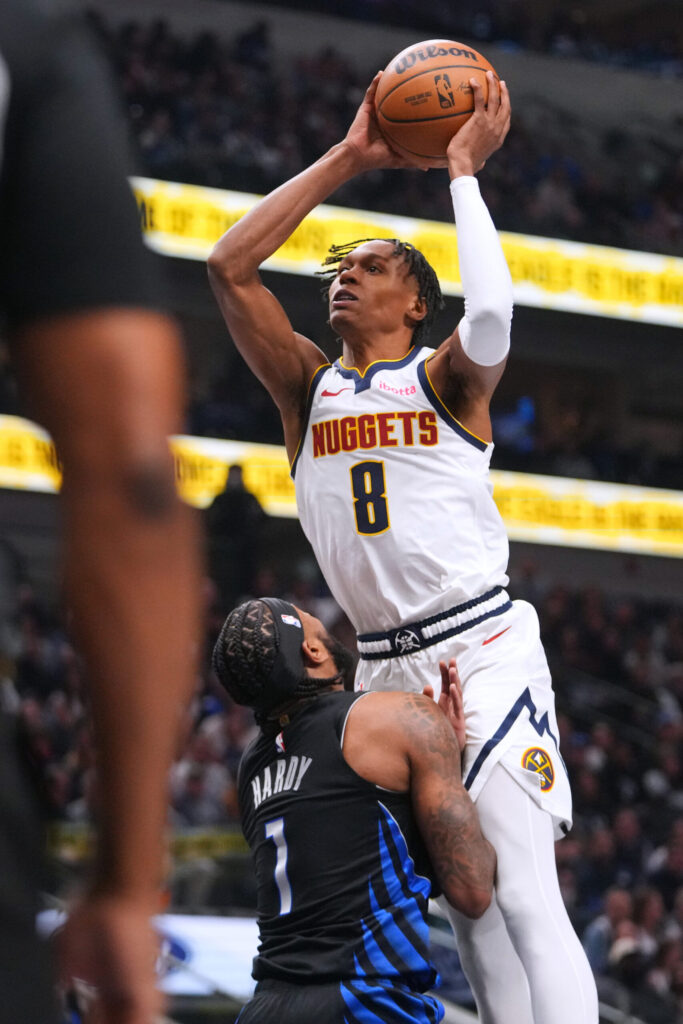
Even good problems require solving.
In the last few weeks, Peyton Watson has played the Nuggets into a pickle. Once the franchise and Watson failed to reach a contract extension in the offseason, the 23-year-old was destined to enter restricted free agency this summer. That means Denver will have the opportunity to match any contract offered by another team before Watson potentially heads elsewhere, but the two sides cannot agree to a new contract until free agency begins in July.
The number on Watson’s next contract is increasing with each big performance from the young wing, who recently went from being represented by Excel Sports Management to Klutch Sports Group.
“There’s a big opportunity at hand this year for me in general on the court, and that’s something that I’ve been taking the most seriously, because at the end of the day, that’s just going to make my agent’s job –- whoever my agent is –- easier, if I’m doing my job out there on the court,” Watson answered when the Denver Gazette asked about the change Nov. 26.
“Excel did nothing but great things for me –- super supportive. It was just more so a business decision on our side.”
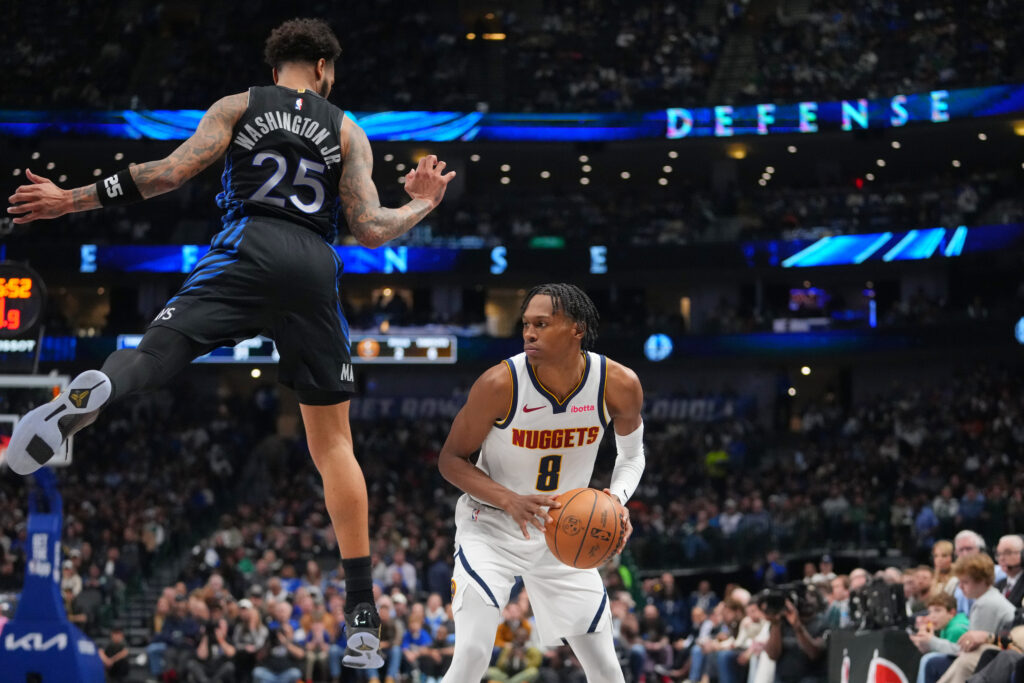 Denver Nuggets guard Peyton Watson (8) avoids the defense of Dallas Mavericks forward P.J. Washington (25) while preparing to take a shot during the first half of an NBA game Wednesday in Dallas. (AP Photo/Julio Cortez)
The Nuggets know the risk of restricted free agency after losing Kentavious Caldwell-Pope, another Klutch client, and getting nothing in return when he signed a deal with the Magic that the Nuggets were unwilling to match in the 2024 offseason. Denver could get something back via a sign-and-trade move with Watson if they are under the first apron, which is the case at the season’s midway point. If Denver doesn’t believe there’s a way to retain him, they could make a move ahead of the Feb. 5 deadline, but it’s unlikely that move increases their chance of winning this season.
Watson’s case is different than Bruce Brown’s in 2023, because the Nuggets have Watson’s Bird rights, which gives the franchise the ability to match any salary. The Nuggets were capped at what they could offer Brown when he left for Indiana and significantly more money as an unrestricted free agent.
Matching a contract offer almost certainly means the Nuggets operate as a second-apron team next year unless Denver makes a trade to shed salary. A trade could also open up more playing time for Watson if Denver is reluctant to match a big salary for a reserve. Teams in the second apron have extremely limited flexibility when it comes to making trades and signings and even bigger tax bills. The first apron also comes with some restrictions and fees attached, but it’s not nearly as punitive. Denver’s among the many teams that have typically avoided the second apron since the new collective bargaining agreement took effect a couple of years ago.
The first-apron line is expected to be around $210 million with the second apron starting in the range of $223 million. Denver’ is already allotting some $186 million to its projected starting five – Nikola Jokic ($59 million), Jamal Murray ($50M), Aaron Gordon ($32M), Cam Johnson ($23M) and Christian Braun ($22M) – with another $15 million going to Zeke Nnaji, Julian Strawther and DaRon Holmes II. Trading Jokic, Murray or Gordon should be a non-starter. Denver would have to massively shake things up to avoid the first apron with or without Watson.
Johnson’s contract is the first to come off the books following next season, while Braun’s deal provides a good gauge of what Watson might be worth on the open market.
After averaging 15.4 points, 5.2 rebounds, 2.6 assists and 1.1 steals in his age-23 season, his first as a starter, Braun and the Nuggets agreed to a five-year extension worth $125 million days before the extension deadline in October. Watson entered Wednesday’s win in Dallas averaging 13.7 points, five rebounds, 1.8 assists, one steal and one block per game. Those numbers are quickly growing as Denver continues to deal with a rash of injuries.
The salaries potentially coming off Denver’s books this offseason are small ones that won’t provide much help to the front office. Bruce Brown and Tim Hardaway Jr. will be unrestricted free agents after signing one-year, veteran-minimum contracts worth $2.3 million last summer, and the Nuggets own team options on Jalen Pickett and Hunter Tyson worth $2.4 million. Hardaway has significantly outperformed his contract, while Pickett’s recent play makes it a near certainty his option is exercised. The majority of Jonas Valanciunas’ $10 million contract for next season is not guaranteed, but waiving the Lithuanian would create a hole at backup center that needs filling.
In their first offseason, Denver’s lead executives, Ben Tenzer and Jon Wallace, attached a future first-round draft pick to Michael Porter Jr. in a trade that brought in Johnson and provided the financial flexibility to trade for Valanciunas. The duo might need to showcase even more creativity to keep Watson around if ownership’s directive is to avoid the second apron.
MAVERICKS 118, NUGGETS 109
What happened: Denver turned a six-point advantage after one quarter into a 63-46 lead at halftime. Dallas closed within 10 to start the fourth, but Denver held on for its first three-game win streak since Nikola Jokic’s injury and improved to 28-13.
What went right: The Nuggets committed just nine turnovers and outscored the Mavericks by 33 from 3-point range. Denver went 16 for 38 (42.1%) compared to Dallas’ 5 for 34 (14.7%).
What went wrong: Cooper Flagg rolled an ankle in the second quarter, and the favorite for Rookie of the Year did not play in the second half. Dallas still managed to score 32 and 31 points in the final two quarters.
Highlight of the night: Caleb Martin’s driving dunk over Peyton Watson in the third quarter was the most impressive play of the night.
Up next: It’s back to Denver for Saturday’s game against Washington, the first leg of another back-to-back.