
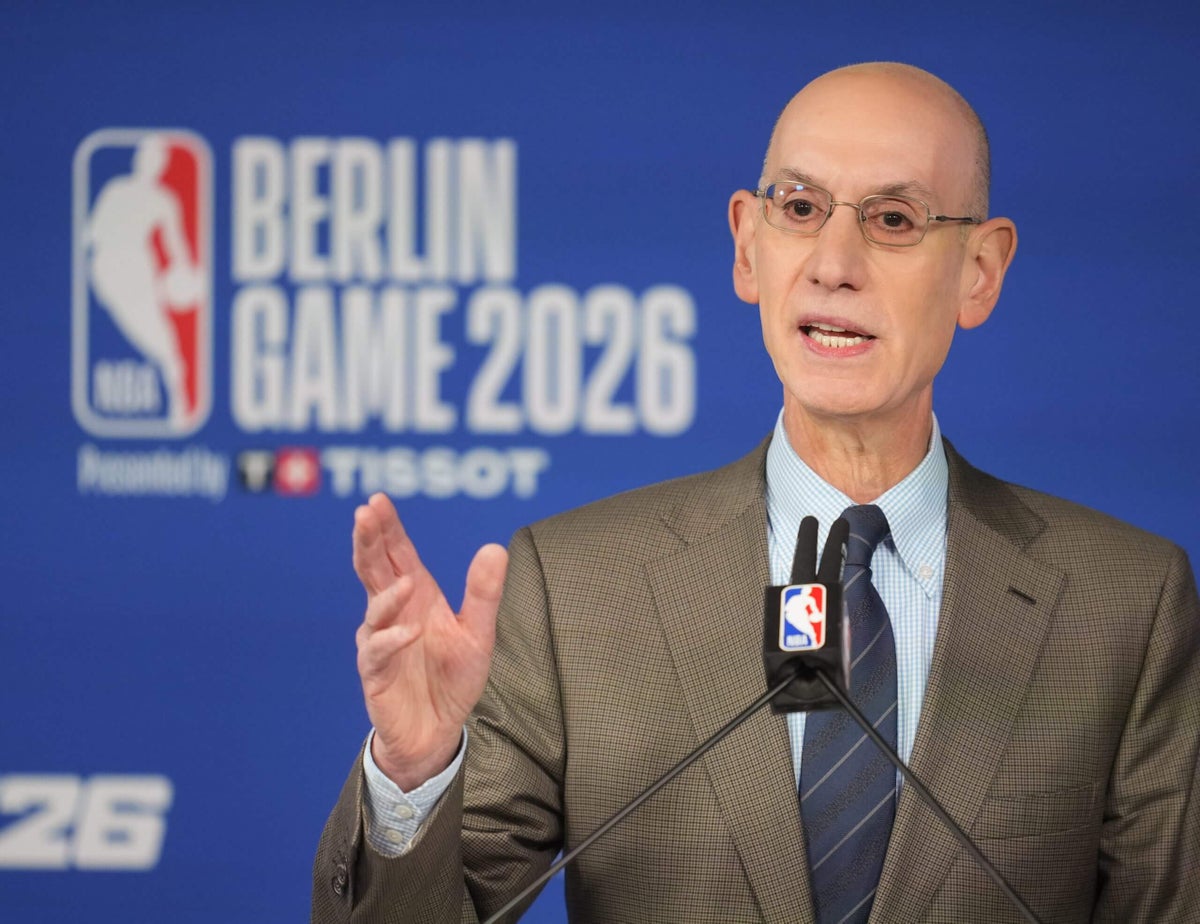
BERLIN — The NBA has descended upon Europe again this week, not only to stage a basketball game or two, but also to build momentum toward starting a new league on the continent.
Potential media partners, investors, club owners and fans are excited, of course, but not all are pleased by the looming presence of NBA commissioner Adam Silver and most of his top lieutenants in Berlin and London over the next several days.
Basically, the EuroLeague — Europe’s most prestigious basketball league — isn’t going to let Silver and FIBA, the international governing body for basketball which is partnering with the NBA in Europe, stand up a new league without a fight.
The EuroLeague continues to monitor what the NBA intends to do and whether the American behemoth will try to pick off any of its 13 licensed teams, and sent a letter to Silver’s office last week warning that there could be legal action if the NBA engaged with teams the EuroLeague said are under contract, a European basketball source confirmed to The Athletic.
Asked during his Berlin news conference ahead of the Orlando Magic-Memphis Grizzlies game on Thursday for his reaction to the EuroLeague’s threat of legal action, Silver said, “I send the legal letters to my lawyers, so I’ll let them handle that.
“I don’t think by any means it’s inevitable that there is a clash (between the NBA, FIBA, and EuroLeague,” Silver said. “I think there’s opportunity here to grow European basketball. And frankly, I’m much more focused on the competitive landscape, not just with other sports in Europe, but with other entertainment options. That’s how we view the NBA. We don’t think of ourselves, even in the United States, as necessarily competing against other basketball organizations or other sports organizations. We’re competing for people’s attention.
“And if I thought that the ceiling was the existing EuroLeague and their fan interest, we wouldn’t be spending the kind of time and attention we are on this project.”
In a few ways, the new NBA-FIBA league would resemble the EuroLeague’s current structure. All teams also play in a domestic league; at least 13 teams are anchor members that compete regardless of how they do domestically; with a chance for non-anchor clubs to play their way into the international league each year.
On that last point, about clubs being able to play their way into the EuroLeague, the NBA’s model would open up far more opportunities than currently exist for non-anchor teams to reach the highest level of play.
The NBA has cited London, Paris, Rome, Milan, Berlin, Munich, Barcelona, Madrid, Athens, Istanbul, Manchester (England) and Lyon (France) as targeted destinations for anchor teams in a new league.
Of the 20 teams currently playing in EuroLeague, eight play in cities on the NBA’s list, which means some historic franchises could be left out of NBA Europe, though they could, if they wanted to, play their way in through FIBA or through their domestic league.
But EuroLeague has largely been a money-losing proposition, and Silver has long said there is an enormous opportunity for marketing and growth in Europe. If professional sports is a $50 billion a year enterprise in Europe, nearly 99 percent of it is generated by soccer, with less than 1 percent generated by basketball.
There have been numerous attempts by the NBA to partner with the EuroLeague that seem to have fallen through, and now EuroLeague is scrambling for survival. The relationship between the EuroLeague and the NBA has deteriorated over the last few months after they seemed to find room to talk this summer. “The NBA has made it very clear: it’s under our terms or nothing,” the source said, and the EuroLeague has balked at those asks.
So far, nine of the EuroLeague’s 13 permanent ‘A’ license clubs have re-signed to stick with the league for the next decade, while Barcelona is expected to soon announce its decision to stay as well. Real Madrid, ASVEL (of France) and Fenerbahçe (Turkey) faced a Thursday afternoon deadline to sign their license extensions. They are also the clubs believed to be most likely to jump to the NBA’s emerging European league. Two European basketball sources said those license agreements have out clauses, believed to be worth roughly $10 million, so any of these EuroLeague clubs could, those sources believe, opt out and join the NBA’s venture.
“While we’re looking at this opportunity to create a league in Europe, if we do it properly, the league maybe physically based here in Europe, but the hope would be just like with the NBA, that people are following it around the world,” Silver said, while also adding “I think if we were to successfully launch this new league, it will take a while, I think, before it is a viable commercial enterprise.”
Various NBA officials have set a soft target of October 2027 for an NBA Europe league launch. Silver also said in December that the NBA would decide this year whether to expand domestically by adding two more teams. If NBA team owners move forward with domestic expansion and grant final approval for a European venture, Silver and his team would have two massive projects on their hands in roughly the same time frame.
Silver joked that reporters could “see the bags under my eyes” before explaining that, of the two, a new league in Europe would be a heavier lift. If the NBA adds two more teams — Silver previously said the league was focused on Seattle and Las Vegas as the two new potential markets — most of the work once a decision to expand is made would fall on the incoming teams to build out their organizations.
“We love hard work at the NBA,” Silver said. “I would say I have an enormous deep bench of fantastic colleagues. Mark Tatum (NBA deputy commissioner who is overseeing the European project), one of them, sitting here. We have the strong support from the NBA governors. … And also say that my job overseeing this enterprise is to help provide the blueprint, setting it, putting in place the elements that are necessary for success, but then step aside and let others do that work.”
Silver said he recently consulted Luka Dončić, who is a product of Real Madrid, for his thoughts on standing up a new European league. He is also meeting over the next several days, in Berlin and London, potential media rights holders for a European venture, investors, and current European club owners. He spoke extensively on Wednesday night with Alba Berlin team owner Axel Schweitzer and Alba vice president chief executive officer Marco Baldi at a reception.
Silver also said he has grand designs for yet another European league — in the women’s game.
“We would like to do a women’s league in Europe as well, if we can figure out the correct model,” Silver said.
Joe Vardon reported this story from Berlin; Mike Vorkunov contributed reporting from New York.