
As the NBA trade deadline approaches, several teams remain firmly embedded in league-wide speculation. Few are mentioned as frequently as the Golden State Warriors.
The reasoning is straightforward. Golden State is operating at the back end of a dynasty. The Warriors have struggled to gain real traction during the 2025–26 season, yet Stephen Curry remains remarkably productive, performing at a level that still closely resembles his prime.
That imbalance has kept the Warriors active in star-level trade discussions. With Curry still capable of anchoring a contender, the front office faces increasing pressure to maximize the present rather than hedge too heavily toward the future.
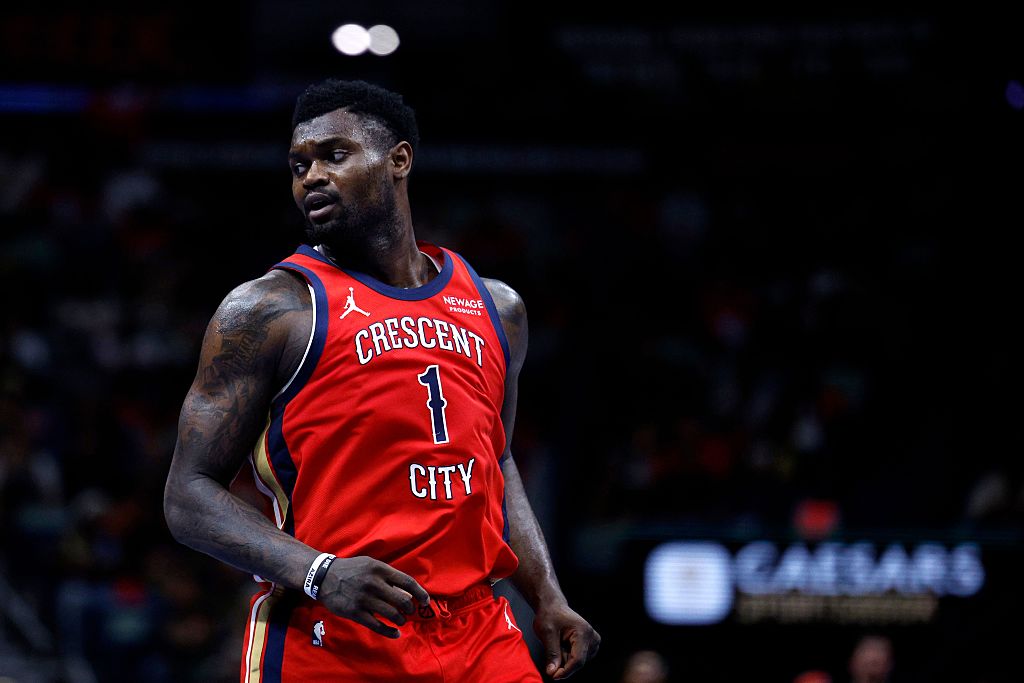
One name that continues to surface on the periphery is Zion Williamson of the New Orleans Pelicans.
Golden State Warriors Land Zion Williamson in NBA Trade Proposal
New Orleans Pelicans Receive:
Golden State Warriors Receive:
Why the New Orleans Pelicans Do the Deal
Williamson’s tenure in New Orleans has been defined by unrealized potential. When the Pelicans selected him No. 1 overall, he was expected to be a franchise-altering force. Injuries and availability concerns have prevented that vision from fully materializing.
The financial structure complicates matters further. Williamson is playing on a five-year, $197.2 million extension signed in 2022, one of the most uniquely constructed contracts in the league. The final three seasons were originally non-guaranteed and tied to benchmarks involving weight, body composition, and games played. While his 2025–26 salary became fully guaranteed in July 2025 after he met certain conditions, the guarantees for 2026–27 and 2027–28 remain tied to future availability.
That framework offers protection, but it also forces clarity. New Orleans committed to Williamson for this season, yet the long-term calculus remains unsettled.
On the floor, Williamson has still produced when available. He is averaging 22.6 points on 58.7% shooting this season, continuing to overwhelm defenders at the rim. The production is real. The question is whether it aligns with the Pelicans’ evolving timeline.
That timeline increasingly revolves around Derk Queen. The rookie has flashed star-level upside, positioning himself as a long-term centerpiece. Importantly, New Orleans paid a premium on draft night to acquire Queen, surrendering a valuable future first-round pick in the process. Replenishing draft capital is now a logical priority if the organization chooses to pivot.
Jonathan Kuminga fits cleanly into that recalibration. He is on a two-year, $46.8 million contract, with a $24.3 million team option for 2026–27. That structure gives New Orleans flexibility: Kuminga can either be evaluated as a core piece alongside Queen or treated as an expiring asset if the option is declined. His waived no-trade clause also ensures full transactional freedom.
Combined with Moses Moody’s perimeter shooting and defensive versatility, the Pelicans would be assembling a younger, more controllable core while restoring future draft equity.
Why the Golden State Warriors Do the Deal
For Golden State, this is a calculated gamble rooted in urgency.
Williamson’s durability concerns have depressed his trade value, but his impact when healthy remains undeniable. Across 241 career games, he is averaging 24.4 points per contest, driven by elite efficiency and physical dominance in the paint.
Placed alongside Curry, Williamson’s skill set would be amplified. Curry’s off-ball gravity stretches defenses to their limit, while Williamson’s relentless rim pressure collapses them from the inside. Few combinations would force opponents into more severe defensive compromises.
The contract mechanics matter here as well. While Williamson’s 2025–26 salary is fully guaranteed, the conditional nature of the remaining seasons provides a degree of insulation. Golden State would not be committing to a fully guaranteed long-term max if health issues persist.
Kuminga’s situation further accelerates the logic. Despite signing his extension late in 2025, he reportedly requested a trade in January 2026, complicating his future with the organization. His contract, with a looming team option, effectively functions as a high-salary pivot point—useful for matching money now, but uncertain beyond this season.
Converting that uncertainty into a singular high-upside swing aligns with Golden State’s win-now mandate. The Warriors are not positioned to wait patiently for internal development. They are positioned to chase impact.
Bigger Picture
Teams place immense faith in the draft. Sometimes that faith pays off. Other times, it forces uncomfortable recalibrations.
When the Warriors selected Kuminga, they were operating from a position of strength, still entrenched as perennial contenders. The pick was a swing on upside that has not fully paid off.
For the Pelicans, Williamson was supposed to be the center of everything. Trading him would represent an acknowledgment that the original vision fell short. It would be a sobering decision—but possibly a necessary one.
At this stage, the persistent rumors suggest the question is no longer whether New Orleans will explore life beyond Williamson, but how decisively it is willing to build around what comes next.
Latest NBA News & Trade Rumors
NBA Rumors: Boston Celtics, Detroit Pistons Interested In Trading For Memphis Grizzlies’ Jaren Jackson Jr.
NBA Rumors: Sources: Dallas Mavericks To Sign Jeremiah Robinson-Earl To Hardship 10-Day Contract