
LOS ANGELES –– Marvin Gaye, his voice smooth as silk but heavy as stone, posed a befitting question that looms over the Lakers’ locker room: What’s going on?
No one answers. They can’t.
The Lakers have forgotten how to speak in their native tongue; they’ve forgotten the language of victory.
Since starting the season as crooners, making sweet melodies of victories.
But now, Los Angeles has lost its song; it has forgotten how to defend, how to rebound, how to share.
In their last five games, Los Angeles has forgotten how to win—going 1-4, each defeat a mirror reflecting a slightly different fissure in a team that looks lethargic, outmatched, and old.
The Lakers are inconsistent. They are lethargic. They are reeling.
Thursday night’s 135-117 loss to the Charlotte Hornets was not an aberration. It is their identity.
The Hornets, a team that had lost seven straight before beating the NBA-leading Oklahoma City Thunder by 27 points, ran the Lakers out of their own building.
LaMelo Ball scored 30 points, hit nine threes, and celebrated each make like a man who knew he was performing surgery on a corpse.
The Lakers gave up 105 points in the final three quarters. They were outrebounded by 15. They allowed 56 points in the paint. They defended like five strangers who had met at Poinsetta Park.
The numbers are a death certificate. The Lakers made 14 threes on 37 percent shooting, scored 117 points—and lost by 18.
Somehow, they surrendered 20 threes to a Hornets team that shoots them gleefully, carelessly, like children throwing rocks at a window.
The Lakers allowed 14 offensive rebounds, which turned into 15 Hornets’ points.
The Hornets’ four young stars—Ball, Brandon Miller, Miles Bridges and rookie Kon Knueppel—combined for 100 points and 19 threes.
The Lakers’ bench contributed nine points on 4-for-19 shooting.
With how abysmally the Lakers are playing, it begs the question: Where is the chemistry? Where is the vocal leadership? Where is the team that started the season 15-4 and looked like a contender?
The body language tells its own story.
LeBron James, 41, plays like a man who has seen everything and is tired of most of it, moving through possessions like a ghost haunting his own career.
When he’s fouled, and the whistle doesn’t come, he watches teammates sprint back while he trots, leisurely, as if taking in the majesty and lore of an arena he has conquered a hundred times before. He is an elder statesman picking his spots, but the spots are fewer, and the cost is higher.
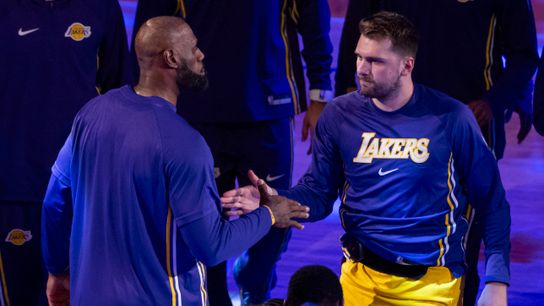
James finished with 29 points and nine rebounds. Luka Dončić led all scorers with 39 points.
Where the box score sees excellence, the film sees isolation.
The Lakers are being led by two stat-padding stars who refuse and/or cannot play defense.
It begs the question whispered in hallways, shouted on talk radio, never quite asked directly in postgame pressers, but always hanging in the air, thick as the smoke from one of Gaye’s cigarettes.
Do either of them care at this point?
Dončić, who shot 4-of-19 from two-point range, appeared to be pressing. But when you’re not shooting well, you must create for others.
However, creating for others requires a belief that others will finish. The Lakers’ reserves shot 4-for-19.
Austin Reaves, the third piece of the supposed Big Three, remains sidelined with a calf strain. His absence has been compounded by whispers from James’ agent, Rich Paul, that Reaves should be traded.
The body language since those rumors surfaced has been disengaged, listless, as if the locker room has already started dividing assets in a divorce that hasn’t been filed yet.
The impact is beginning to show.
JJ Redick, the podcaster-turned-head coach who preaches process and connection, looks like a man trying to hold sand in his fists.
His postgame answers have become variations on a theme: “We weren’t as organized,” Redick parroted. “We were fairly organized. We just weren’t able to create advantages.”
But the advantages are not tactical. They are spiritual. They are about wanting to be the hunter instead of the hunted. The Lakers are the hunted every night—every opponent’s Super Bowl, every young star’s chance to prove themselves against icons.
They know it. They accept it. But they do not embrace it.
“I think in general, these guys grew up watching LeBron James play,” Redick said. “The Lakers are like the Celtics, arguably the most storied franchise in all of sports. So, we don’t get a lot of off nights from other teams in terms of energy and being up and all that stuff.”
The problem is not the opponent’s energy. It is the Lakers’ lack of it.
Marcus Smart, the veteran brought in to be a vocal leader, spoke after the game like a man searching for answers in a language he had forgotten.
“It doesn’t matter who it is, the team, doesn’t matter the player,” Smart said. “When they play us, everything goes through the roof. You know, if they were shooting 20 percent, they’re shooting 50 percent.”
He paused, the weight of it pressing down.
“We got to figure it out. You know, we got to play with a little bit more urgency on that end, especially, and kind of impose our will,” Smart said.
But whose will is being imposed?
James’ will is to survive the season, to make one more run at a fifth ring.
Dončić’s will is to score, to create, to prove he is the best player on the floor even when his shots don’t fall. The two stars, plus Reaves, have played together three times this season. Three. The sample size is minuscule, the chemistry nonexistent, the trust theoretical.
The excuses are valid—injuries, age, a roster built on hope as much as hardwood. But excuses are currency for losers, and the Lakers are spending theirs like gamblers at a rigged table.
Something has to give. Either the Lakers find the energy they showed against Atlanta, the physicality they flashed in Sacramento, the commitment to defense that marked their early-season success—or they continue this slow fade into irrelevance, a team of ghosts humming a Marvin Gaye tune in a locker room that no longer feels like home.
Gaye recorded “What’s Going On?” after his brother returned from Vietnam, a song about trauma and disillusionment. The Lakers are living their own version of that disillusionment. They have the talent. They have the names. They have the history. What they lack is the will to fight for every possession, the voice to hold each other accountable, the chemistry to turn three stars into one sun.
“What’s going on?” the song asks.
The Lakers have no answer.
And until they find one, the losses will continue to pile up, each one a mirror, reminding them of a question they cannot escape.