
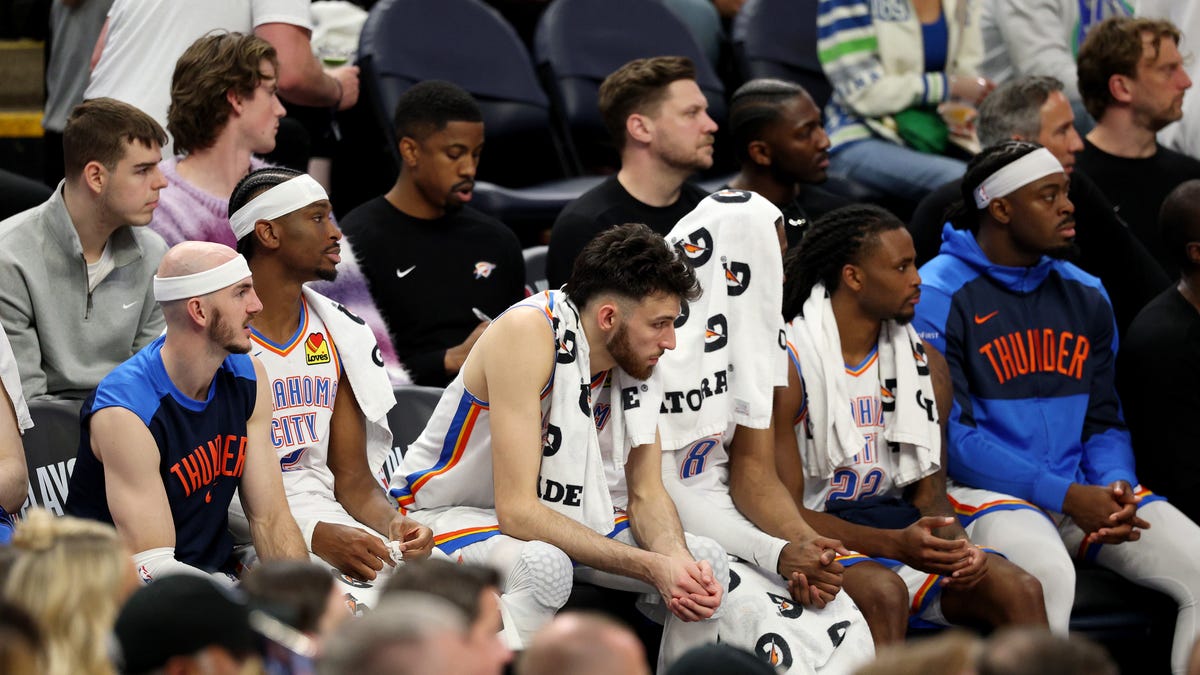
MINNEAPOLIS — If NBA benches had corners, Jalen Williams would’ve been tucked away in this one. With just over a minute left in Saturday’s third quarter, the Thunder called the timeout that signaled its defeat. Williams’ night, like the rest of the Thunder starters, was finished.
His teammates ejected from their seats. Williams sat frozen in the folding chair closest to the baseline, hunched over with his elbows on his knees. A towel sat atop his head, draping down to his shoulders. It sat just high enough to expose his empty stare.
A quarter stood between him and the bus ride away from the misery of Game 3. Away from a team he couldn’t recognize.
Williams, like the rest of the Thunder starters, watched their 143-101 loss get away from it far earlier than the point when he stared into oblivion.
Its origins lie somewhere in a peculiar first quarter.
Perhaps when Anthony Edwards, who stormed out to 30 points in 30 minutes while missing just five shots, collided with Williams, emerging with a ball he ferociously punched through the rim on the break. Or when Rudy Gobert blitzed Shai Gilgeous-Alexander, sprinting at Vince Wilfork-speed to the rack for free throws. When he missed the second shot, Edwards skied past SGA for a deflating offensive board.
There were the shoving matches between Timberwolves forward Julius Randle and Williams, given a West finals hall pass by Josh Tiven and his officiating crew; Randle terrorized from their blindspot. The eight-second violation — probably premature — wasn’t fruitful.
Minnesota played with an urgency. Coal at its feet, gun at its head, gallon of water in its bladder without a bathroom nearby kinds of urgency.
“Just fighting the human nature effect,” guard Alex Caruso said. “We were up 2-0. They lose, they’re down 3-0. History says — the numbers say it’s pretty much a wrap. This was their Game 7. We didn’t do a good job of answering that early.”
Frank young center Chet Holmgren called it an edge. A bloodthirst you could whiff. This feisty, foam-at-the-mouth energy that pushed Minnesota to blow up OKC’s offense, stiffen its own defense, and push the Thunder off its block.
“Wherever they wanted to go, they got there,” Holmgren said. “… It’s not an X’s and O’s thing. It’s pretty simple.”
Minnesota dropped the most points by a Thunder opponent all season. The next most scored against OKC in the postseason was 121, Denver’s output in its Game 1 comeback win. Its once 45-point deficit was also the largest of its season.
OKC and Minnesota’s roles in the paint flipped. The Wolves’ points there have increased with each game after scoring just 20 in Game 1. They scored 56 points on 62.2% shooting in the paint Saturday.
The Thunder scored inside at will in Oklahoma City. Multiple 50-plus point games there this series, with bonkers efficiency in Game 2. It logged 42 in Game 3, with 18 of them coming in an inconsequential fourth quarter.
To add insult to identity crisis, OKC lost the turnover battle for the first time in these playoffs, 14-10, notable considering how quickly its steals and ball pressure had unraveled the Wolves through two games.
It all ballooned, a game sent out of hand by an urgent crew.
“We don’t try to go out like that, I promise,” Gilgeous-Alexander chuckled.
The difficulty in matching that edge, of trimming Minnesota down by 1,000 Williams cuts or one of SGA’s 10 speeds, lies in being unable to keep the Wolves from scoring. Minnesota’s set defense was tougher than a popcorn kernel. Impenetrable, with the feedback sending OKC’s ball handlers off their paths. The Thunder shot just 40.7% from the field, 31.8% from deep.
Gilgeous-Alexander finished with 14 points — his fewest points in any game this season — while shooting 4 for 13 and committing four turnovers in 27 minutes. Williams, after two games without turnovers, also coughed it up four times, posting just 13 points on 3-of-9 shooting.
Among the things that the fortune cookie likely didn’t say: Terrence Shannon Jr. was arguably about as impactful as any Thunder player on Saturday.
He entered Saturday having scored six points throughout the postseason. In Game 3, he had nine points in his first four minutes alone, a stint worthy of a standing ovation. Ajay Mitchell, who played the majority of his minutes in the fourth, tied SGA for a team-high 14 points.
At different times from the postgame podium, Holmgren and Williams uttered conflicting statements. Holmgren, a brutal self-critic who would prefer to face the ear-bleeding music, said “after a game like that, nobody’s thinking ‘just throw it away, scrap it.’” Williams, who made note that he lost by 60 points once at Santa Clara, said “you just gotta scrap it.”
What they agreed on: Saturday wasn’t worth sticking around Target Center.
The Thunder’s final bus time on the white board just outside the locker room showers read 10:50 p.m. Those times are typically meaningless, with players lacing their shoes and scrolling their phones well past then on other nights. Mostly wins, though not exclusive to them.
On Saturday, the room was vacated minutes before then. Not one player had the desire to linger in the filth of Game 3.
The Thunder could decide on its Monday fate from the hotel.
“We got punched in the mouth today,” Gilgeous-Alexander said. “Next game, we’re either gonna get back up or not, we’ll lose a game. We have a decision to make.”
Joel Lorenzi covers the Thunder and NBA for The Oklahoman. Have a story idea for Joel? He can be reached at jlorenzi@oklahoman.com or on X/Twitter at @joelxlorenzi. Sign up for the Thunder Sports Minute newsletter to access more NBA coverage. Support Joel’s work and that of other Oklahoman journalists by purchasing a digital subscription today at subscribe.oklahoman.com.