
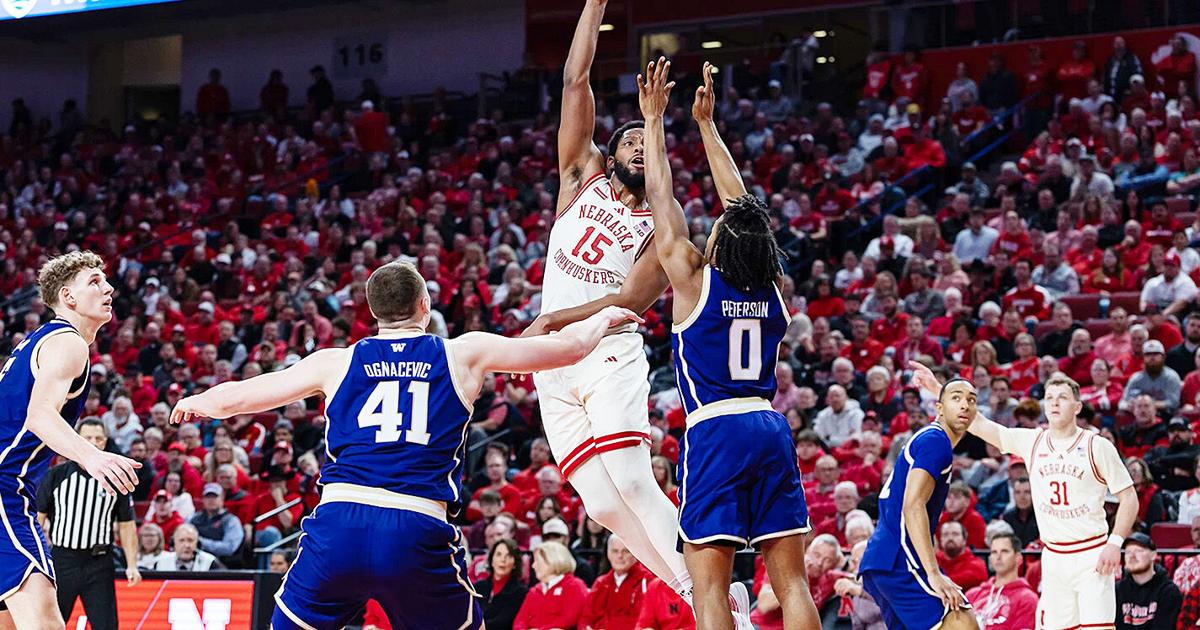
LINCOLN — Jared Garcia knows his college basketball clock is on its last couple rounds.
Following Wednesday night’s Nebraska home win over Washington, a career that has spanned four institutions in four different states was whittled down to its last 12 regular season games, with just a handful of chances left for Garcia to make an impact on the most historic season in Huskers basketball history.
Garcia, however, has still found the time to plan for his future, using his remaining time in Lincoln to set up his life-after-basketball plans.
A sixth-year forward on the Huskers’ men’s basketball team, Garcia is finishing up classes this semester to earn his master’s degree in strategic innovation and finance. In the near future, he wants to put himself in position to help underprivileged kids get sports equipment to have the same opportunities to take his career to the next level during his childhood.
Garcia said he wants to start in a familiar area, like Houston, where he spent most of his life after his family moved him from the Bronx, N.Y, when he was 6 years old and began his basketball path.
The plan, he said, is to then expand to the greater Austin and New Orleans areas, eventually going national and even global. There are a lot of communities around the world near and dear to Garcia’s heart — even outside the United States — that he said he feels responsible to help.
“Growing up, my background, some of my cousins weren’t fortunate enough to get sports equipment and take their game to the next level because they didn’t have that access,” Garcia told the Tribune in a recent interview.
Garcia said he’s had those goals for a couple of years, dating back to participating in kids camps and community events during his two-year career as a player at Tulsa.
He has understood the bigger picture of life for even longer.
While Garcia has lived out his college basketball dreams for the better part of the last decade, he keeps in mind those in his life who are dependent on him, and all of the others he has seen who will never get that chance.
Because of that, he never runs out of motivation on the court.
Honduran heritage shaped Garcia
Draped over the balcony inside of Nebraska’s practice facility are a set of flags representing the countries and cultures on the Huskers’ roster this season.
Netherlands for Rienk Mast. Iceland for Leo Curtis. Turkey, Lithuania, Armenia and Honduras, too, added this summer with the addition of Garcia to the program.
Garcia said walking into the facility every day and seeing the flag of his family heritage makes him smile, because it reminds him of his purpose, and his why.
As a kid, Garcia spent the summers in Honduras on the northern coast, in Masca Village in Omoa, near Puerto Cortes. He often took the 10-minute walk to the beach or played in a nearby river with the local kids.
There, Garcia said he saw how the other half lives. While he took swimming classes, did karate and was fortunate to play multiple sports as a kid in the United States, the other children he played with were lucky just to get their hands on a toy.
“Honduras, the economy is not that good,” Garcia said. “A little bit of corruption and under-the-table stuff down there that happens. It’s very different from here. It is very violent. It’s more of a survival type of thing out there. Not too much opportunity to do a lot of things. Here, a lot of people come to America for those opportunities to excel in life. Honduras is kind of rough.”
Garcia’s grandparents moved to the Bronx, New York in the 1970s, where his dad, Steven, was born, before they moved back to Honduras to raise him. The family still has roots there today. Steven eventually came back to New York in his 20s, where Garcia began his life.
The Honduran culture means everything to Garcia. Family is No. 1, and sticking by those who are in his circle is top priority.
That helped develop Garcia’s priorities as a young kid, being grateful for what he had, and those who sacrificed around him to have it.
Garcia’s mother, Frances Lacayo, moved Garcia from the Bronx to Houston for better opportunity — both in living and in sports — being in an environment which allowed him to play something year-round.
She scraped together the money to send him to St. Thomas More School, a college preparatory school in Connecticut, so that he could be set up for college opportunities. He always had dreams to make the NBA. Now, those dreams are more transcendent.
“I was fortunate and blessed to grow up in a good environment and to be around good people,” Garcia said. “A lot of people don’t get that, and I noticed that growing up, going back to Honduras and seeing the opposite.
“It opens my eyes, makes me grateful, appreciative of what my grandparents and parents have done, all the sacrifices they have made. With that, I want to give back, because what is the point of having things if you can’t share?”
Basketball isn’t a hotbed in the Honduran culture, but was a staple in Garcia’s family. Lacayo, and her brother Edil, played major roles in Garcia’s basketball journey.
Lacayo played basketball and volleyball at Dominican University in New York. Edil played four years at Lehigh.
It took some trial and error for Garcia to join them. He was a soccer goalie. And even played offensive line and running back in football, before Lacayo pulled him out of that sport so he didn’t get hurt.
Garcia, however, kept growing. And once he settled on basketball, it became his avenue to shine.
The gift of parenthood
Lacayo remembers hearing the panic in her son’s voice as he rushed through the airport trying to get to his layover in order to arrive in time for the birth of his daughter.
Garcia would frantically tell Lacayo how many centimeters his co-parent was dilated, and Lacayo, a nurse in the maternity ward, assured him he was going to make it to the hospital in time. Sure enough, Garcia did.
Garcia’s life changed forever when his daughter, Xela, was born in April 2024. If there is anything that makes playing for yourself obsolete, becoming a father is it.
“She will look up to me whenever she gains that knowledge as she gets older,” Garcia said. “So I have to set a good example.”
Becoming a father was a surprise to Garcia, and his family, but it made him grow up quickly.
“He knows he has to be there for her and provide for her,” Lacayo said. “Just trying to do better and be better.”
His income was suddenly being spent on diapers, baby food and clothes rather than what he wanted.
Anything that Garcia desired was no longer the priority.
“Clothes are expensive,” Garcia joked. “Now I know how my parents felt when I was growing up, because I used to fly through my clothes like it was nothing.”
Garcia’s experience in fatherhood has been different.
The last time he saw Xela in person — she lives in Washington D.C. — was at Christmas. He only gets to see her a couple of days at time, before having to return to Lincoln for his school and basketball duties. He may go a couple of months in between before he sees her again.
The hope is to get her to a game in February, maybe at Rutgers, which is only a couple hours drive.
“She motivates me,” Garcia said. “I have her saved on my phone so I can look at it if I am feeling down and it picks me up.”
A true team player
Garcia’s lone season at Nebraska has been a little bit of a change of pace.
He hasn’t played the minutes, or produced the points, that he has been used to at his previous college stops. He’s averaging less than nine per night and only scoring nearly four points per game. Both, if they were to hold, would be the lowest since his second season at Charlotte back in 2021.
Garcia doesn’t have any anger, animosity, frustration or regret about these last months of college basketball, because he carries that same selfless mindset onto the court with him.
“For us, we are playing for the name on the front of our jerseys,” Garcia said. “For what we are doing this season not too many people here have seen that. For us to do this is very special.”
Garcia said he has been willing to accept whatever role he’s been asked to do by Nebraska’s coaching staff because of that.
Some night’s, the Huskers have needed Garcia to make shots off the bench. Others, he has been the unexpected closer, like he was in Nebraska’s upset win over Illinois, scoring 10 points in the final six minutes of the game.
In other games, he may not play at all because the matchup isn’t right. As long as Nebraska is winning, Garcia is happy to be a part of it, because he’s seen life’s alternatives.
“One person’s success is everybody’s success,” he said.
In Wednesday’s home win over Washington, Garcia’s role — and season — took a new twist when Braden Frager left the game with a sprained ankle.
Called into action, Garcia scored five points and grabbed five rebounds on a night the Huskers needed someone to step up.
“It was good to see Jared knock down that 3,” Nebraska coach Fred Hoiberg said. “He had a good post move and got to his jump hook in the second half, and had a couple good rebounds for him, as well.”
Garcia knows his role is going to change moving forward. He’ll be more counted upon, meaning he needs to be more on-point with what he is doing on the court.
If that means 10 minutes or 15, he plans to be ready.
“Everybody comes from something different, but if you are able to come into a program and take on your role positively, it’s a great thing,” he said. “Whatever the team and coach needs, Ill do it to the best of my ability.”
Garcia’s mindset won’t change, because it never has.
There is a bigger picture to worry about, and Garcia is happy to be a part of it.