
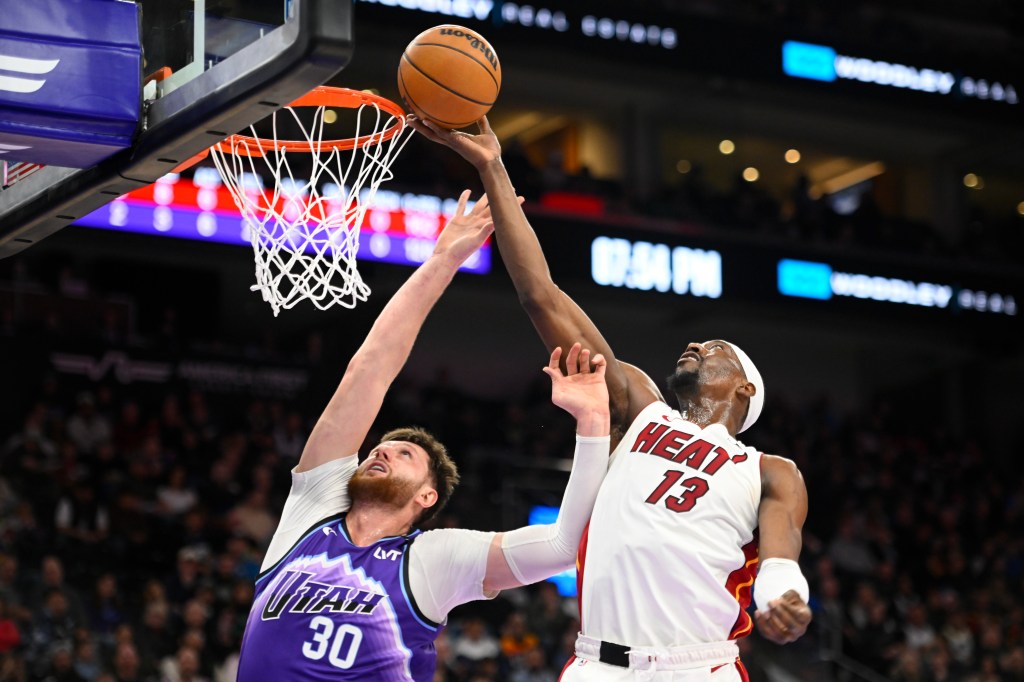
SALT LAKE CITY — To a degree, the Miami Heat’s five-game western swing stood in the balance Saturday night against the Utah Jazz.
After a 1-2 start to the stretch of five road games in seven nights, Erik Spoelstra’s team stood in jeopardy of returning to South Florida with a losing record.
Instead, with a 147-116 victory, the Heat moved to 24-22, avoided falling to No. 9 in the Eastern Conference, and potentially could wind up with a winning trip, with the Phoenix Suns, Sunday’s opponent in the trip’s finale, to be without sidelined guard Devin Booker due to an ankle sprain.
Of such absences, the Heat know plenty, again playing in the absences of Tyler Herro, Kel’el Ware and Davion Mitchell, and now with concerns with rookie point guard Kasparas Jakucionis.
Both Herro (ribs) and Ware (hamstring) already are back in Miami, with Mitchell likely to miss his third consecutive game Sunday with his shoulder contusion.
So this time the Heat did it by committee, with contributions throughout the rotation.
Center Bam Adebayo set a double-double tone, with 26 points and 15 rebounds, continuing his recent revival, this time 4 of 10 on 3-pointers.
“We know what we’re capable of, we just gotta be more consistent with it,” Adebayo said. “But that’s from top to bottom.”
There also were 23 points from Nikola Jovic, 20 from Pelle Larsson and 17 from Andrew Wiggins, as well as 13 from Norman Powell and 12 from Jakucionis.
The only downside of the loss was Jakucionis having to be helped off the court in the final minutes after going down behind the Heat basket after being elbowed in the head.
“I just kind of got hit in the head, I think, and fell down, got up,” he said. “But I’m good, so everything is fine.
“I stood up and I was fine. So just had to check in with the doctor, and we’re good.”
With the loss, the Jazz fell to 15-31, getting a 17-point, 12-assist, 10-rebound triple-double from center Jusuf Nurkic.
Five Degrees of Heat from Saturday night’s game:
1. Game flow: The Heat led 35-34 after the first period and 73-52 at halftime.
The Jazz clawed within 15 early in the third period, before the Heat pushed back to a 22-point lead, eventually taking a 108-89 lead into the fourth.
From there, the Heat again pushed their lead into the 20s, allowing, on the first night of the back-to-back set, Adebayo to take the rest of the night off with 5:32 to play.
For the Jazz, the close of the game seemingly was devoted to getting Nurkic his third consecutive triple-double.
2. Breaking glass: The Heat held a 19-1 edge on offensive rebounds in the first half, outscoring Utah 19-4 on second-chance points over the opening two periods.
To put those 19 first-half offensive rebounds into perspective, consider that the Heat had 12 and 14, respectively, in their previous two games, and recently had five and nine in consecutive games against the Oklahoma City Thunder and Phoenix Suns.
The Heat closed with 26 offensive rebounds to the Jazz’s seven.
The Heat entered 17th in the NBA at 11.4 per game.
“We’ve been making more efforts with this,” Spoelstra said of the offensive rebounding. “It’s been an emphasis all year. But guys are doing a better job of making the efforts these last three weeks or so. Anything that has to do with just making a multiple effort, we want to do it as a basketball team.”
3. Fouls, fury: Returning to what previously had been problematic, Larsson was forced to the bench with two fouls in the opening 1:54. For Larsson, fouls had haunted him throughout his rookie season, after being acquired by the Heat in the 2024 second round out of Arizona.
But rather than allow the whistles to stifle his game, Larsson returned on the attack in the second period, with eight points in the period to help spark the Heat to their 21-point halftime lead.
“It shows that he’s able to stay engaged on the sideline and not be taken out of any kind of rhythm,” Spoelstra said. “He’s not really a rhythm player, so it’s more effort, energy and making the intangible plays. The first foul he got, that really wasn’t a foul. So it was a cheap foul. And it was unfortunate he had to come out. But he’s mentally stable enough to be able to handle that and then came back in and made a big impact.”
Larsson also again showed his improved 3-point stroke, closing 3 of 6 from beyond the arc.
“I was worried it was going to be one of those nights,” Larsson said of the early whistles. “But Wiggs kind of took the assignment off of me after that when I came back in, so I didn’t risk getting more fouls. He did a great job, so I could just not worry about it.”
4. Stepping in: With Mitchell sidelined, Jakucionis, before he was hurt, thrived in his fourth career start, playing in attack mode both off the dribble and on the glass.
It was a solid bounce-back after being limited to three points and only 11 minutes in Thursday night’s loss in Portland.
“I’m encouraged by what Kas has been doing the last month,” Spoelstra said. “It’s not always going to translate to wow moments, but he was really steady tonight, played with energy, played also smart.”
Jakucionis scored nine points in the first 5:22 of the third period, which made it the highest-scoring quarter of his rookie season.
He closed 4 of 6 from the field, including 2 of 3 on 3-pointers, with five rebounds, his night ending in the locker room ahead of his teammates.
5. The Jovic-coaster: After a brutal outing Thursday in Portland that had him introspective at Saturday morning’s shootaround, Jovic was exponentially better Saturday — which actually was an upgrade.
Jovic was up to 11 points by halftime, playing with an aggressive bent that had him with six free throws over the opening two periods.
“This is what a lot of players go through, and he just has to stay the course,” Spoelstra said. “He’ll be just fine. And it was probably really good for him to see the ball go in, to find a way to get to the free-throw line, be able to make some plays. He’s important to what we’re trying to do.”
Jovic again played as backup center, with Ware missing his fourth consecutive game. He closed 6 of 12 from the field.
“I just trust in my work,” Jovic said. “I think it’s as simple as that. I think the team needed me. I felt responsible for some of the losses and I just wanted to show people that I’m worth it.”