
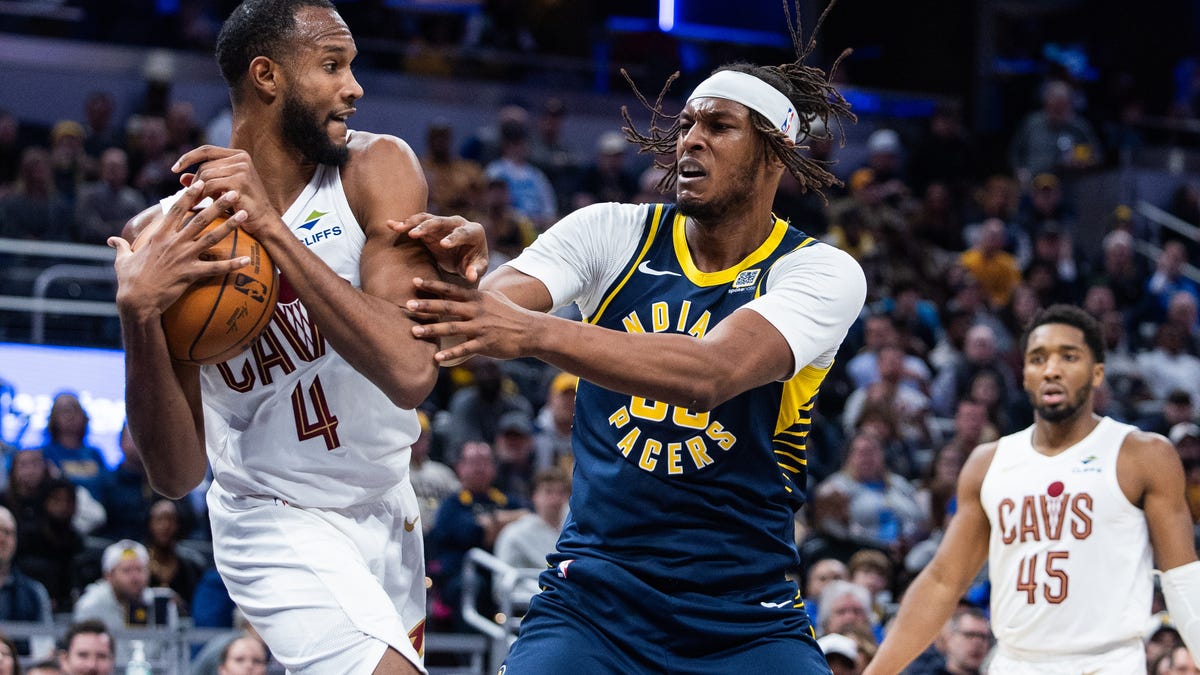
INDIANAPOLIS — For the Pacers, the first round of the NBA playoffs was about experiencing new things in similar places. In the Bucks they faced the the same team they faced in the first round of last year’s playoffs, but this time roles were reversed with the Pacers being the higher seed and getting homecourt advantage.
In the Eastern Conference semifinals they’re in a more similar situation to the ones they faced last year but against a team they haven’t seen in the postseason since 2018 with both teams having either completely or almost completely turned over since.
The last time the Pacers played Cleveland in the playoffs, the Cavaliers had LeBron James on the roster. James is long gone now, but this Cleveland team finished the regular season with the second-best record in franchise history and the best of any Cavaliers squad that didn’t have James on it. At 64-18 they are one of just three Cleveland teams to win more than 60 games and they finished three games better than any other team in the Eastern Conference. While the Pacers needed five games to eliminate the Bucks, the Cavs blitzed past the Heat in a four-game sweep that was arguably the easiest of any of the first round matchups.
The Pacers won the season series 3-1, but the last two games were played in the final week of the season when the Cavs had already clinched the No. 1 seed and were resting their starters. The only games they played that were normally matched came Jan. 12 and Jan. 14 in a home-and-home series the teams split and the road team won each game.
The Pacers will certainly be betting line underdogs, but who actually has the edge? Here’s how they line up in some key categories.
Pacers vs. Cavs: Offense
The 2023-24 Pacers were the sixth-highest scoring team in NBA history with 123.3 points per game and the highest scoring team in the league since 1984. This year’s Cavaliers team is the 11th-highest scoring team in league history and the second-highest scoring team since 1984 with 121.9 points per game.
The most obvious change the Cavs made from last season to this one when they fired coach J.B. Bickerstaff and hired former Golden State assistant Kenny Atkinson to replace him was they stopped trying to slow the game down and trusted themselves to play with pace even with two 6-11 big men in the starting lineup in Evan Mobley and Jarrett Allen. They jumped from 20th in the league in scoring to first, from 24th in pace to 10th and from 16th in offensive rating to first, posting 121.0 points per 100 possessions.
After last season, there was concern about whether star guards Donovan Mitchell and Darius Garland could co-exist or if they were both too ball-dominant. In Atkinson’s offense, that hasn’t been an issue. Mitchell averaged 24.0 points and 5.0 assists per game as the 2 guard, which will certainly be enough to get him a second All-NBA nod and could be enough to get him the fifth spot on the first team. Garland made his second All-Star team and had his most efficient season with 20.6 points and 6.7 assists per game, shooting a career-best 47.2% from the floor and hitting a career-high 212 3-pointers.
The bigs proved they could co-exist as well and didn’t need to slow down and play bully-ball to do so. Mobley, the No. 3 overall pick in the 2021 draft, showed dramatic improvement in his perimeter game, which raises his ceiling and justifies the max contract extension he signed in the offseason. He averaged a career-high 18.5 points per game, made a career-high 62.1% of his 2-point shots and 85 total 3-pointers — more than he hit in the first three seasons of his career combined — to post a career-best effective field goal percentage of .604. Allen didn’t change his offensive game much, taking just five 3-pointers and missing them all, but he made a league-best 70.6% of his shots, 71.2% of his 2-pointers in one of the best seasons of his career.
And the Cavs surrounded those four stars with shooters. Guards Ty Jerome, Sam Merrill and Max Strus each hit more than 100 3-pointers and wing De’Andre Hunter hit 42.6% of his 3-point attempts in the 27 games after he was acquired from the Hawks at the deadline. The Cavs finished second in the league in both field goal percentage (.491) and 3-point percentage (.383) and led the league in effective field goal percentage at .578.
The Pacers’ numbers dipped a tad after their franchise record-breaking 2023-24 campaign, but they still finished seventh in the league in scoring (117.4 points per game), third in field goal percentage (.488), ninth in 3-point field goal percentage and ninth in offensive rating (115.4 points per 100 possessions.) They’re also seventh in the league in pace and finished fifth in fast-break points.
Point guard Tyrese Haliburton has been one of the most impactful offensive players since the All-Star break and finished third in the NBA in assists with 9.2 per game. Forward Pascal Siakam gives them both an excellent isolation option when their system breaks down and an excellent transition finisher and catch-and-shoot 3-point option. Center Myles Turner set career highs in 3-pointers and 3-point percentage. Starting small forward Aaron Nesmith has been particularly efficient since the All-Star break and in the playoffs he’s averaging 14.8 points per game on 53.8% shooting including 51.9% from beyond the arc.
Advantage: Cavs
Pacers vs. Cavs: Defense
The Cavs’ increased focus on offense cost them a little on the defensive end, but not much. Last year’s team gave up 110.2 points per game and this year’s gave up 112.4. They fell from seventh to eighth in defensive rating but actually had a better defensive efficiency mark this year than last year.
They have the pieces necessary for a defense to be excellent. Mobley anchored the group so well he won Defensive Player of the Year, giving the Cavs both a shot-blocker at the rim and a big man who can manage ball-handlers in the pick-and-roll. He finished the season with 1.6 blocks and 0.9 steals per game. Allen can also defend the rim and he averaged 0.9 steals and 0.9 blocks per game. Mitchell and Garland averaged 1.3 and 1.2 steals per game respectively off the perimeter. Jerome averaged 1.1 steals per game off the bench and the acquisition of Hunter gives them a big wing coming off the bench who can defend every possible position.
The Pacers dramatically improved on the defensive end, moving up from 24th to 14th in defensive rating. They were seventh in defensive rating after Dec. 8, before which they started 10-15. Turner’s 2.0 blocks per game were the most among players who appeared in at least 65 games and guard Andrew Nembhard anchored a defense that increased its reliance on full-court pressure. When the Pacers beat the Cavs in January, they did it by causing eight second-half turnovers and turning those into 15 points off turnovers in the second half while holding them to 28.2% shooting.
Advantage: Cavs
Pacers vs. Cavs: Depth
The Cavs put three players on the All-Star team and unquestionably had one of the three best starting lineups in the NBA, but their bench was a big part of what made them special.
Jerome, who helped Virginia to the 2019 national championship, missed almost all of last season with a severe ankle injury but came back and had by far the best season of his professional career and was named a finalist for Sixth Man of the Year. He averaged 12.5 points per game on on 51.6% shooting including 43.9% from 3-point range with 111 3-pointers. He’s been astounding in the playoffs so far, averaging 16.3 points per game and shooting 50% from 3-point range.
The acquisition of Hunter was quietly one of the most important pickups at the trade deadline. The Cavs kept him on the bench, but his 6-8, 225-pound frame makes him a multi-positional defender and he’s scoring inside and out. He averaged 19.0 points per game for the Hawks before the trade and is averaging 14.3 since the trade and shooting 48.5% from the floor and 42.6% from 3-point range. Merrill gives them another 3-point shooting option and wing Isaac Okoro gives them another multi-positional defender.
The Pacers’ bench led the league in scoring in 2023-24 and their contributions to the playoff run were major. They haven’t stood out quite as much this season, but Pacers coach Rick Carlisle has leaned on them heavily still to prop up the full-court pressure. Point guard T.J. McConnell finished 11th in the NBA in bench scoring and first in bench assists and even though he wasn’t quite as efficient as he was last year, he still shot 51.9% from the floor. Forward Obi Toppin finished seventh in the NBA in total bench points and guard Bennedict Mathurin averaged 16.1 points per game — mostly in a starting role — but moved to the bench late in the year.
Advantage: Cavs
Pacers vs. Cavs: Coaching
Kenny Atkinson was named NBCA Coach of the Year which is voted on by the coaches and he has a good chance at winning the media award as well. He couldn’t have done more in his first year with the Cavs to earn it. He obviously started off with a very good foundation set in the tenure of J.B. Bickerstaff as he inherited an established playoff team that won 48 games last year and lost to the No. 1 seed and eventual champion Celtics in the Eastern Conference semifinals. However under Atkinson, several players found their ceilings to be much higher and players who weren’t expecting to have huge roles such as Jerome ended up being critical.
Still, Atkinson will be going to the playoffs for just the second time as a head coach as his Nets lost in the first roundin 2018-19. He hasn’t been this far before. Rick Carlisle has plenty of times, winning a championship in 2011 with the Dallas Mavericks. Carlisle caught Atkinson off guard with the full-court pressure in the Jan. 12 meeting and even though the Cavaliers responded two days later, tight playoff series are all about adjustments and Atkinson didn’t have to make many to beat the Heat. Dealing with Carlisle will be much more difficult and will present challenges he hasn’t yet proven he can overcome as a head coach. This might be the time he does it, but it won’t be easy.
Advantage: Pacers
* if necessary
Game 1: at Cleveland, Sunday (May 4), 6 or 8 p.m., TNT
Game 2: at Cleveland, Tuesday (May 6), TBD
Game 3: at Indiana, Friday (May 9), TBD
Game 4: at Indiana, Sunday (May 11), TBD
Game 5*: at Cleveland, Tuesday (May 13), TBD
Game 6*: at Indiana, Thursday (May 15), TBD
Game 7*: at Cleveland, Sunday (May 18), TBD
Get IndyStar’s Pacers coverage sent directly to your inbox with the Pacers Update newsletter.