
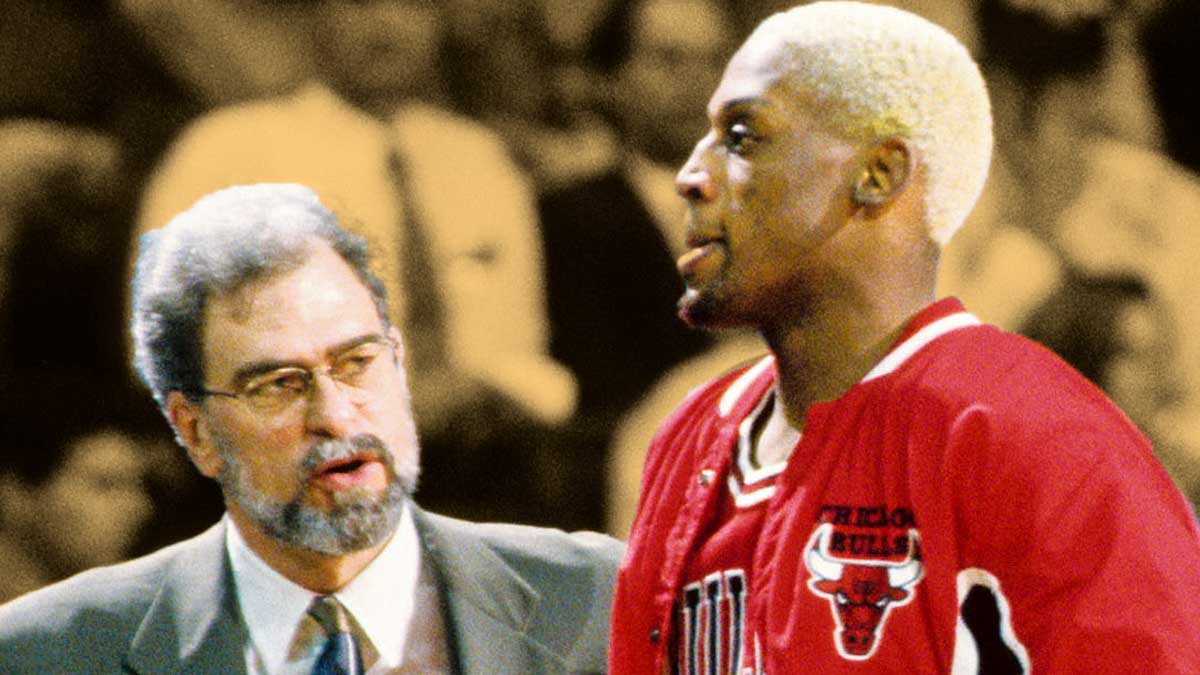
Phil Jackson knew he was in for a lot of work when he assisted in acquiring the highly eccentric Dennis Rodman. No doubt about his rebounding, but what came after that was a wild card. Jackson, a strategist who’d built harmony in locker rooms loaded with ego, understood what he was getting.
Rodman was a cultural anomaly wrapped in neon hair dye, tattoos, and controversy. The basketball world knew what he brought — boards, defense and tenacity. But the real gamble was everything else.
A party freak
Chicago, coming off three championships in the first half of the ’90s and missing out on back-to-back Finals, welcomed chaos into a system built on discipline and balance. And even as Rodman’s game aged like a vintage rebound machine, his off-court life only got louder.
Advertisement
“When Dennis went to a bar, all bets were off,” Jackson said. “He really wasn’t a person that partied. But when he did, it was all out. It could be a 24-hour party. That’s where we really had to watch Dennis closely, because it didn’t stop at closing time.”
By the time Rodman arrived in Chicago in 1995, he was miles removed from the blue-collar, hard-nosed role he played for the Detroit Pistons Bad Boys era. Those Detroit teams were gritty and unforgiving and won back-to-back titles in ’89 and ’90 at the expense of the Bulls in the conference finals.
But Rodman’s evolution — or unraveling — had long since taken him from bruiser to headline act. He was in the San Antonio Spurs flashing leopard-print hairstyles and dating Madonna before landing with the Bulls.
Rodman never lived on the surface. He lived in extremes. There wasn’t a halfway setting. If he stepped into a bar, it didn’t matter if it was a Tuesday before a game. The night might stretch into morning and slide past sunrise. He didn’t drink daily, but when he did, it was an event. That’s why Bulls players, as Jackson admitted, often kept their distance off the court. They respected what he brought on it, but away from the hardwood, Rodman operated in a world that didn’t sleep.
Rodman’s escapades
Rodman tested the limits of everything he did. The Bulls tolerated it because they had to because he performed and because Michael Jordan, Scottie Pippen, and Jackson found a way to keep the engine running while the sideshow whirled in chaos. But trust wasn’t the same as closeness. Rodman was rarely, if ever, part of the team’s inner social circle. He did his job, then disappeared into the night.
Advertisement
Jackson knew there wasn’t a template. Rodman couldn’t be boxed in or explained in team meetings.
“You couldn’t ever call anything close to Dennis Rodman,” Jackson said.
This is why his presence in Chicago — on arguably the most controlled, success-driven dynasty in basketball history — was so strange and yet so effective. He wasn’t a leader in the traditional sense. He wasn’t cracking jokes on the team bus or organizing dinners. But come game night, he was in the trenches doing what no one else wanted to.
That dichotomy defined his tenure in Chicago. On one end, Rodman anchored the paint for a team that went 72–10 in the 1995–96 season—still tied for the best regular season in the NBA’s history. He led the league in rebounds with 14.9 per game and often defended the opponent’s best big man.
Advertisement
On the other end, he could vanish to Vegas in the middle of a championship chase. In January 1998, during the height of the Bulls’ final run, he jetted off to Sin City in the middle of the season, prompting Jordan and Jackson to send someone to retrieve him.
Rodman’s 1996–1998 run with the Bulls added three more titles to his resume and cemented his legacy. But it also cemented something else—that not every piece in a dynasty has to fit perfectly. Rodman knew this. He rebounded, defended, and disrupted. The rest, the drama, and the spectacle were background noise as long as the wins piled up.
Still, his presence forced the Bulls to adapt.
Teammates had to learn how to coexist with someone whose lifestyle was completely detached from the NBA norm. While Jordan was legendary for his obsessive competitiveness and Pippen for his precision, Rodman lived on impulse.