
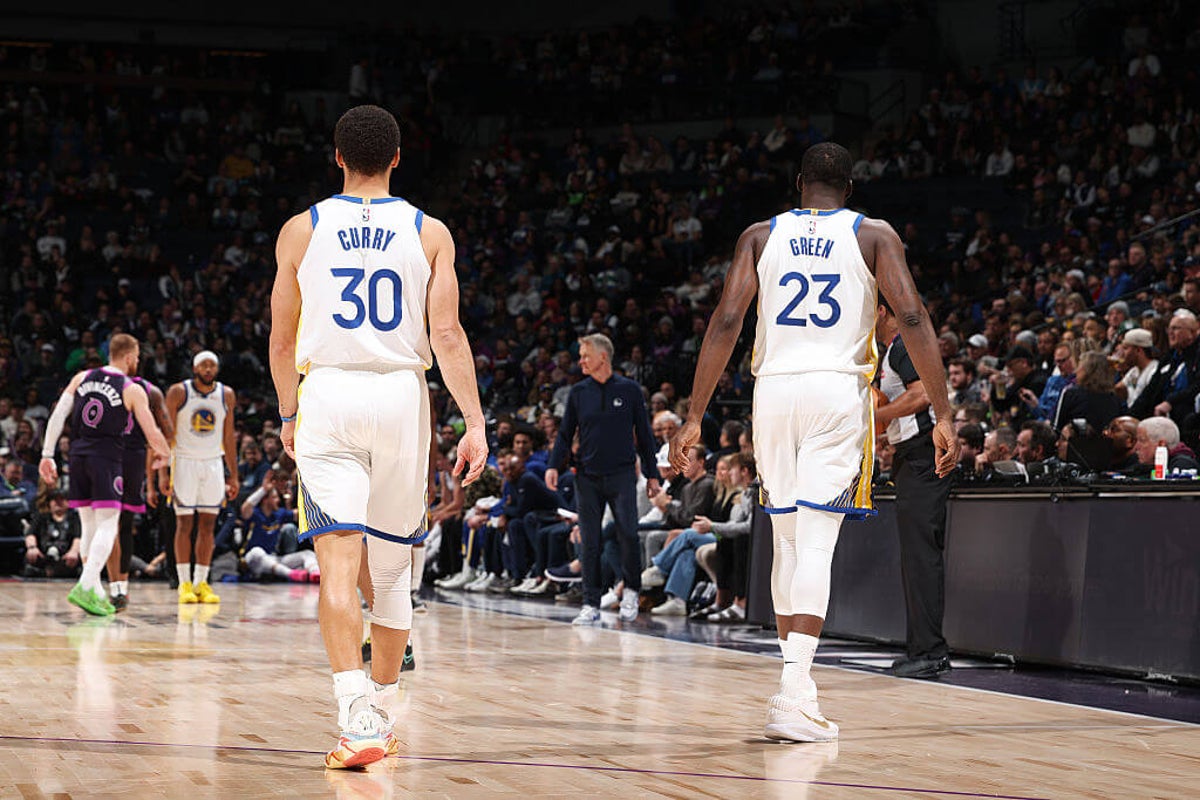
MINNEAPOLIS — Stephen Curry was supposed to be spending his Saturday afternoon entertaining thousands of fans inside of Target Center in downtown Minneapolis. Instead, the 37-year old star of the Golden State Warriors was glued to his television just like so many other Americans across the country, watching the civil unrest unfold just a few miles from the Warriors’ team hotel.
After the Warriors’ charter landed on Friday, Curry was one of many members of the team’s traveling party who could see the peaceful protests from outside his hotel window. Less than 24 hours later, Curry and the rest of his teammates were left to think about the real world events unfolding around them after the NBA postponed Saturday’s game following the shooting by federal agents of Alex Pretti.
The Warriors and Timberwolves made the game up on Sunday, in a contest that players and coaches admitted was strange given what was going on around them — but the entire sequence of events that led up to that game was part of the strangest week of the Warriors’ season. It ended late Monday night with a 108-83 loss to the Minnesota Timberwolves — but the ramifications of what went on both on and off the floor will last far longer than a week’s worth of games.
The tenor of the entire season changed two Mondays ago when Jimmy Butler went up for a pass over Miami Heat guard Davion Mitchell and landed awkwardly on his knee. While the official diagnosis wouldn’t be known until a couple hours after the game was finished, most within Chase Center already knew what they had seen — especially Curry.
He watched helplessly as Butler was helped off the floor. He spoke stoically after a 135-112 win over the Heat — the Warriors’ 12th victory in 16 games — but the magnitude of the moment seemed to hang over Curry the next few days. He played poorly in last Tuesday’s blowout loss to the Toronto Raptors, going just 6 of 16 from the field and not even playing in the fourth quarter. His body language represented that of many within the Warriors’ organization — the look of a proud man showing up to work after getting an emotional punch to the gut. He was there, but his heart appeared to be somewhere else after watching his teammate suffer a season-altering injury.
The juxtaposition of Curry coming to grips with his new reality and 23-year-old Jonathan Kuminga’s re-emergence into the lineup was the most interesting part of Tuesday’s game. Kuminga, who hadn’t played since getting 10 minutes on Dec. 18, was back in the rotation — a fact made even more impressive given that he had demanded a trade a few days before that. He scored 20 points and showed the type of athletic flashes that have defined his five-year career.
Before the game, Warriors GM Mike Dunleavy made waves around the NBA landscape by noting that in order for a player to make a trade demand, there needed to be demand for his services. It was a not so veiled message to Kuminga, and his agent, Aaron Turner, that there wasn’t much interest in the player as far as the organization was concerned. Turner responded after Kuminga’s performance with a tweet centering around the definition of demand.
That the public back and forth reached this point after months of frustration only underscored another layer of awkwardness for a team that had to reassess both its present and future on the fly.
By the time the Warriors played Dallas on Thursday, their new reality had set in. Butler was gone, Kuminga was back and the games kept coming. After Kerr said that Kuminga would stay in the rotation, he had to chuckle before the game against the Mavericks at the continued questions about the talented but inconsistent forward.
“Go ahead,” Kerr said with a smile. “I know. You’ve got lots more Kuminga questions. Go ahead. Fire away.”
Kerr tried to take it all in stride, but his attitude about the situation mirrored that of many in the organization. As well-liked as Kuminga is within the locker room and by some Warriors’ staffers who have seen him grow through the years, the incessant questions about his future, his place on the team and his latest trade demand has seemed to wear out so many within the team. Kuminga would get his chance and Kerr would, once again, see what would happen. For the second straight game, Kuminga played well, scoring 10 points, but left the game with knee soreness.
The Warriors hung tough against the Mavericks but ended up losing, 123-115. Kuminga walked slowly out of the locker room and declined to speak to reporters. Curry, who uncharacteristically took the night off from speaking to the media after Tuesday’s loss, said he didn’t want to answer “existential” questions about the future, deflecting a question about what he felt the organization should do in the wake of Butler’s injury. Making matters worse for the Warriors was the fact that an ice storm was bearing down on Dallas and forced them to push up their flight to Minneapolis to Friday morning.
When the Warriors arrived, they saw the emotional frustration within the city related to the events of the past few weeks while dealing with how to respond to what has increasingly felt like a lost season. The Warriors said before the game that an MRI on Kuminga’s knee revealed a bone bruise to go along with the hyperextension he sustained versus the Mavericks. He would be re-evaluated again in a few days, but it is unclear, as it has been all year, what his future holds.
Kerr eloquently described how he was feeling, not only personally, but about the country, before Sunday’s game. After it was over, Kerr and Curry described the hollowness they felt playing in a basketball game in which, as Kerr put it, a “pall” still hung over the city.
Kerr empathized with the Timberwolves for having to play under such circumstances after the events of Saturday in their home city. Kerr and several staffers compared the emptiness around downtown, coupled with the frigid temperatures outside, to feelings that existed during COVID. The games had to go on, but the passion that each usually brought was overwhelmed by events out of their control.
Curry sat out Monday’s game with a knee issue that had been bothering him for several days, and he was not alone. Draymond Green, Al Horford, De’Anthony Melton and Kuminga all missed the game, as well. With just 10 healthy bodies, the undermanned Warriors played hard, but they didn’t have enough talent to match up with the Timberwolves, even without Anthony Edwards. The intensity that usually comes with a matchup between two of the NBA’s biggest stars was replaced by a profound stillness.
Longtime NBA veteran Buddy Hield took a philosophical approach while describing his team’s experience over the last week.
“You just got to put your head down and move on,” Hield said in a quiet Warriors locker room late Monday night. “There’s no excuses. Every day is a different life challenge and life obstacle. It’s not gonna be clear cut. It’s not gonna be out in the open where everything’s where (we) just go by the book. There’s gonna be ups and downs, there’s gonna be obstacles, and that’s what life’s about, getting through it. Figuring it out. And that’s what we did, figured it out.”