
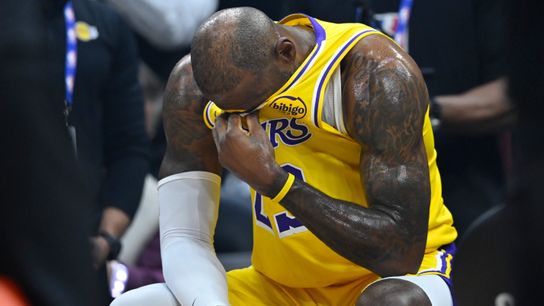
CLEVELAND — The Jumbotron bathed him a glorious savior. Not the harshness of reality, purple and gold, but the soft yellow hues of memory, of history, of moments frozen in time.
They painted him a savior.
There on the screen above Quicken Loans Arena—wait, no, it’s now Rocket Arena. Although the name has changed, his soul still lingers in the bowels of the building—ran the footage: a 22-year-old LeBron James scoring 25 consecutive points against Detroit during the 2007 playoffs, erecting a throne for a king, while he lifted, a kingdom, a city, on shoulders sturdy enough to bear the weight.
The timeout horn to return to action blared with 7:46 remaining in the first quarter.
The video ended. The camera cut to the floor.
And there kneeled LeBron James: 41 years old, 23 seasons deep, tears streaming down cheeks that had seen everything basketball could offer.
“I don’t know,” James said. “Didn’t expect that, but obviously a lot of memories here. A lot of history.”
James wiped his face with a towel. The crowd roared. This was his tenth time returning to Cleveland as an opponent, but the first time they showed that game—the one before the championship, the one that proved he could be mythic.
Usually, they showed 2016, the parade, the fulfillment.
This time, Cleveland showed promise; they highlighted what could have been.
It also broke the Lakers.
The final score read 129–99, Cleveland Cavaliers.
But numbers lie. This game, if it could be called such, was an autopsy performed in public; a dissection of a dream that started with tears of gratitude and ended with tears of unfiltered exasperation.
The Lakers began beautifully.
Luka Dončić, fresh from tweaking his left ankle on a bizarre fall off the court’s edge—”the floor,” as JJ Redick would later call it, “is absolutely a safety hazard”—limped to the locker room, then returned like a man possessed.
Dončić scored 29 points on the night, 12-of-20 from the field, but the real number was this: after missing his first four free throws before the injury, he hit 14-of-15 after.
“I was like, hopefully he can get back by the second quarter,” Gabe Vincent said. “He actually got back before the second quarter started.”
The Lakers’ offense hummed. They built a 40–30 lead with eight minutes left in the second quarter.
Ten points. They were up. They were rolling.
Donovan Mitchell, Cleveland’s brilliant guard, had yet to find his rhythm.
The Cavs were 6-of-22 from three-point range. There were enough bricks to build an annex specifically for James.
Then the margins moved.
Not with trumpets, but with whispers.
A missed rotation. A failed box-out. An offensive rebound here, an extra possession there.
The Cavs scored eight points off 10 first-half offensive rebounds. The Lakers’ lead shrank: 8 points, then 6, then 4.
“I felt like we got a little lucky,” Redick said. “We couldn’t get to 50/50 balls. They had 10 offensive rebounds and only scored eight points off them. We got a little bit lucky.”
Such a small word for such a fragile thing. At halftime, the score was 57–55. Two points. Los Angeles’ dream still had breath.
Then, a natural disaster in nylon shorts unfurled.
The Cavaliers scored 42 points in the third quarter; the Lakers, 22.
Cleveland shot 68% from the field, hitting 7-of-11 three-pointers.
Mitchell, who’d been quiet, scored eight points in the flurry, Jaylon Tyson added seven.
Dean Wade, who spent the first half doing in-game cardio, hit two corner threes.
“We got blitzed in the third quarter,” Redick said. “Should have gone to the bench earlier in that third. We just didn’t look like we had all our juice.”
Whatever you call it, the Lakers had none.
Both teams shot 6-of-22 from three in the first half.
Then the third quarter arrived, and Cleveland became magma while Los Angeles became stone.
“The momentum shift, the energy shift,” Vincent said, “that’s what kind of built up their confidence.”
The Cavs ran. They cut. They moved like water, finding cracks.
The Lakers stood like statues, their rotations a step slow, their hands a moment late.
The Cavs’ lead ballooned: 5 points, 10 points, 15, 20.
The quarter ended 99–77; the game was essentially over.
James’ tears hadn’t even dried yet.
The NBA’s all-time scoring leader finished 3-of-10 from the field with all three, like most of his career, coming at the rim, with 11 points.
For the first time in 13 trips to Cleveland as an opponent, James failed to score 20.
For the first time in his career, “The King,” deposed, lost this badly in this building—his worst defeat as a visiting player.
Yes, he’s 41 years old, as if age could explain this.
As if the emotion of seeing his 22-year-old self hadn’t drained him before the game truly began.
“I think it’s just being present,” James said. “I don’t know what the future holds. So I’m just trying to live in the moment.”
The moment, as have many since he donned a Lakers’ uniform, betrayed him.
His plus-minus was minus-24, matching the Lakers’ three-point differential (9-of-32 vs. Cleveland’s 17-of-44).
He was human. Painfully, visibly human.
Because he has inexplicably defied time, it was expected that he would play well.
Yet, it oddly appeared as if it was his first time stepping foot in the arena, although he’s been there a plethora of times.
But this wasn’t first-time nerves; it was something deeper.
This was a man confronting his own basketball mortality while his team collapsed around him.
The Lakers fell to 3-2 on their seven-game road trip. They’d dreamed of 4-1, maybe 5-0, but must now salvage what remains.
Redick took responsibility.
“You can say I got out-coached. I probably should have made substitutions earlier,” Redick said.
“I hate the way we played tonight, but that happens in the NBA season,” James said.
Dončić, when he finally spoke, kept it simple.
“Everybody had a great game. The ball was shared. Fifteen shots up, so take JJ’s point,” Dončić said.
Fifteen shots. Shared ball. It didn’t matter.
When a team surrenders 42 points in a quarter, when a legend scores 11, when the past reduces you to tears, the details become cruel punchlines.
The Lakers fans—those who braved the cold, who made the trip, who believed—left with that unique frustration that curdles into exasperation.
They’d seen LeBron cry. They’d seen the Lakers crumble. They’d seen a 20-point loss that felt like 40.
James isn’t under contract for next year.
He is 41, in year 23, playing every other night on a road trip that stretches his minutes and his psyche.
“I’ve not even thought to the point of a farewell tour,” James said. “I haven’t had the conversation with myself and my family on when it’s over.”
The road trip continues: Washington, Brooklyn, New York.
The Lakers are still 28-18, still contenders, still alive.
But something shifted in that third quarter, something beyond points and percentages.
This was supposed to be a celebration; it became a lament.
The tears that rehydrated the hardwood started as gratitude, became tears of something else—not quite grief, not quite anger, but the painful recognition that even kings grow old, even dreams crack, even the most emotional homecoming can become the most brutal goodbye.
What happens when a dream becomes a fleeting, fading memory?
On Wednesday night, that dream wept, it faded, it scored 11 points. It begs the question: what if this was the last time?
“Being present,” James repeated. “That’s where I’m at.”
The present is 129–99.
The present is a third-quarter collapse.
The present is tears—first his, then theirs.
The present is the hardest place to be.