
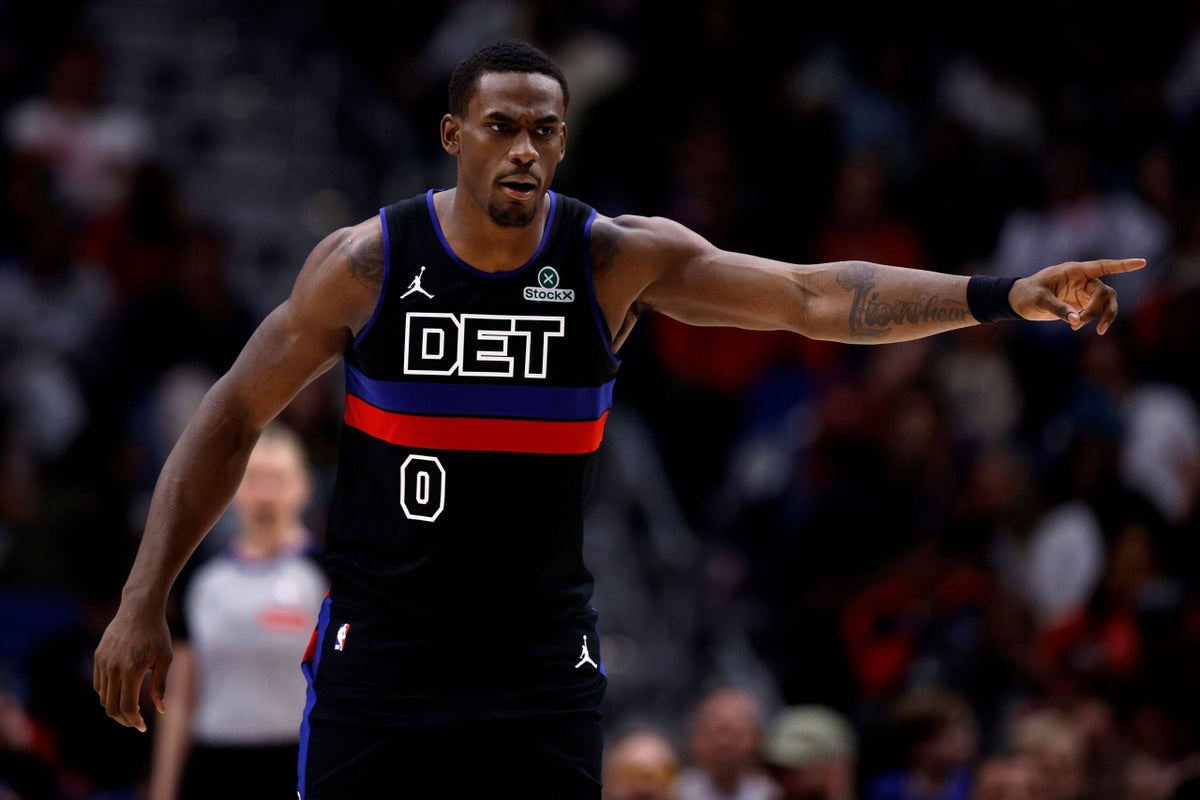
In a league full of athletes who boast physical tools that make everyday people marvel at their abilities, Jalen Duren still stands out with the Detroit Pistons. He possesses a combination of brute strength and agility that has helped him evolve into the ideal big man to complement teammate Cade Cunningham’s skill set.
Duren is in the midst of a fourth-year leap that has coincided with the Pistons becoming the Eastern Conference’s best team. He was primarily used as a lob threat and occasionally an offensive hub in his first year under head coach J.B. Bickerstaff last season. But at 22 years old, 6-10 and 250 pounds, Duren is blossoming into one of the more versatile young centers in the NBA.
Per Cleaning the Glass, 33 percent of Duren’s shot attempts have come from the midrange, which is on pace to become a new career best and is in the 75th percentile for bigs. Bickerstaff challenged Duren to refine his game on both sides of the floor over the summer, and thus far, Duren’s improvements have been glaring.
He sat down with The Athletic earlier this month to break down a handful of plays that exemplify just how versatile he’s become.
This was setting up to be a typical pick-and-roll until Cade (Cunningham) rejected your screen. You see that and slip behind Nic Claxton. At what point do you decide, this screen-and-roll situation isn’t working, I’m about to dive to the rim?
As soon as I saw Claxton get above me. So when I’m setting the screen, with Cade, he’s such a good player. He’s so dynamic. Since he’s 6-7, it makes it easier to play with him and I know he can see different reads. So my thing was, once he gets an advantage, get out. I felt like right here with Claxton above me, once I get behind him, it’s over — it’s lob city.
Anytime I get behind any big, it should be lob city. So that’s all my thought process was. Get Cade the advantage, get behind the big.
So, are you looking at the low man (Michael Porter Jr.) to pull over as you roll, or is he irrelevant at this point to you?
I tell the guards every time, if that low man is anywhere below (the restricted area), and if the low man isn’t a big man, he’s not going to help as much. So nine times out of 10, if there’s a guard down there, he’s going to move out of the way, especially if it’s a lob. Now, if I’m catching on the roll, and I bring the ball down, of course, they’ll swipe at it.
If it was a lob, more times than not, they’re just going to move out of the way. But right here, if the low man is in the charge circle, I’m like, “Bro throw that up, I’m going to dunk on him.” That’s how we talk.
And that’s how we end up with the dunk on Ben Mathurin.
Exactly. If the low man is too low, throw that up and I’m going to dunk on him. He’s a non-factor.
How long did it take y’all to develop the chemistry where you don’t even have to communicate about those nuances anymore?
It didn’t take long, it was just game reps, man. Just playing with each other and being in constant communication. I mean, we break down plays, even in-game.
Like when something happens or a team guards us a certain way, I’ll go to Cade or he’ll come to me like, “Yo, this is what they’re doing. Let’s do this.” So, it’s constant communication, constant communications to where it’s like, we talk so much that it’s like, now I kind of know what you’re thinking.
Or it might be situations that we’ve already been through, that we’ve talked about earlier. I mean, last season, two seasons ago, that we kind of already have down pat, so it’s just an understanding.
Cooper Flagg is coming down the lane here. Klay Thompson’s gravity pulls Duncan Robinson and Cade up. So now that you’re the last line of defense, it’s on you to stunt and recover. Are you anticipating a lob to Daniel Gafford, or are you trying to stunt to see how far Cooper comes down before recovering to Gafford?
Yeah, it was a stunt to try to get Coop to shoot the floater. Like, we’ll live with a floater rather than a dunk. Especially if I can make him hesitate on his floater. But I saw he dropped it off, and it’s big man tendency to show the ball, so I was able to get my hands on it.
This is a two-part question because then you sprint down the floor, obviously. But Klay doesn’t pull over to stop you in transition because he’s on Duncan. Max…
He’s not big enough!
I was just about to say, he’s not big enough and you also slow down for a second to create separation. It looked like Cade was getting ready to hit you with a bounce pass but the window closed quickly, so he just threw it up. At what point do you recognize this is going to be a lob?
I knew I was getting it because we were running together. If we’re running together like this, he’s going to throw me the ball. I’ve already noticed that. If nobody stops me, I’m going to get the ball. So, my thing is always, since he’s looking out for me, look out for him. Catch the ball and don’t allow it to be a turnover, you know what I mean? Like, complete the play.
So, I look at myself as his tight end. So right here, that’s all that was. I’m like, “All right, he’s not going to stop me from getting this catch.” And that’s all it was. However he delivers the balls, is however he delivers it. Whether it’s a bounce pass, a lob, a chest pass, whatever it is, my job is to make sure I complete it.
Are you tracking how close you are to the rim so you’re not in a position where you’re catching it and falling out of bounds?
Yeah, it’s just court awareness. That’s just knowing where you’re at on the court from playing ball. You’ve got to know where you are on the court without having to just constantly look at the rim while you’re running. I’m seeing where I’m at, I’m knowing I’m getting to the rim. He’s knowing I’m getting to the rim and he’s timing the pass and he timed it perfectly.
That was a good one, that’s one of my favorite lobs.
Now this one was interesting because usually if you’re down this far and you seal, you’ll take a couple of dribbles and power through a defender’s chest. Or you might pump fake a couple times and get to the free-throw line. But instead, you get him off balance and then spin back for the lefty hook over your right shoulder.
What about how Onyeka Okongwu defended you here made you decide you were going to come back over the right shoulder?
I wanted to just make a quick move and as you said, keep him off balance. Honestly, I felt like he was smaller than me in size, so I tried to get to my jump hook. That’s why I tried to explode on the hook. I thought if I could get some good height on (the hook), I was going to get a good look. I’m pretty confident in my left hand, so I knew if I could get to it, I could get a good look.
You work with player development coach Eric Curry often. It’s usually one-on-ones and getting to moves like these. How helpful has he been to your growth offensively?
It’s huge. Me cooking “E” over the last two years, bro, it definitely has been a big part of my game. You see me, I play one-on-one almost every day (with Eric). It might look like just one-to-one, but it’s really scripted in my head. So I have him guard me, and I try to play as realistically as possible. I’m working on shots, hooks, taking him off the dribble, certain moves I make.
Whenever I can, I try to get guys to kind of play in the shift, playing the gaps, playing the help. So it’s as realistic as possible. So I think that just plays into what I’ve been able to do on the court this year.
Y’all had a few options on this action here. It looked like either Javonte Green was going to set the flare for Daniss Jenkins to fly off of, or it could’ve even been a dribble-handoff. What did you see on this action that made you size Jay Huff up for a midrange pull-up?
When I’m coming down the court full speed, (Pistons head coach) J.B. (Bickerstaff) usually yells to get to an action. I could get to a handoff or a pitch and follow or whatever. So right here, I’m like, I’m coming down and as I’m about to get into the handoff with DJ, I see TJ McConnell start to jump over toward me. And it made me, out of reaction, go back to protect the ball.
And then from there, I just got into my rhythm. I’m there and I saw Huff backed up, that just put me in my rhythm. This all goes back to what I said with “E”. This is all stuff that I do pregame. This is all stuff I do in practice every day. Right there, like the last move, I didn’t even think about it.
This seems similar to the action we were just looking at with DJ and Javonte, but DJ kicked it to you. Then DJ was getting ready to set a screen for Javonte, but then he slipped it. What did you see that let you know you were going to have an opportunity to make this pass?
As soon as I saw Dyson Daniels’ left foot jump up on that screen. Because he tried to jump up to switch to get to get on Javonte. I already knew Nickeil Alexander-Walker was going to be on DJ’s back. But if DJ didn’t slip that, the next time we ran that, I would’ve said, “Yo, you should have slipped it, because Dyson is jumping up trying to be aggressive on the switch.”
Are you anticipating Jalen Johnson pulling over at all?
I see his body language. He’s attached to Ausar (Thompson), but he’s not even in a stance to get over there quick enough. Like, look at the paint. Look at AT. From the beginning, the paint was wide open. So even Jalen was in a stance, for DJ, it’s just the finish on the right side of the rim, you know what I mean? But as soon as I saw that left foot of Dyson Daniels, I knew it would be open.
And at that point, I’ve just got to get DJ the ball.
How are these reads something you’re working on throughout the summer to improve on?
I think a lot of the passing and reads come from pick up, like playing pick up with the team. A lot of watching film like this, understanding where guys are going to be. I think I can get better at that, like recognizing the corner man, as you said. Because sometimes that guy slips and then that corner man would help in.
And I don’t do the best job of hitting that corner. Not like I don’t do it accurately, it’s more like I don’t do it. So I’ve got to start looking to hit that corner more when those guys try to help in on that cut.