
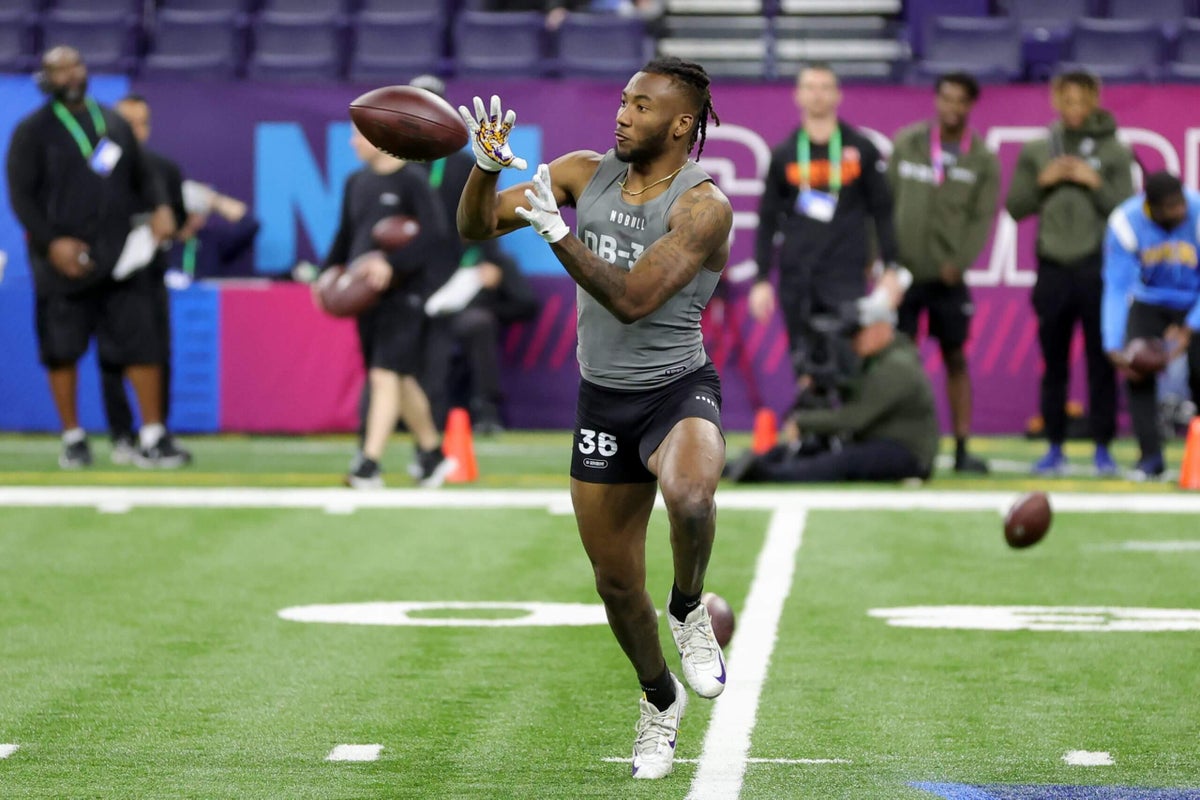
This segment of the NFL offseason — at least for the 30 teams not playing in the Super Bowl — is when coaches begin to familiarize themselves with draft prospects.
The Minnesota Vikings, in particular, have three staffers contributing at the Senior Bowl. Passing-game specialist Ryan Cordell, assistant outside linebackers coach Patrick Hill and offensive quality-control coach Derron Montgomery are getting a hands-on feel in Mobile, Ala. Their perspectives will help inform the team’s draft board later this spring.
So we thought it’d be worth examining a question: Which positions on the Vikings roster are most in need of youth?
Here are eight positional needs, ranked from biggest to smallest:
1. Cornerback
Finding a young cornerback is paramount this offseason. Byron Murphy Jr. is under contract for the next two seasons, and Isaiah Rodgers is secured through 2026. Behind them, the depth is a complete question mark.
Because defensive coordinator Brian Flores tends to play with multiple safeties, the Vikings can get away with less talent at this position. But they would stand to benefit from incorporating more man coverage and match concepts.
Minnesota was fortunate with the health of Murphy and Rodgers in 2025. Expecting both to start all 17 games next season would be taking a big risk.
Cornerback is certainly a spot that could make sense near the top of the draft, where the prospects are most explosive. Two years ago, current Philadelphia Eagles cornerback Quinyon Mitchell made a sizable impression on the Vikings at the Senior Bowl. There are enough highly-touted cornerback prospects to make this a possibility in Round 1.
2. Interior defensive line
This might sound like cherry picking, but all four teams competing in the conference championships last weekend possess elite interior defenders. It’s difficult to overstate Milton Williams’ presence for the New England Patriots. The Seattle Seahawks spent a first-round pick on Byron Murphy II for a reason. Quarterbacks like to step up in the pocket. Vertical pocket pushers can make things uncomfortable.
The Vikings made it clear that they value the position with how they spent last year in free agency. They paid Jonathan Allen and targeted Javon Hargrave. Neither became the dominant force the franchise hoped they’d be.
Fortunately, young players Jalen Redmond and Levi Drake Rodriguez developed and showed some real promise this season. Redmond, in particular, is an impact player.
Still, that should not prevent Minnesota from pursuing more depth and playmaking at the position.
3. Safety
Evaluating safeties in the draft is one of the more challenging tasks for NFL evaluators. It’s less a physical and athletic position and more about aptitude and processing speed. That’s difficult to uncover.
From a sheer positional need perspective, this could be higher on the list. But, as we’ve documented over the last few years with Flores manning the operation, the safety spot is the hub of communication for the Vikings defense. Safeties make calls on the field. Safeties orchestrate coverages on the back end. Asking a rookie to do that would be a tall order.
There are a handful of experienced safeties available in free agency. When the Vikings clear up cap space, that’s one of the more likely free-agent priorities.
That said, in the long run, Minnesota would benefit from getting a younger, more explosive prospect in the pipeline. Jay Ward, who had some positive moments at the end of the season, will be entering the final year of his rookie contract. Another safety waiting in the wings would be nice.
4. Tackle
Do the Vikings need a rookie tackle to start immediately? No.
Left tackle Christian Darrisaw and right tackle Brian O’Neill are both under contract for the 2026 season.
Depth is crucial, though, and here’s why: O’Neill will turn 31 this fall and is in the final season of his contract. An extension is possible. Darrisaw, meanwhile, will be further removed from his torn ACL and MCL. A capable, younger tackle would offer insurance on both fronts. It would also cover injury risk.
Draft picks at other positions would serve as short-term upgrades. This, though, would be more of a long-term play. The Vikings used a fourth-round pick in 2024 on Walter Rouse, but he has not progressed to a point where the Vikings view him as an eventual starter.
5. Edge rusher
Can you ever have enough young, talented, developing edge rushers? The Eagles don’t believe so.
So, why should the Vikings?
The Vikings have Jonathan Greenard, Andrew Van Ginkel and Dallas Turner under contract through 2026. However, the following offseason, Van Ginkel’s contract will be set to void, and the team will be in the midst of deciding whether or not to pick up Turner’s fifth-year option. Greenard’s contract will also likely need reassessing.
So why not approach the situation proactively, seeking an edge rusher in a draft class full of good ones? With Turner, the Vikings have talked at length about the time it takes to progress at this position. Adding to the room with another young player feels like a no-brainer.
6. Center
The Vikings will almost certainly have a new center in 2026. Veteran Ryan Kelly is under contract, but the Vikings structured his deal with an off-ramp this spring. They would save more than $8 million by cutting him.
Backup Blake Brandel has shown flashes. The Vikings also respect Michael Jurgens’ understanding of the system. Rolling with either as the primary starter for 2026 would be a strategy built more on hope than conviction, something the Vikings can ill afford to do if they want to earn GM Kwesi Adofo-Mensah and coach Kevin O’Connell their first playoff victory.
Drafting Kelly’s replacement would be sensible for the long haul. But that shouldn’t preclude Minnesota from finding a sustainable center through free agency, as well. The Vikings haven’t drafted and developed a late-round, multiyear starter on the offensive line since Brandon Fusco in 2011 and John Sullivan in 2008. Turning the tide on that front would go a long way toward helping the Vikings build an optimal roster.
7. Running back
It remains puzzling that the Vikings did not select a running back in last spring’s draft. They had identified Tahj Brooks, who was drafted by the Cincinnati Bengals in the sixth round, as an intriguing prospect. But Minnesota entered the draft with just four picks, and after trading for Jordan Mason, it decided to use them on other positions.
Still, the team’s future at running back is uncertain. Aaron Jones, who is revered internally, is a potential cut candidate. Meanwhile, Mason’s contract will void after the 2026 season.
Unlike last spring, the free-agent running backs likely to be available are more intriguing than those in this draft class. Notre Dame’s Jeremiyah Love is a potential star, but the depth does not come close to last year’s.
8. Tight end
Ranking tight end this low on the list doesn’t mean it isn’t essential, especially if there is a player with a skill set they admire.
The Vikings may have to rework tight end T.J. Hockenson’s contract. Josh Oliver is under contract for three more seasons. Minnesota also liked the contributions it got from undrafted free agent Ben Yurosek. The team also used a sixth-round pick last year on Gavin Bartholomew.
The 2026 draft class offers a bevy of types of tight end, many of which could intrigue the Vikings. That said, forcing the issue wouldn’t make sense with the holes they’re looking to fill elsewhere.