
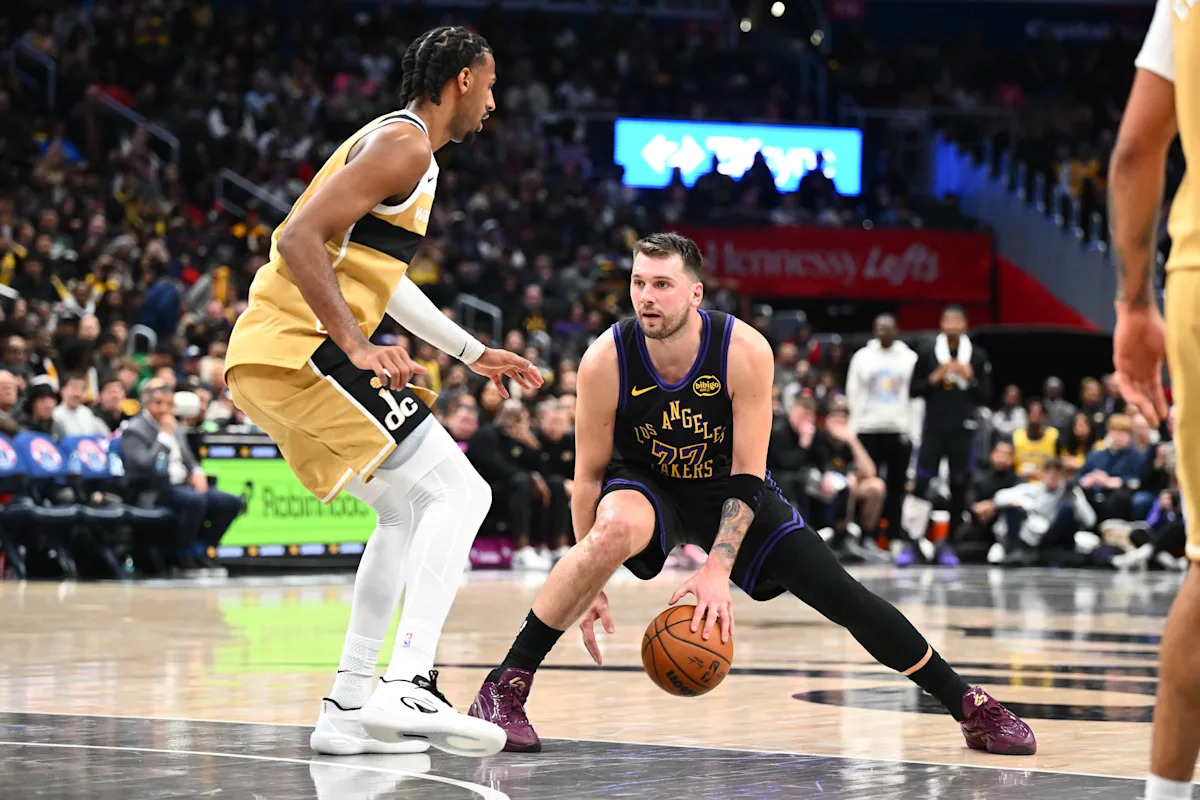
The Wizards took on the Los Angeles in the hostile road environment of…well…Washington, DC, and got stomped, 142-111.
If you’re a Wizards fan — and you probably are if you’re reading this — fire this game into the sun. Shoot into a memory hole. Nothing to see.
Advertisement
There’s stuff from this one the Wizards youngsters could probably learn. Maybe something about being mentally and physically prepared on the second night of a back-to-back. Perhaps some lessons about maintaining top physical condition and all-around fitness to sustain a long career. There were lessons about building skills, developing counters for when the defense stymies you, and learning the game so you can think a step or two ahead of your opponent. Possibly, something about staying humble when things have gone well recently (like a two-game winning streak).
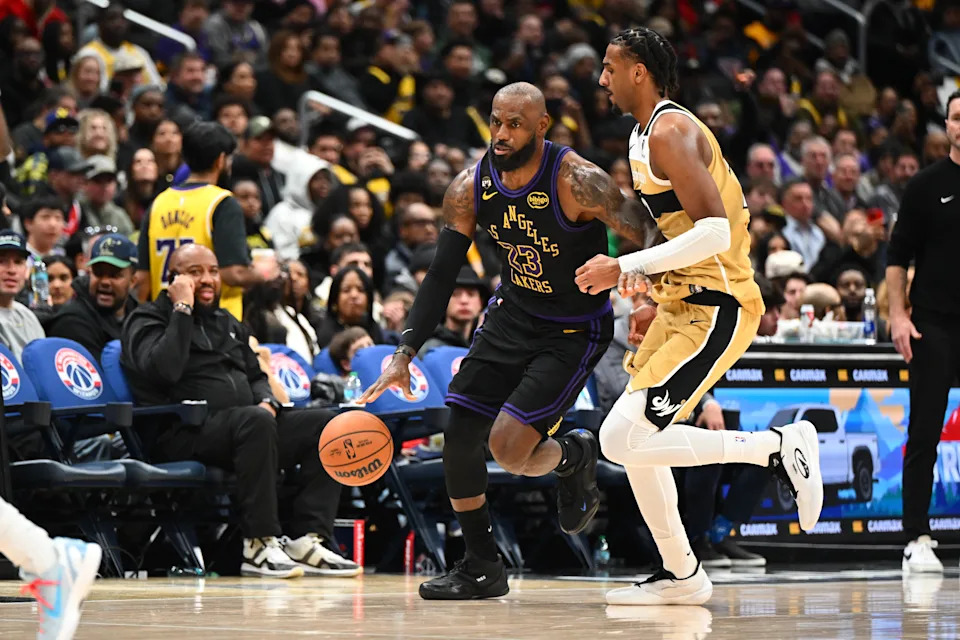
This wasn’t the play, but Lakers great LeBron James threw down a poster dunk on Wizards big man (and the NBA’s leading shot blocker) Alex Sarr. | Brad Mills-Imagn Images
Maybe.
For me, the biggest takeaway: fugetaboutit. Young players, bad game against a veteran team coming in hot after a bad loss of their own — a team playing for something and with something to prove.
Advertisement
If you were a DC-based Lakers fan and could get a ticket, you were likely entertained by the nine alley-oop dunks Los Angeles successfully executed against Washington defenders who kept getting so mesmerized by The Ball that they forgot to defend the big guy standing near the basket. (The Lakers had a 10th lob attempt that Deandre Ayton couldn’t convert. He ended up getting the offensive rebound and drawing a foul. He made the free throws.
Or they forgot to rotate when Alex Sarr went to help, which was a lot because no one in a Wizards uniform could keep a Lakers player in front of him.
Or they kinda pointed vaguely where a teammate should go while the teammate’s back was turned instead of verbally communicating, as players are taught to do.
If you’re keeping score at home, that’s 20 Lakers points on 10 lob attempts. Yikes,
Advertisement
This one was over quickly. The Lakers kicked the Wizards in the teeth in the first quarter, and continued kicking in the second. Washington trailed by 29 at the half, and the Lakers coasted in from there.
The only real drama was whether Luka Doncic would get a triple-double by halftime (he did) and whether the Lakers would ever stop dunking on Washington (they did, but only because time expired).
Thoughts & Observations
LeBron James is still pretty dang good. Last night, he converted a left-handed catch and dunk on a lob pass that I thought was too high for nearly anyone, much less a 41-year-old. He also threw down a driving dunk on Sarr after drawing him on a switch and clearing the court so he could attack.
Luka Doncic was outright clowning the Wizards, who were incapable of slowing him. He finished with 37 points, 11 rebounds, and 13 assists. His point total would likely have been higher if the refs had called the 5-6 clear fouls Washington committed that didn’t draw a whistle.
The Wizards had a positive scoring differential with only one player: Anthony Gill. Gill basically had the game of his career — 9 points on 4-5 shooting and 10 rebounds in just 17 minutes of action.
Washington’s poor defense made Ayton look like an all-time great. He finished with 28 points on 14 field goal attempts along with 13 rebounds, and 3 blocks.
Washington did the same favor for backup big man Jaxson Hayes, who scored 10 points on 5 field goal attempts.
At least The Puppy Race at halftime was entertaining. Bark Carrington came through with the come-from-behind win when the race’s early leader succumbed to an apparent case of ADHD inches from the finish line.
Four Factors
Below are the four factors that decide wins and losses in basketball — shooting (efg), rebounding (offensive rebounds), ball handling (turnovers), fouling (free throws made).
Advertisement
The four factors are measured by:
eFG% (effective field goal percentage, which accounts for the three-point shot)
OREB% (offensive rebound percentage)
TOV% (turnover percentage — turnovers divided by possessions)
FTM/FGA (free throws made divided by field goal attempts)
FOUR FACTORS
LAKERS
WIZARDS
LGAVG
eFG%
69.4%
52.5%
54.3%
OREB%
33.3%
32.7%
26.1%
TOV%
24.2%
16.7%
12.8%
FTM/FGA
0.282
0.071
0.209
PACE
107
99.5
ORTG
132
103
115.5
Stats & Metrics
PPA is my overall production metric, which credits players for things they do that help a team win (scoring, rebounding, playmaking, defending) and dings them for things that hurt (missed shots, turnovers, bad defense, fouls).
PPA is a per possession metric designed for larger data sets. In small sample sizes, the numbers can get weird. In PPA, 100 is average, higher is better and replacement level is 45. For a single game, replacement level isn’t much use, and I reiterate the caution about small samples sometimes producing weird results.
Advertisement
POSS is the number of possessions each player was on the floor in this game.
ORTG = offensive rating, which is points produced per individual possessions x 100. League average so far this season is 115.5. Points produced is not the same as points scored. It includes the value of assists and offensive rebounds, as well as sharing credit when receiving an assist.
USG = offensive usage rate. Average is 20%.
ORTG and USG are versions of stats created by former Wizards assistant coach Dean Oliver and modified by me. ORTG is an efficiency measure that accounts for the value of shooting, offensive rebounds, assists and turnovers. USG includes shooting from the floor and free throw line, offensive rebounds, assists and turnovers.
Advertisement
+PTS = “Plus Points” is a measure of the points gained or lost by each player based on their efficiency in this game compared to league average efficiency on the same number of possessions. A player with an offensive rating (points produced per possession x 100) of 100 who uses 20 possessions would produce 20 points. If the league average efficiency is 114, the league — on average — would produced 22.8 points in the same 20 possessions. So, the player in this hypothetical would have a +PTS score of -2.8.
Players are sorted by total production in the game.
WIZARDS
MIN
POSS
ORTG
USG
+PTS
PPA
+/-
Alex Sarr
28
63
124
21.1%
1.1
130
-30
Anthony Gill
17
38
155
16.7%
2.5
185
2
Will Riley
25
56
93
26.6%
-3.3
116
-5
Bub Carrington
25
57
102
26.9%
-2.1
102
-28
Malaki Branham
22
49
134
19.6%
1.8
113
-3
Justin Champagnie
24
53
138
10.7%
1.3
67
-27
Kyshawn George
27
61
96
26.7%
-3.1
46
-17
Jamir Watkins
35
78
78
14.6%
-4.2
15
-15
Bilal Coulibaly
24
54
74
18.1%
-4.1
-18
-22
Sharife Cooper
13
29
60
15.6%
-2.5
-65
-10
LAKERS
MIN
POSS
ORTG
USG
+PTS
PPA
+/-
Luka Doncic
31
68
135
40.0%
5.3
450
21
Deandre Ayton
29
65
174
23.7%
9.0
383
30
Jarred Vanderbilt
16
36
149
14.9%
1.8
265
7
LeBron James
30
66
109
26.4%
-1.2
134
25
Jaxson Hayes
14
30
178
17.0%
3.2
269
-3
Jake LaRavia
25
56
102
6.5%
-0.5
98
24
Gabe Vincent
18
41
134
10.4%
0.8
130
3
Rui Hachimura
18
40
129
20.1%
1.0
108
-2
Drew Timme
17
38
128
10.9%
0.5
31
17
Marcus Smart
27
59
71
11.1%
-2.9
1
21
Maxi Kleber
5
12
211
18.5%
2.2
416
4
Dalton Knecht
5
12
103
27.8%
-0.4
168
4
Bronny James
5
12
107
31.4%
-0.3
58
4