
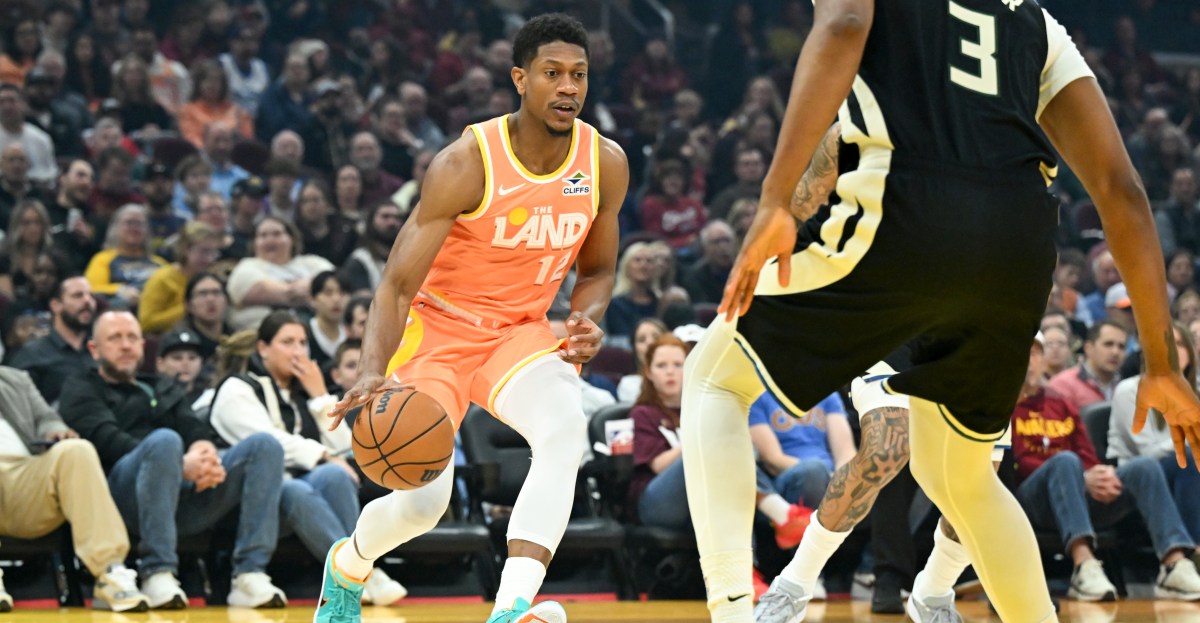
Welcome back to our trade candidate series! After analyzing a couple of guards the Bucks could pursue in Ja Morant and Malik Monk, we turn our attention back to a wing. Milwaukee won’t have to look far, as Cleveland has a wing who would fit: De’Andre Hunter.
De’Andre Hunter, 6’7”, 221 lbs. wing
Season averages: 13.8 PPG, 4.3 RPG, 2.1 APG, 0.6 SPG, 0.1 BPG, .420/.306/.879
The former no. 4 overall pick has had a rocky seven seasons. Traded on draft night to the Hawks as part of the deal that sent Anthony Davis to the Lakers, Hunter spent five and a half seasons in the ATL. Constant injuries limited him to playing in 61% of the possible games, including a torn meniscus in his sophomore season. Former GM Landry Fields opted to trade Hunter, who had two additional seasons at $48m remaining, to the Cavaliers at the trade deadline last season. In the deal, they received Caris LeVert, Georges Niang, and five draft picks (three second-round picks and two first-round pick swaps). Hunter played in 27 games for Cleveland, becoming a highly productive player. He averaged 14.3 PPG, 4.2 RPG, and 1.3 APG, shooting 48.5% from the field and 42.6% from beyond the arc. The Cavaliers went 20-7 in those contests, helping secure the no. 1 seed in the East. Even in that limited time, it helped propel Hunter to a fourth-place finish in Sixth Man of the Year voting.
2025–26 has been a much different barrel of fish, as our colleagues at Fear The Sword can attest. His shooting stats have fallen off a cliff: 49.8% effective field goal percentage (59.7% last season), 42% from the field, and 30.6% from three. His defense hasn’t been effective either, with a -5.6 net rating (22nd percentile among wings per Cleaning The Glass). The few bright spots for Hunter on either side of the ball have been his mid-range shooting and his playmaking. 36% of his shots have come in that area (89th), and he’s drilling them at a 49% rate (80th). His assist percentage (11.5 percent, 62nd) and APG (2.1) are at a career high.
Hunter is yet another player the Bucks have been connected to in rumors. Brett Siegel of ClutchPoints reported on Wednesday that Milwaukee had called Cleveland about Hunter, even offering up Kyle Kuzma as the centerpiece:
“Much of the same can be said about Hunter and the Cleveland Cavaliers. The Bucks have attempted to center their offer to Cleveland on Kyle Kuzma, sources said. Kuzma is not a player the Cavs hold interest in, nor would they be able to make anything work salary-wise since they are a second-apron team.”

The Cavs only make this deal if they’re saving a substantial amount of money without breaking up the core. To make it happen, I’m wrangling in the Nets to make it a three-team deal. In this shuffling of wings, Milwaukee acquires Hunter and Larry Nance Jr., Kuzma heads to Brooklyn and a 2027 second-round pick, and Cleveland gets Cam Thomas, Ziaire Williams, and Andre Jackson Jr.
As part of that same report from Siegel, the Cavs also don’t want to get less back than they sent out for Hunter in the first place:
“The Cavs have received plenty of interest from teams in both conferences regarding Hunter and have been hesitant to trade the 28-year-old wing. While it is believed that Cleveland’s front office is closely monitoring their cap situation and has explored ways to move out of the second apron, the Cavs have signaled that they don’t want to take back less value than they gave up for Hunter last season, especially with the need many teams have for a player of his skills.”
Thomas, while not a good fit with Donovan Mitchell or Darius Garland, would thrive in a bench role alongside Lonzo Ball. Williams offers Cleveland a less expensive wing option whose numbers are similar to Hunter’s. The former no. 10 overall pick is averaging 9.4 PPG, 2.4 RPG, shooting 40.5% from the field, 30% from three-point range, and 87.7% at the charity stripe. The Cavaliers have to send out Larry Nance Jr. to get back down to 15 players. Nance is expiring, so the Bucks don’t add any long-term money from him. Kuzma becomes an expiring contract next season for Brooklyn, who could either trade him or let his deal expire to create cap space. They add another second-round pick from the Cavs via the Nuggets, giving them 31 draft selections from 2026 to 2032.
Hunter is the best player in this deal, but the Cavs are saving $11.1m this season and $16.2m in 2026–27 by getting rid of him. Cleveland’s luxury tax bill is the league’s largest at $163.7m, a high price to pay for a team that hasn’t made a conference finals appearance in the Donovan Mitchell era. In this trade, the Cavs would save $55.6m on their projected tax bill this season. As for the tax aprons, they would still be over the second apron by $10.9m and would still be over it in 2026-27, but by $1.7m, less than their projected $17.9m. They could dip below it should they trade the expiring deals of Ball ($10m) or Max Strus ($16.6m), who have been injured or ineffective.
Despite the latest reporting about Giannis from Milwaukee’s favorite insider, I’m proceeding as if Giannis will be here long term. Hunter has a proven track record as an efficient shooter and would slide in nicely as the starting small forward. In non-Giannis minutes, the Bucks could play Hunter as a small-ball four next to Bobby Portis or Myles Turner at center. He could also be the secondary perimeter creator Milwaukee has been missing since they traded Khris Middleton away. Hunter’s usage is up to 21% this season (85th), the second-highest of his career. That’s in the same range as rookie Kon Knueppel (21.1%) and Zach LaVine (21.9%). Having another player who is often used to handling the ball can help relieve pressure on Giannis, who has the third-highest usage rate in the league (36.2%). Between the two calf injuries he’s had already, I’m not sure Giannis could sustain his level of play unless part of the load were taken off his shoulders.
Much like some of the other players, Hunter takes a high volume of catch-and-shoot three-pointers. This season, Hunter is averaging 4.0 attempts per game, which ranks 48th out of 208 qualified players. The percentage is down to 32.7% (156th), but he shot 40.7% last season (57th out of 217 qualified players). In this regard, he would be the Bucks’ replacement for what Taurean Prince did for them last year. I’m not saying that Prince is at the same level or better than Hunter, but Prince was a reliable shooter off the catch, hoisting up 3.3 3PA and shooting 49.8%.
Another area he could help the Bucks is in mid-range scoring. Milwaukee sits below league average in mid-range frequency at 29.1%. Bobby Portis has been the lead marksman from the mid-range area, hitting it at a 46% clip and averaging five attempts per game. Behind him are Kevin Porter Jr. (43%, 4.9 FGA), Ryan Rollins (40%, 3.9 FGA), and Kuzma (40%, 3.0 FGA). Giannis’ mid-range shooting has dropped off a cliff since last season. On 7.7 FGA, he was shooting 47%, and now he’s down to 4.0 FGA, converting a measly 28%. Hunter would be a more efficient mid-range shooter than Kuzma, with better on-ball skills to create his own shot. He can break down the defense from the perimeter, unlike BP, who takes mid-range fadeaway jumpers from the post. Even though KPJ can do it, Hunter is more refined in this area.
Do you believe that Hunter can get back on track in Milwaukee, or would you prefer someone else? Let us know in the comments below.