
By Dan Gelston
PHILADELPHIA — Joel Embiid had missed yet another game with an injury in a lost season where he struggled with his health and performance for the Sixers.
Paul George offered advice to Embiid last year on how to handle the grind of playing through so many injuries, insight from one All-Star to another on persevering when the bad days outweighed the good and it seemed only darkness loomed at the end of the tunnel.
“Drugs help me,” George said in late February 2025. “That’s kind of what gets me over the hump. I get it, especially how big he is, the size he is, and how he plays. I know it takes a toll on him.”
George already had acknowledged in the same month that he needed pain-killing injections to play through an array of injuries, notably tendon damage in his left pinkie.
A nine-time All-Star, he opened the window to the heart of what some athletes are willing to do to keep pushing, keep playing, no matter the hurt — even on the inside — to play the next game.
George’s tribulations piled up last season in the first year of a $212 million, four-year contract that sent championship expectation soaring. They cratered in a 24-win season, his first teaming with Embiid and Tyrese Maxey to form a Big Three All-Star trio.
His first season in Philly was marred by knee and adductor injuries that resulted in the forward having one of the worst years of his NBA career. Perhaps worse, George was so stressed from wildfires that the Los Angeles-area native acknowledged he could not sleep as he thought of friends who lost their homes and was consumed by fear that his own family home could have been lost in the disaster.
“Can’t get any worse than last year,” George said in September ahead of training camp. “That was a rock-bottom type of season.”
The hole only got deeper.
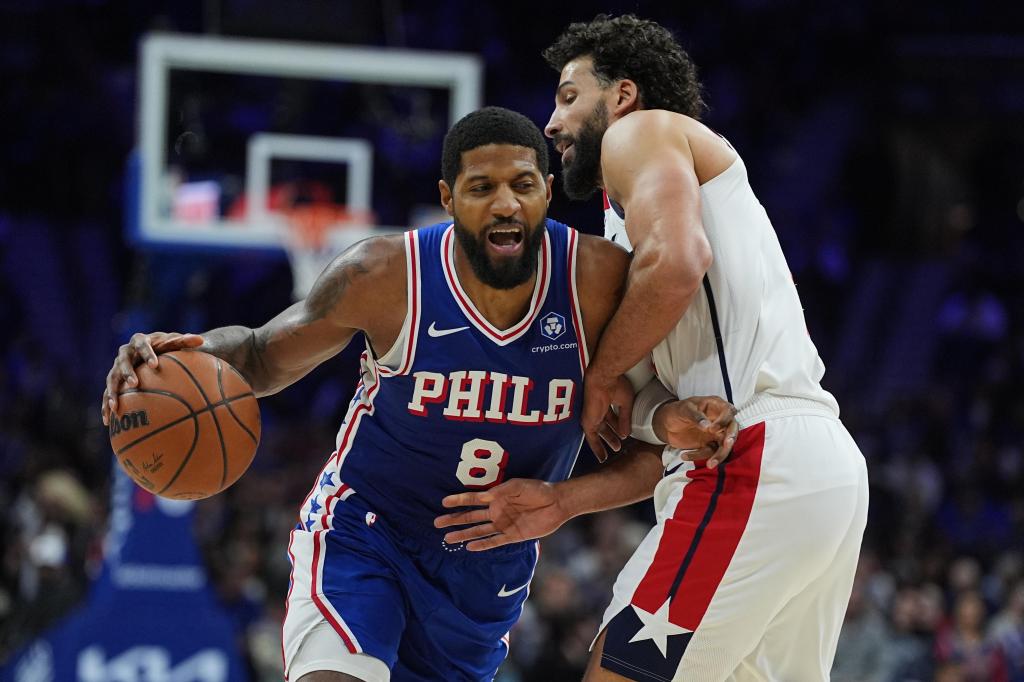
George was walloped Saturday with a 25-game suspension for violating the terms of the NBA’s anti-drug program. The league did not disclose the nature of the violation or the substance involved, and George released a statement to ESPN saying that in dealing with an unspecified mental health issue, he took something that was “improper.”
The suspension will cost George roughly $11.7 million of his $51.7 million salary. The final bill on what his absence will cost the Sixers will come at the end of a surprising season for the perpetually maddening Sixers.
George had averaged 16 points in 27 games, that scoring average third-highest behind Maxey and Embiid. He had one of his best games of the season in a 32-point outburst fueled by nine 3-pointers against Milwaukee Tuesday.
With George playing serviceable minutes, the 76ers returned to a familiar holding pattern, much as they’ve been in most of the last 25 years: tantalizingly talented and good enough in spurts to spark musings of what a long playoff run could be, yet injured, and not deep enough to truly get excited about championship prospects.
“I think he’s done well with what we’ve needed him to do, but there’s been a lot of unfortunate things,” coach Nick Nurse said. “Injuries, obviously. The team’s whole situation last year. Obviously, a couple injuries early this year coming out of some stuff, so it’s been unfortunate, but it’s where we are.”
Stuck.
George was absent Saturday night as the franchise celebrated the 25th anniversary of Allen Iverson and the 76ers’ improbable run to the 2001 NBA Finals. Iverson was in the house with many of the featured players and architects of the conference champions, like former team president Pat Croce and general manager Billy King.
The old-timers swapped stories of a run that ended against Kobe, Shaq and the Los Angeles Lakers, and the big-screen highlights of Iverson rekindled memories of a time when the undersized guard with the supersized heart was a perfect match for a city that prizes authenticity and hustle as much as production.
Yet the throwback night was a jarring reminder of how far the Sixers had receded in NBA relevance. OK, 25 years from a last championship appearance isn’t great for any franchise, nor is 43 years from their last title. But 2001 was also the last year the Sixers advanced out of the second round of the playoffs.
The second round!
The Sixers wasted the final seasons of Iverson’s tenure. They’ve churned through hired guns like Chris Webber and James Harden and Jimmy Butler. They quit too early on prospects and future core players on other championship teams like Andre Iguodala and Jrue Holiday. The ill-fated Process — a deliberate attempt at shredding talent to tank for a horde of assets and a lengthy rebuild — yielded Embiid and a trail of wasted draft picks: Ben Simmons, Markelle Fultz, Jahlil Okafor.
Maxey was a sleeper hit as the No. 21 overall pick in the 2020 draft. A strong rookie season from No. 3 overall draft pick VJ Edgecombe, and a return to form for Embiid — he dropped 40 points against New Orleans, the first time he’s hit that total in the regular season since his franchise-record 70 in January 2024 — had raised the prospects that maybe this could be a season where the Sixers hit it big.
Maybe the Sixers still can if they can tread water and stay healthy until George is eligible to return with 10 games left in the season.
King, who ran the 76ers until 2007 and later worked as GM of the Brooklyn Nets, eventually returned for a stint on Philadelphia sports talk radio. He has followed the Sixers through every splashy signing and draft-pick bust and said the failure to duplicate the 2001 run had an easy explanation: It’s hard to win in the NBA.
“You’ve got to get lucky, you’ve got to be healthy,” King said. “But it is hard. After that run, trying to put it back together, I sat in that seat, it’s hard to duplicate it. But you’ve really got to get lucky.”
The 76ers may have used up their luck when Iverson stepped over Tyronn Lue in Game 1 of the ‘01 Finals and stepped into 25 years of bad luck and — as George was only the latest to show — bad decisions the franchise just can’t shake.