
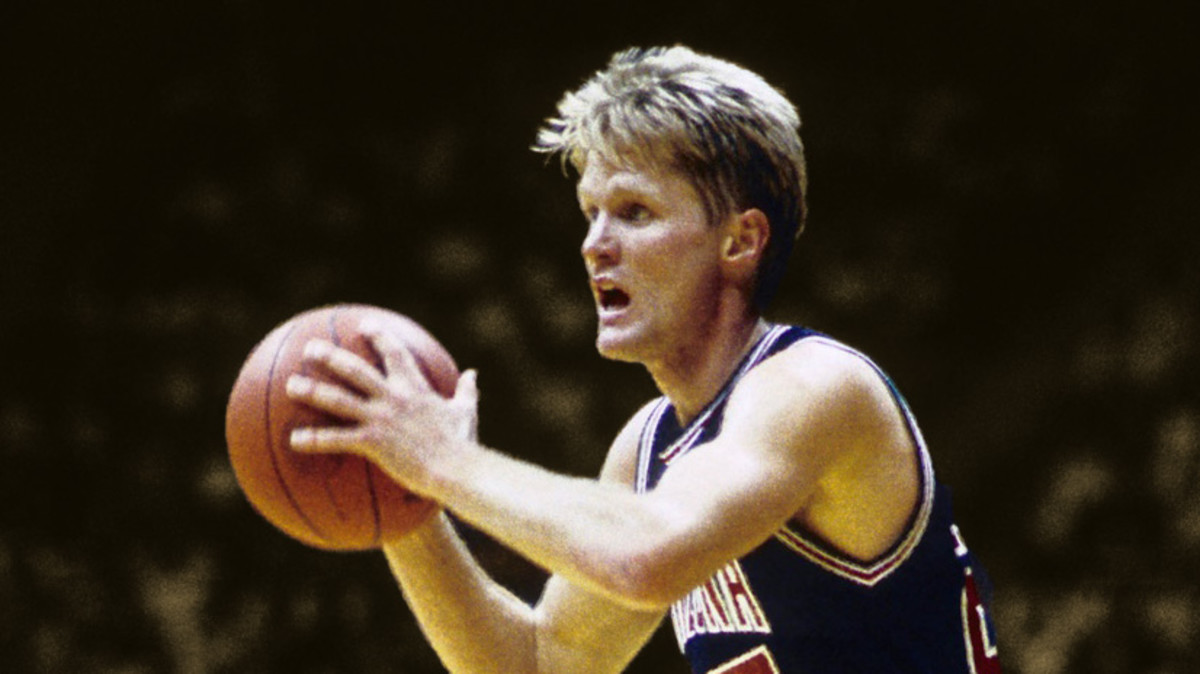
Sticking in the NBA as a fringe player takes more than luck; you need one elite skill and a team that knows how to use it. Luckily for Steve Kerr, he had both. He was an elite shooter and stumbled into a system built to take advantage of it.
“My career was in trouble after my fifth, maybe fourth year,” recalled the multi-titled Golden State Warriors head coach on the Tom Tolbert Show. “Fourth year, I think, when I got traded to Orlando, barely played after a few years in Cleveland, Phoenix. So, nobody called me, a free agent, and Chicago called and said, ‘Hey, do you wanna go to camp, non-guaranteed?’ I said, ‘Hell, yeah!”
Advertisement
Picked 50th overall in the 1988 NBA Draft, Kerr’s career was truly hanging in the balance after a few uneventful years. The season he got traded from Cleveland to Orlando, the University of Arizona product played less than 10 minutes a night, averaging 2.6 points and 1.3 assists. Even the skill Steve was known for, elite three-point shooting, was a mess, as he shot only 23 percent from downtown that year.
Perfect fit
When the Chicago Bulls called to check out Kerr, they were also in the middle of something. They just won three straight titles, but Michael Jordan was on his way out to pursue baseball. With John Paxson battling injuries and “His Airness” gone, Chicago’s guard rotation was suddenly messed up.
Nonetheless, Steve impressed the Bulls’ front office so much that they upgraded his non-guaranteed deal to a four-year, $2.9 million contract. For Kerr, besides the fact that beggars can’t be choosers, playing alongside and learning from Paxson and a champion organization was too much to pass up.
Advertisement
“I watched John Paxson play for years, and I loved the Triangle; I loved the way Paxson played. I thought that’s kinda my style of offense, so I jumped at it,” Kerr said.
As Kerr pointed out, the “Triangle Offense” was the only system that could hide his weaknesses. He was not necessarily a ball-handling point guard nor a volume-scoring 2-guard. Phil Jackson‘s system did not require Steve to bring the ball up every single time, and he was not asked to be a scorer.
“The Triangle just provided me with the protection I needed in terms of getting hounded by point guards up and down the floor because it was a two-guard front offense,” the NBA’s all-time leader in three-point percentage stated.
Within the confines of the “Triangle,” Kerr flourished. In his first season, Steve played the most games (82) and minutes (24.8) of his career up to that point. He was considered for Sixth Man of the Year honors, averaging 8.6 points and 2.6 dimes and connecting on almost 42 percent of his downtown tries.
Advertisement
Building a reputation
Kerr arrived in Chicago with little fanfare but quickly proved he belonged. The nine-time champ became known for his reliable shooting, smart decision-making, and calm presence in tight moments. Between 1996 and 1998, he helped the Bulls win three championships, offering steady playmaking and timely shooting to support a team built to compete at the highest level. Steve’s game fit perfectly alongside stars who demanded attention, which gave him the space to thrive.
Those seasons changed the direction of his career. The Bulls allowed Kerr to show what he could be, and Steve turned that opportunity into a strong NBA resume. Thanks to Chicago, the Arizona product built the reputation that would carry him well beyond his playing days.