
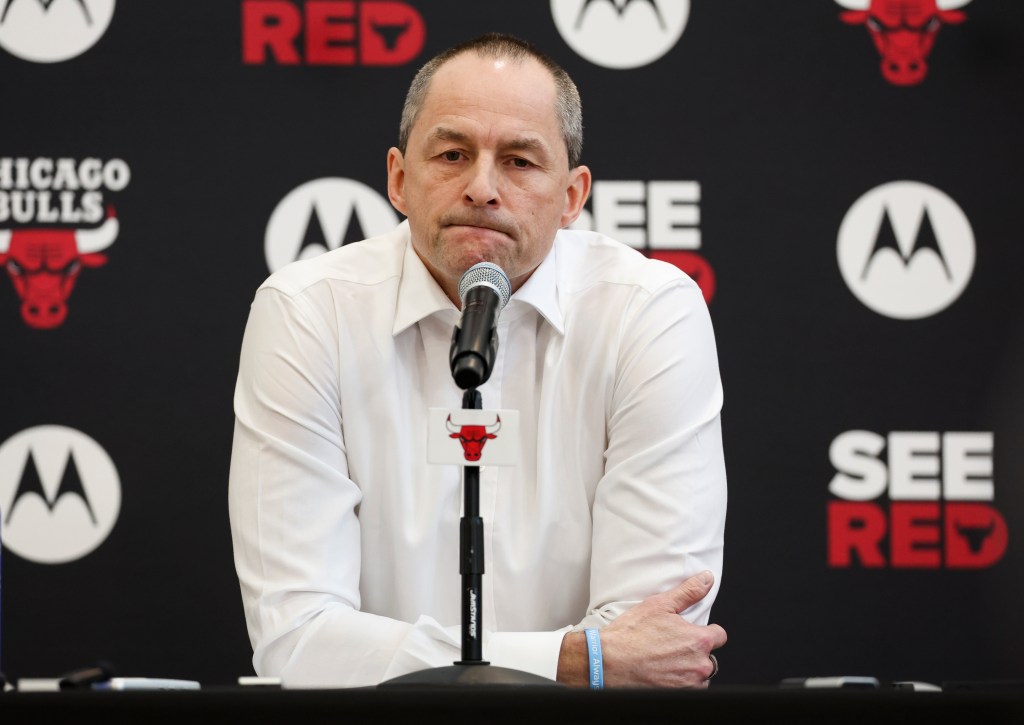
MILWAUKEE — The Chicago Bulls might be bracing for a nose dive.
After years of relative reticence at the NBA trade deadline, executive vice president of basketball operations Artūras Karnišovas came into this week swinging. The Bulls pulled the trigger on three trades between Saturday and Tuesday, picking up two second-round draft picks and three new guards while parting ways with center Nikola Vučević and Kevin Huerter.
Bulls fans aren’t quite accustomed to this much deadline action. And looking at the current state of the roster might evoke an automatic reaction: “What the hell?” But for the Bulls front office, there’s a purpose to the strangeness.
The Bulls entered this crucial trade window with eight expiring contracts on their books. Only a few of those players — Ayo Dosunmu and Coby White — were considered serious candidates for re-signing or extension. Essentially, the Bulls carry a wealth of cap space with the ability to take on money from other teams while reaping as much value as possible from players who were already on their way out.
There are two ways to use this type of positioning at the deadline. The most straightforward approach is to ship off expiring players for second-round picks or comparable players set to become restricted free agents, such as acquiring Jalen Duren from Detroit. But the other approach is more subtle: offloading genuinely productive players to prevent the Bulls from winning just enough games to squeak into the play-in tournament
Tanking does not happen by demanding coaches or players to lose games on purpose. There may be a scant handful of examples of this strategy being applied in other markets, but in Chicago, it’s always been clear that this burden can’t be placed on the men actually playing the game. These players care. Coach Billy Donovan cares. None of them want to lose, even if it clearly — and logically — helps the team in the long term.
Executives are the ones who tank teams. They do so by trading the right players at the right time to ensure a team’s competitiveness dips low enough to guarantee losses. And Karnišovas appeared to pull that lever on Tuesday, moving two Bulls anchors to create a talent vacuum in the roster.
Heading into this week, the front office felt more willing at this deadline than in prior seasons to make the type of “losing moves” that could ultimately benefit the Bulls in the draft. This marks a significant shift away from the team’s prior strategy for midseason roster management, embracing pragmatism to take a step (however small) backward with the intention of long-term improvement.
This is not the type of thing that can be done halfway. If the Bulls don’t complete their intended moves this week — which could include offloading Dosunmu and/or White — they could end up in the unfortunate purgatory of being pretty bad. Pretty bad teams are essentially unwatchable, but still not quite abysmal enough to drop out of the play-in tournament and secure a top eight (or top four) draft pick. Pretty bad is the stuff that mires a team in mediocrity. Pretty bad is the mindkiller.
As underwhelming as this season has been, the Bulls are still stuck in the pretty bad sector of the league. But with Karnišovas’s work this week, their season is beginning to trend in the right direction.
 A fan cheers to get on the big screen in the third quarter during a game between the Bulls and 76ers on Dec. 26, 2025, at the United Center. (Dominic Di Palermo/Chicago Tribune)
With Tuesday’s dismal loss to the Milwaukee Bucks, the 24-27 Bulls fell to 10th place in the Eastern Conference. The Charlotte Hornets are only one game behind with a full head of steam to push for play-in position — a challenger the Bulls should embrace with open arms.
The Bulls have also sunk to the 13th-worst overall record in the NBA. That makes them bad, but not bad enough. In their current standings as the second-to-last team in the lottery, the Bulls hold only a 4.8% chance at landing a top-four pick in the draft (and only 1% odds of landing the No. 1). But they still stand only 3.5 games ahead of teams like Milwaukee and Memphis, who are tied for eighth-worst in the league.
Closing the gap on those teams would boost the Bulls’ odds of picking in the top four up above 20%. The Bulls might never catch up to true tankers like the Brooklyn Nets and Washington Wizards, but there’s still plenty of value in improving their odds by losing a handful more games than expected.
There’s a reason tanking isn’t popular. Losing isn’t fun. Rooting for a team to lose is even less fun. It’s painful even when it’s on purpose. And ultimately, this tactic still all comes down to luck, a fact that teams like the Utah Jazz have cursed after years of failed tank jobs.
The good news for the Bulls is that this version of losing doesn’t have to last long. That’s the whole point of using expiring contract acquisitions to force a late-season collapse. The Bulls have not hindered themselves with any bad money deals that will last after this year. In the summer, they will be open for business to embark on another round of trades and free-agent pitches to build on that younger timeline. And with a little lottery luck, this team could be on track to actually resemble a youth-focused rebuild rather than cycling through mini “re-tooling” projects ad nauseam.
Most importantly, for the first time in a long time, the Bulls finally have a burst of momentum that actually matches the stated goals of the front office.
But first, Karnišovas has to finish the job. Start counting down the seconds to 2 p.m. Thursday.