
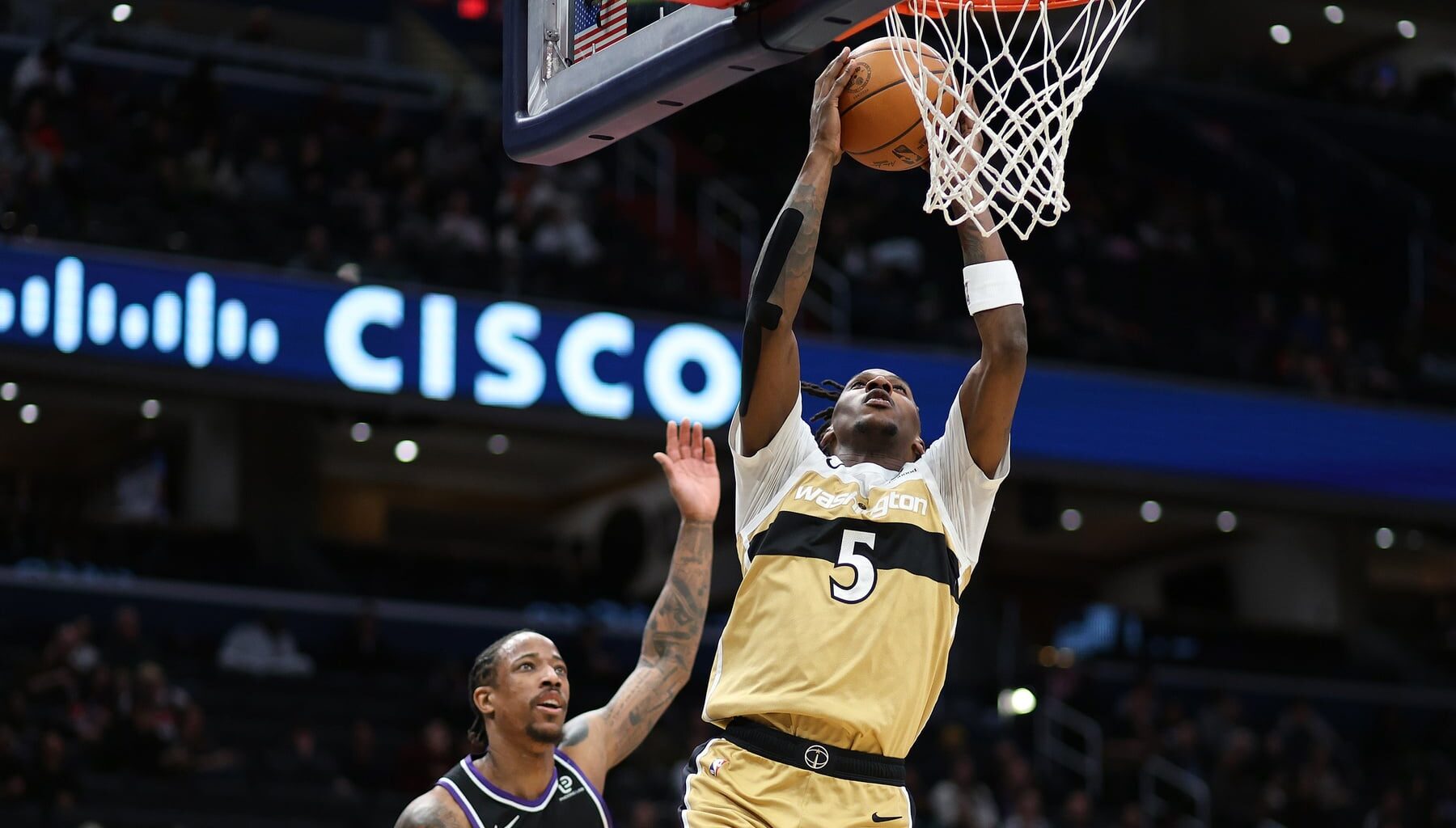
The Washington Wizards made two crucial decisions for their franchise’s future during the 2025 NBA Draft. The first (and obvious one) was drafting Tre Johnson with the sixth overall pick. The second decision was trading Walter Clayton Jr for Will Riley and the Utah Jazz’s second-round pick. Now, in February of their rookie years, Johnson is balling, Riley looks to be a solid bench piece, and that second-round selection could become a very formidable backcourt stopper, and his name is Jamir Watkins.
Wizards Second-Round Rookie Is Battling For Long-Term Role
Watkins is currently on a two-way contract with the Wizards, spending time in the G-League and with the main roster. However, with his recent play with Washington, he’s certainly put the front office on notice. Two important questions arise: Can Watkins continue to provide this level of impact? If so, can he be a real long-term option in Washington?
Watkins’ Impact
While Watkins is only averaging 3.8 points on rather horrid shooting throughout his 23 appearances with the Wizards this season, his primary impact is on the other end of the floor. The second-round pick has ten steals over the last five games, with four blocks in that same span. He has the third-lowest defensive rating on the team and the sixth-highest defensive win shares.
He’s extremely athletic and provides Washington with a great backcourt stopper against some of the opponents’ primary scoring options. In the backcourt, especially with Trae Young potentially returning soon, Watkins will be able to provide the only real defensive impact at the guard slots. Surrounded by offensive playmakers and scorers, Watkins would excel as the primary defensive guard in the next era of the team.
He’s been dominant on that side of the floor, but his offense needs a real tune-up if he plans on sticking around D.C.
Watkins’ Shortcomings
While a unit on defense, his offense is the complete opposite. With the Capital City Go-Go, Washington’s G-League affiliate, Watkins is shooting 41.7% from the field along with 33.3% from behind the arc. Those numbers aren’t bad when considering he shoots around 12 shots per outing. However, switch jerseys, and there is a completely different story.
In the NBA, Watkins is shooting 39% from the field and just 23.3% from three. Even with just above three shots per game, defenses understand why Watkins is on the court. It’s not for his shooting ability, it’s for his production on the other end of the floor. That being said, there is a bright spot that the Wizards should take into consideration.
Much is the case with a vast majority of second-rounders; they need real time to develop their games. Most 30-60 selections in any NBA draft find themselves without a team after a few months and stay in the G-League, or are completely ostracized from stateside professional basketball. They end up playing overseas or training for years, trying to claw their way back to the league.
However, when a second-round pick does pan out, it can be legendary. Watkins’ teammate, Khris Middleton, was the 39th overall pick in the 2012 NBA Draft, and is now a three-time NBA All-Star and the Milwaukee Bucks’ franchise leader in three pointers. There are multiple players—Jalen Brunson, Nikola Jokic, and Draymond Green—who are major contributors to their franchises. All three of these players were drafted in the second round, and there are plenty more around the league.
Watkins may not hit that level; however, those three have proven that the second round can be extremely worthwhile. With some extra research, the second round can be as rewarding as the lottery.
The Last Word
Most people didn’t expect Watkins to play much this season, but his impact hasn’t gone unnoticed. He’s an excellent defender and should be battling for a real role on the final iteration of the Wizards’ future roster. His offensive game does need great improvement, but a second-rounder isn’t drafted based on what they can do now; it’s all about their potential to get better.
© Daniel Kucin Jr.-Imagn Images