
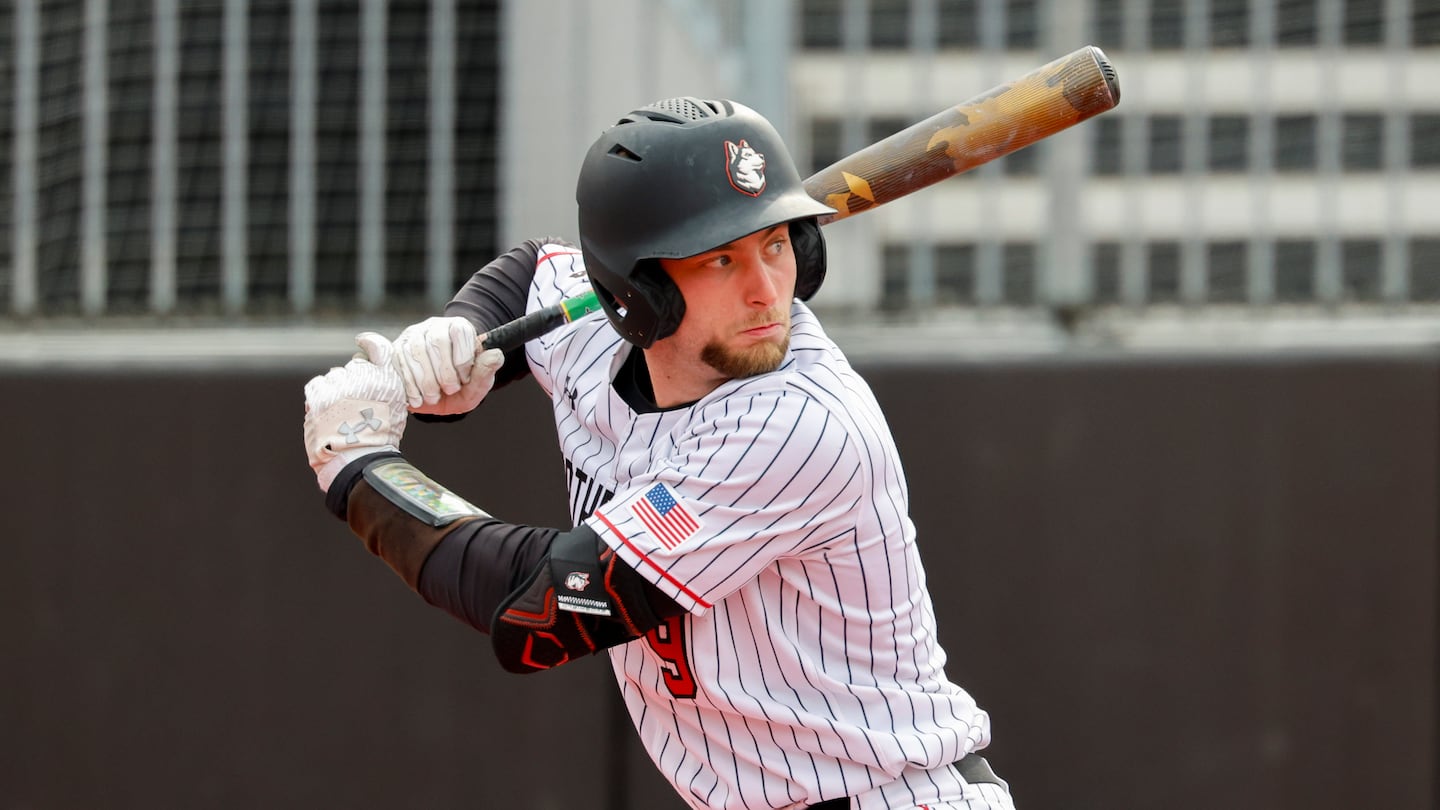
“I think it’s just all excitement,” said Northeastern’s Mike Glavine, who was named CAA Coach of the Year last week for the fifth time. “That’s the beautiful thing about the regionals, you’re probably going to run into somebody that’s highly ranked, tough to beat … It’s just going to be a great challenge. I think overall, the overwhelming feeling is just excitement.”
Get Starting Point
A guide through the most important stories of the morning, delivered Monday through Friday.
Holy Cross, Rhode Island, Fairfield, and Central Connecticut State are also representing New England in the 64-team field, but its Northeastern that has shown the potential to make a serious run.
The Huskies have dominated behind an elite three-man rotation of Massachusetts natives: Hamilton’s Will Jones, Acton’s Jordan Gottesman, and Lynn’s Aiven Cabral. Northeastern has posted the nation’s best ERA (2.92) and WHIP (1.04), each by a wide margin, and its 17 shutouts are as many as the next two best teams combined.
Jones has been the ace in a stunning breakout season for the lefthander, a campaign that has seen his 5.23 ERA in 2024 drop to a miniscule 1.82, second-best in the country.
With the stakes raised, Glavine isn’t messing with the formula.
“I think that’ll be the biggest thing: not changing [anything],” he said. “We’ve changed in the past, haven’t had success in the regionals for all kinds of reasons — probably all mostly my fault — because of changing and doing things differently. Will Jones will pitch Game 1, he’s pitched Game 1 for us all year, and then we’ll go from there.”
The NCAA regionals haven’t been kind to Northeastern, which has lost all six of its games there under Glavine dating to 2018, including unsuccessful runs in 2021 and ’23.
But when you combine the Huskies’ elite pitching with a lineup that scored a conference-leading 7.6 runs per game — anchored by CAA Co-Player of the Year Harrison Feinberg (.379/.465/.593; 18 HRs, 66 RBIs, 36 SBs) — you’ve got a team prepared to compete with the big guns on the national stage.
“[In 2021 and 2023] I felt confident going into it, and we were just sort of ran out of gas,” Glavine said. “This year presents a different feeling of confidence and so I feel, standing here, this is the most confident team we’ve had going into a regional.
“Like, why not us? Why can’t we do this? Why can’t we come out of this regional? There’s no reason why we can’t.”
Holy Cross (31-25) faces North Carolina in Chapel Hill, N.C., on Friday at noon. This is the Crusaders’ first NCAA bid since 2017.
Rhode Island (38-20) is the third seed in the LSU regional and will play Dallas Baptist on Friday (7:30 p.m.) at Baton Rouge, La. This is Rhode Island’s third NCAA appearance, and the first since 2016.
Fairfield plays Coastal Carolina on Friday in Conway, S.C. (6 p.m.). Central Connecticut State takes on Auburn on Friday in Auburn, Ala. (7 p.m.)
Commodores sit atop field
Vanderbilt, which gave up just three runs over three games in the SEC Tournament, was awarded the No. 1 overall seed and was among a record 13 teams from the conference to be selected to the 64-team field.
The tournament opens Friday with 16 double-elimination regionals. Winners advance to eight best-of-three super regionals. Those winners move on to the College World Series in Omaha beginning June 13.
Vanderbilt has won eight straight games and 13 of its past 16 to earn the No. 1 seed for the second time, and first since 2007. The Commodores, who play Wright State in the opener of the Nashville Regional, are in the tournament for the 19th straight time for the longest active streak.
The national seeds following Vanderbilt (42-16) are Texas (42-12), Arkansas (43-13), Auburn (38-18), North Carolina (42-12), LSU (43-14), Georgia (42-15), and Oregon State (41-12-1). Those eight teams would be in line to host super regionals if they win their regionals.
Seeds Nos. 9 through 16: Florida State (38-14), Mississippi (40-19), Clemson (44-16), Oregon (42-14), Coastal Carolina (48-11), Tennessee (43-16), UCLA (42-16) and Southern Mississippi (44-14).
The last four teams to get at-large bids, in alphabetical order, were Arizona State, Kansas State, Oklahoma State, and Southern California.
Peter Abraham of the Globe staff contributed to this report. Material from the Associated Press was used in this report.
Amin Touri can be reached at amin.touri@globe.com.