
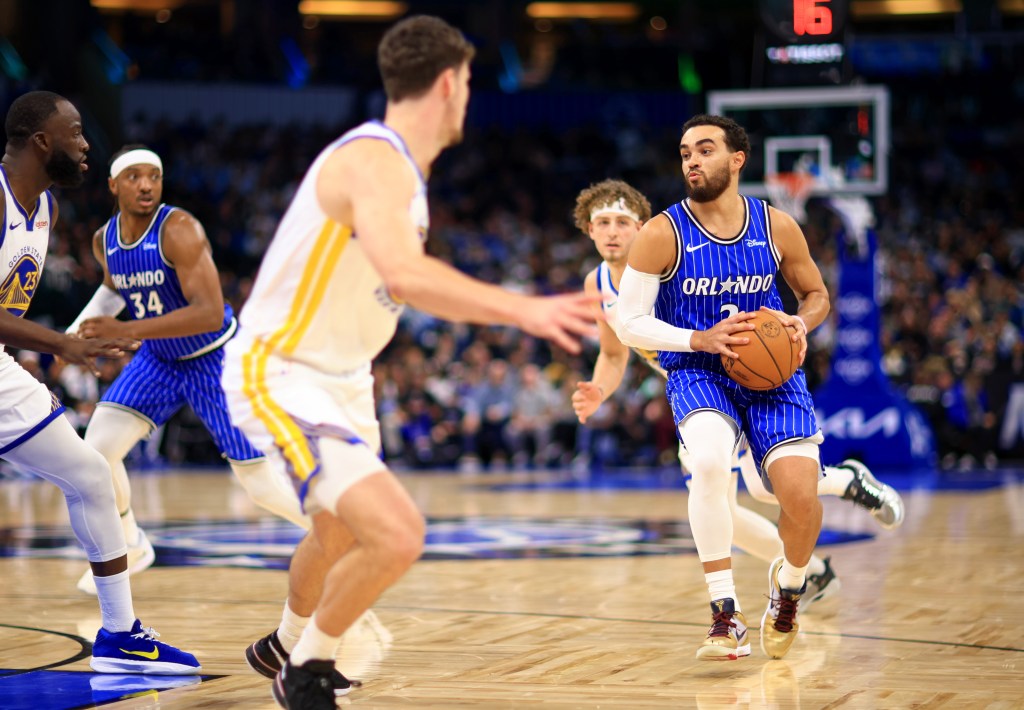
The Magic traded veteran guard Tyus Jones and two second-round picks to the Charlotte Hornets for cash considerations, the Orlando Sentinel confirmed on Wednesday night.
By trading Jones, Orlando moves the 1-year, $7 million contract he signed with the franchise in the offseason and gets underneath the NBA luxury tax threshold.
ESPN first reported the trade and the team officially announced it late Wednesday night.
The second-round picks going from Orlando to Charlotte are the 2027 least favorable of Orlando’s and Boston’s second-round picks and Orlando’s 2028 second-round pick, a league source told the Sentinel.
The Magic were set to hit Thursday’s 3 p.m. trade deadline roughly $5.6 million over the tax and they’re now $1.4 million below it. Orlando’s salaries entering this season totaled $193,471,232, slightly above the $187,895,000 luxury tax line. The team’s new total sits at $186,471,232 following the trade.
Getting below the tax not only helps the Magic this season but also in the future.
Avoiding paying the tax for this season delays when the Magic could get hit with the repeater tax, which applies to teams that have been above the league’s tax line for at least three of the previous four seasons. Teams that pay the repeater face a significantly higher tax rate, especially as they spend more into the tax.
The move also creates an extra standard contract roster spot for the Magic to fill. The team has had one standard contract spot open all season but wasn’t allowed to begin consider filling it until early January when a prorated contract for the rest of the season would still keep Orlando below the league’s first apron.
When Orlando signed Jones over the summer, it used a portion of the non-taxpayer-mid-level-exception, which triggered the first apron hard-cap, a salary constraint set at $195,945,000 by the collective bargaining agreement. By adding newcomers Jones, Desmond Bane, first-round pick Jase Richardson and second-round Noah Penda, Orlando’s total payroll rose to $194,704,322, a number that includes an unlikely bonus to be earned by Bane.
With the Magic only $1,240,678 under the first apron hard-cap entering the season, they didn’t have enough room to even sign a veteran minimum player until later in the season when a salary could be prorated.
When the team added Jones in free agency, Orlando had hoped it was adding a veteran point guard who could help offensively stabilize its second unit following the departure of previous backup point guard Cole Anthony (who was traded to Memphis as part of the Bane trade and later signed with the Bucks after a buyout with Memphis).
Jones, however, failed to provide a scoring burst off the bench. Although he continued to take care of the basketball, he averaged 3 points, 2.4 assists and 1.1 rebounds during 15.7 minutes per night across 48 games, eight of which he started.
A career 37.3% shooter from 3-point range, Jones shot 29.4% from distance this season in Orlando.
The Magic now have work to do to fill out its pair of open roster spots, something they could accomplish via trade ahead of Thursday’s deadline or in the buyout market. The final day a player can be waived by one team and remain eligible to play in the postseason for another is March 1.
With just 13 standard contract players rostered, the Magic will have to sign at least one player to a standard contract in the next two weeks. Teams can only stay under 14 players for 14 straight days at a time and up to 28 days total during the regular season, according to the CBA.
Moving Jones also opens the door for Richardson to see the floor on a more consistent basis.
Jason Beede can be reached at jbeede@orlandosentinel.com