
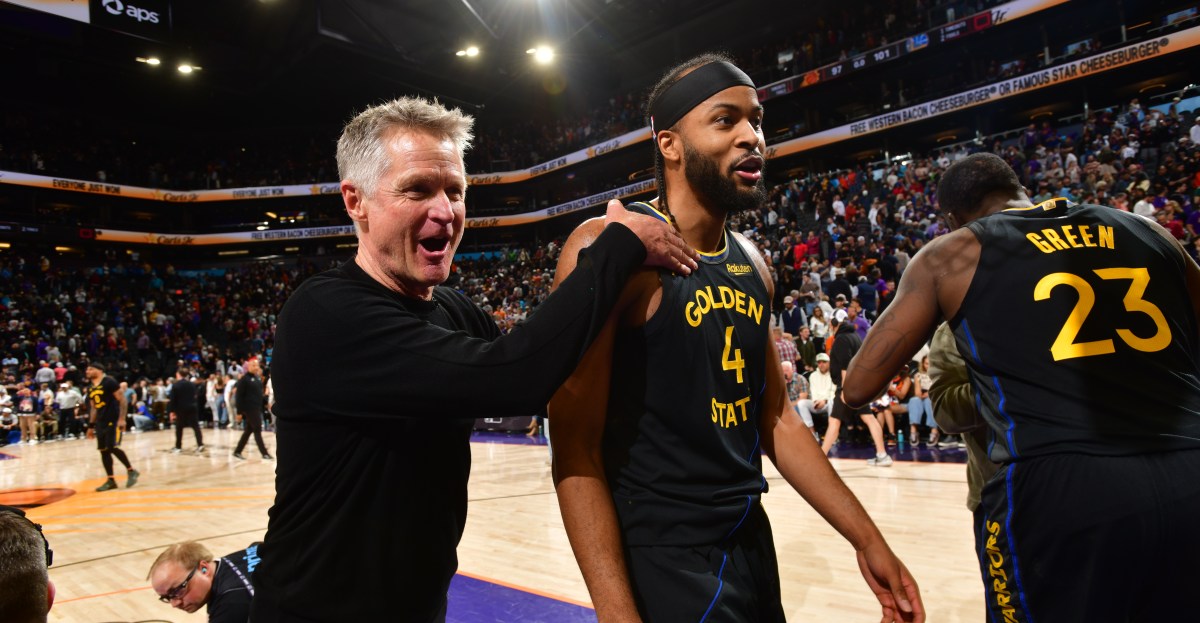
The Golden State Warriors played their token post-trade deadline game on Thursday night, tipping off against the Phoenix Suns just seven hours after the deadline ended, and less than 24 hours after trading away Jonathan Kuminga, Buddy Hield, and Trayce Jackson-Davis, while receiving Kristaps Porziņģis and a second-round pick.
It’s always interesting to see how a team will do post-deadline or post-deal. You might recall last year’s game, where the team, openly emotional after trading Andrew Wiggins right before tip-off, brought the energy of a funeral to a loss against the lottery-bound Utah Jazz.
This Thursday was different. Sure, the Warriors had sent off three players who were loved and respected in the locker room. But in the grand scheme of things, it was a quieter deadline than it had the potential to be, and that was on display with how the Warriors played.
Draymond Green, who had been on the trading block for the first time in his career, knew that his historic run with the Warriors would continue. Brandin Podziemski, Moses Moody, De’Anthony Melton, Quinten Post, Al Horford, and Gary Payton II, who had seen their names floated in rumors and hypothetical deals, knew that this was still their home for the foreseeable future. Gui Santos and Will Richard, seeing that the team had not gone all-in, could trust that they would get steady developmental minutes going forward. And Pat Spencer, playing in his final game of eligibility on a two-way contract, was aware that both cap space and roster space had been created that would allow him to sign a guaranteed deal for the rest of the year.
And so the Warriors that took the court were not tense, nervous, or sad. They were free, joyful, and energized.
The task in front of them was difficult, however. The Suns have been one of the best teams in the NBA over the last month or so and are fully clicking: even with Devin Booker sidelined, they were heavy favorites against a Warriors team that is still playing without Steph Curry (and was quite shorthanded after trading three players, while Porziņģis is not yet with the team).
With only two centers at his disposal, Steve Kerr opted to open the game with a small ball lineup, starting the quintet of Melton, Spencer, Moody, Santos, and Green. Immediately that small lineup issued a warning sign, when Phoenix’s burly center, Mark Williams, climbed over Green for an offensive rebound on the first possession of the game. A crab dribble, a drop step, and a jump hook later, and the Suns were on the board with size and might that Golden State would be hard pressed to match up with.
But the Dubs used their lack of size to their advantage, with a perimeter-oriented attack that was almost comical. Half out of an inability to penetrate, and half a result of getting good looks, the Warriors first eight shots were all from three-point range. They made four of them, prompting an early Phoenix timeout and a 12-9 Golden State advantage.
The Warriors were giving Phoenix fits on the other end of the court, but it mostly didn’t matter. Because of the size advantage, the Suns were content to miss shots, knowing they’d simply get more; eight of their first 14 points came on second-chance opportunities, and they fueled a 10-2 run that gave Phoenix control of the game, and forced a Kerr timeout.
When the timeout ended, Kerr had put Santos back in the lineup, and he rewarded the decision by immediately draining a three, and setting to work doing everything on defense, the glass, and in loose-ball situations.
And still, the Warriors stayed behind the three-point line. A hilarious 19 of their first 20 shots came from distance, as the game started to resemble a three-point contest. Despite their contrasting styles, neither team could gain separation, and the Suns led 29-25 after the first quarter.
It wasn’t always a pretty defensive game, but it sure was early in the second quarter, as the Warriors absolutely put the clamps on the Suns. Their defense created looks for their offense, and Golden State ran off a 12-2 run to open the quarter as they started to take control of the game. They were still living almost entirely on threes, but with renewed defense — and a leap in rebounding effort and ability — they were starting to look good. Some of that improvement on rebounding came the way you would expect it: despite Kerr starting the game with no centers, he toyed in the second quarter with a two-center lineup, inserting both Post and Horford into the game as the Warriors started to equalize in the paint.
At halftime, the Warriors led 59-55, and had attempted 37 threes … and just one free throw. In that regard, the game was looking a lot like Tuesday’s blowout loss to the Philadelphia 76ers … but in almost every other regard, it was a much nicer game.
Except for one. In that game against Philly, the Warriors had played it close in the first half, and fallen apart in the second half. That, unfortunately, started to be the case for the Warriors against the Suns, too. Unlike against the Sixers, it wasn’t a case of energy or effort. Kerr ripped his team after Tuesday’s loss, criticizing their lack of heart — an understandable void, given the looming deadline.
But free and fearless on Thursday, the Warriors played with excellent energy, though in the second half it appeared, for a while, as though it wouldn’t matter. But before the bad, the good: the Warriors came firing out of the gates, simply bringing more energy than their counterparts, and pushing the lead to double-digits. The defense was great, the shots were falling, and life was good.
Then Phoenix drained back-to-back threes, forcing a Kerr timeout, and rudely punched Golden State in the face with a dunk out of the timeout. The effort and defensive performance remained strong, but it felt like the Warriors were clinging to the lead with the most tenuous of grips. Finally, with just over three minutes remaining in the third quarter, Phoenix successfully erased the entirety of the deficit, and took their first lead in a long while.
The wheels were starting to come off for the Dubs. There were a handful of turnovers, with both Kerr and the players feeling that fouls should have been called. As a result, their frustration was mounting, and it was entirely visible. Phoenix was on an 18-5 run, though the Warriors weren’t letting the score get out of hand. They trailed 82-76 entering the final frame, and while they were clearly still in the game, it was apparent that it could slip away from them at any moment.
But it was the start of the fourth quarter that truly made it feel like the Warriors would lose. On the first possession, Jamaree Bouyea drained a jumper. The Warriors missed a shot, then Collin Gillespie poured in a three. They turned the ball over, then Gillespie made another three. Just like that, the Suns had scored eight points in less than two minutes, and it was a 14-point game. It was now or never for the Warriors, and without Curry or Jimmy Butler III, you’d be forgiven for assuming “never” would win that battle.
It did not. The Warriors responded brilliantly. They held serve for a few minutes, keeping the game from turning into a blowout, but not yet mounting a proper run. Then the run came: a 12-3 spurt that pulled them within four points with four minutes remaining. It was a gritty, hard-fought, all-defense game now, with deflections galore and numerous bodies hitting the floor seemingly on every possession. The run turned to 16-5 with two minutes remaining, with the deficit now cut to two points. And then, with the tension molasses thick, the teams played a full minute without a bucket. The Warriors trailed 97-95 as the clock switched from minutes to seconds, but they had the ball.
The excitement was just beginning.
Melton, who has been playing at a near All-Star level pace lately, broke down the defense, got to the rim, and artistically laid in a game-tying finger roll with 55.8 seconds remaining. It was just early enough that the Suns couldn’t stall and play for a guaranteed two-for-one. They worked the clock a bit, though, in hopes of accomplishing just that, but the Warriors had different plans.
Moody, whose defense all night was excellent, blocked a Gillespie shot while Santos leaked out. The result? A Santos transition layup with 28.7 seconds remaining. The Warriors had successfully flipped the two-for-one, and led 99-97, knowing they’d get another possession even if Phoenix scored.
What followed was one of the wildest sequences of the season. With the shot clock running down for the Suns — after a sensational defensive possession by the Dubs — the offensively-revived Dillon Brooks was forced to chuck up a very difficult three. He missed, but the rebound soared long and high, fully up for grabs. The smallest player on the court fittingly grabbed it, with Gary Payton II rising above the trees for the rebound.
He was immediately hounded by a Phoenix team that needed to foul or force a turnover quickly. They effectively avoided the former, and nearly caused the latter. Payton, surrounded by reaching limbs, desperately tried to clear the ball out to Horford, and appeared to throw it out of bounds instead. Horford raced to the baseline, grabbed the ball as he fell out of bounds, and hurled it back into play, attempting to save it. It seemed as though it would end up in the hands of Gillespie, with enough time left for another shot, but Moody played the role of a free safety, turning a deflection into a 50-50 ball, and winning that effort-driven coin flip. Falling to the floor as the ball drifted towards the sideline, Moody dove and smacked the ball up the court into the waiting hands of Melton, alone on the other end of the court.
As the clock rushed to zero, Melton dribbled, jumped, and laid the ball in. It glided through the net as the buzzer sounded and the Warriors, who had ended the game on a 22-5 run, somehow had escaped with a 101-97 victory.
The Warriors were beaten in the paint 32-22, but found other ways to win. Despite the early struggles, they somehow outrebounded Phoenix 53-42, and had 17 fast-break points, while allowing just nine. They finished the night 20-for-55 on threes, for a 36.4% clip.
Spencer led the way with a career-high 20 points on 6-for-11 shooting, and added six rebounds, four assists, and two steals. Santos was tremendous, with 18 points on 6-for-9 shooting, plus four rebounds, seven assists, a steal, and a block. Melton had 17 points and three steals while being a game-high +21, while Payton finished with 15 points and eight rebounds. The only Warrior who struggled with Podziemski, who played just 12 minutes and took himself out of the game as he was battling an illness.
Brooks led the Suns with 24 points, but needed 24 shots to get there. Grayson Allen added 21, and Williams finished with a double-double of 11 points and 10 rebounds. The Warriors improved to 28-24, and will now head back to California, but stay on the road: they visit the Los Angeles Lakers on Saturday night at 5:30 p.m. PT on ABC. Porziņģis is expected to be with the team by then and, if he’s cleared by the doctors, will make his Warriors debut.