
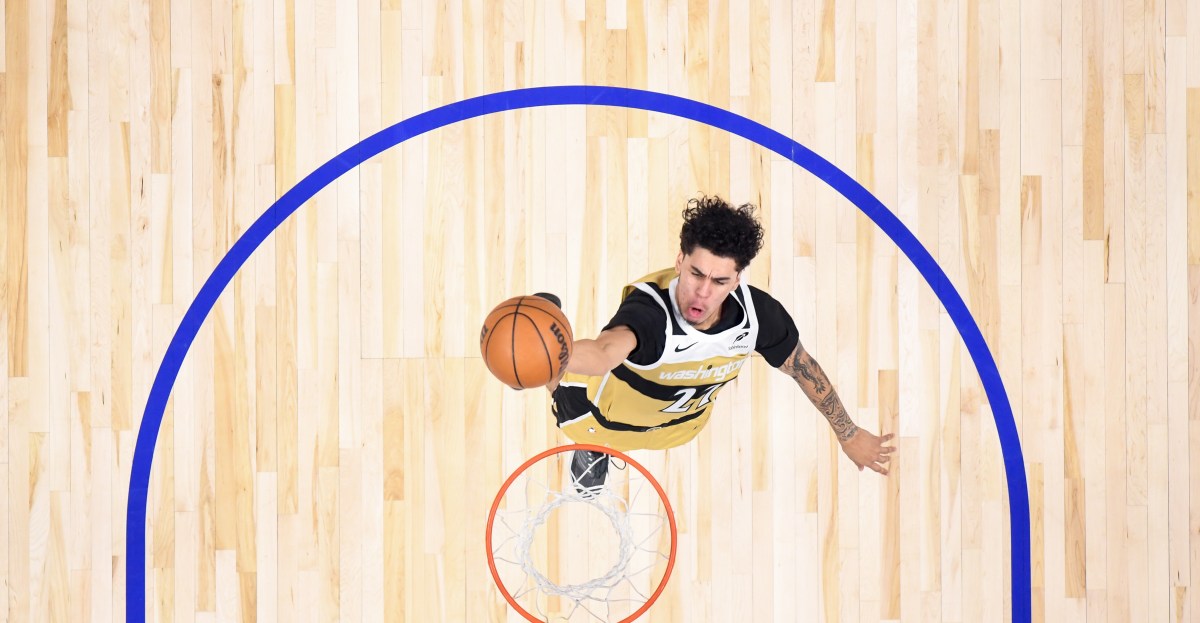
In basketball and narrative terms, the Wizards’ 126-117 win over the first place Detroit Pistons was fun. Entertaining game with extended runs for both teams, great plays from guys on both teams, and drama about the outcome to the very end.
In terms of what the win means for the Wizards…not as much fun. I’ll come back to that.
The game followed the pattern of Washington’s last win — two games ago against the Sacramento Kings. The Wizards shot well and played decently on defense while Detroit missed everything. In the first quarter, the Pistons shot 6-21 from the floor and 1-9 from deep. That’s sub-30% overall and 11.1% on threes.

Wizards rookie Will Riley scored a career-high 20 points in the team’s win vs. the Detroit Pistons. Getty Images
Detroit mostly righted the shooting ship (so to speak) over the final three periods — 52.2% on twos and 33.3% on threes — but the damage was done. Washington ended the first with a 13-point advantage.
It would be inaccurate to say Washington clung to their lead because the Pistons roared back in the second, going on a 17-0 run (which grew to 21-2) to slice a 20-point Wizards lead to as little as one.
Washington re-opened the lead in the third quarter — going up by as much as 19 before the Pistons came back yet again. In the end, Detroit didn’t have enough to pull out a win.
Like the Sacramento victory, head coach Brian Keefe went with the deep bench mob for virtually the entire fourth quarter. The Wizards played just six guys in the final period: — Bilal Coulibaly, Sharife Cooper, Anthony Gill, and Jamir Watkins played all 12 minutes. Tristan Vukcevich played the first minute, and Will Riley went the rest of the way. How’d that work?
Riley — 9 points, 3 rebounds, 1 steal in the final periodCoulibaly — 8 points, 2 rebounds, 2 assists, 1 turnoverCooper — 7 points, 2 rebounds, 2 assistsGill — 4 points, 2 rebounds, 1 assistVukcevich — 3 pointsWatkins — 1 rebound, defense and good vibes
Watching the diminutive Cooper compete with Cade Cunningham and more ballyhooed Pistons was fun. On consecutive possessions late in the game, he knocked down a three and then made slithery lefty drive and finish in traffic.
The Wizard were helped by the perennial Sixth Man of the Year — luck. I’m not talking about Detroit shooting 27.3% on threes. I’m referring to stuff like Coulibaly’s late shot clock heave with about three minutes left in the fourth quarter that somehow went in. Or Watkins banking in a three earlier in the game. Definitely luck. Also, they count.
As for what the win means…there’s a push-pull. The push is that it complicates The Tank a bit. Washington now has the league’s fifth worst winning percentage, which means they’re most likely to land the sixth or seventh pick in this year’s draft. The Wizards aren’t in danger of losing the pick. Yet. It’s top eight protected, so even at fifth worst, they’re safe. But that margin for safety is getting smaller.
The pull is that the factor complicating The Tank is young guys playing well. And the Wizards pretty much have to play the young guys, because there’s basically no one else left. Trae Young won’t be available for at least a couple more weeks. Anthony Davis might not play this season.
Perhaps D’Angelo Russell and Dante Exum, who came in the Davis trade, could help lose games. If the Wizards don’t just buy them out or release them. At 23-years-old, Jaden Hardy, who was also part of the Davis deal, also qualifies as one of the young guys.
I watched the Wizards broadcast because Detroit’s is pretty doggone awful. I was hoping to hear improvement. My hopes were not met.Note to someone running League Pass — stop cutting off the national anthem and timeout entertainment.The most repeated entry in my notes from this game were about Ausar Thompson’s defense. Coulibaly is a very good defender. Thompson is among the very best defensive players I’ve seen this season. Washington’s first offensive possession is a good example — Sarr got a paint touch and kicked to Justin Champagnie for what looked like a routine wide open three. Thompson blocked it.A few minutes later, Champagnie accelerated his shot motion in a similar play to make a three over a Thompson closeout.Champagnie played 16 highly productive minutes — 14 points, 7 rebounds (4 offensive) and a block. The Wizards were +16 on the scoreboard with him in the game.Riley played his fourth straight very good game. Last night, he scored a career-high 20 points to go with tying his career high in rebounds (6), 5 assists, and 2 steals. He showed patience and craft on the offensive end. Right now, he’s still surprising opponents because there’s no way he’s on scouting reports. That will change (probably after the All-Star break), and it will be fascinating to see how he adapts.I don’t know if Cooper has an NBA future beyond “fifth guard in a three-guard rotation,” but it’s fun watching him play. He’s quick, skilled, and competitive. Last night: 18 points (on 8-12 shooting), 3 rebounds and 5 assists. Also 5 turnovers, at least a couple of which looked to be of the needs experience variety.Riley and Cooper did combine for one unacceptable play. In the first quarter, they were positioned at half court for a teammate free throw attempt. The miss got back-tapped, and Detroit’s Marcus Sasser outran both to a) get the ball, and b) get to the rim for a layup.Early second quarter, I enjoyed seeing Gill drain a no-dip three.Funniest play of the game was when Riley threw a lob for Gill, who does not have that kind of verticality. Gill somehow tipped it in and got fouled for an and-one.I probably need to watch more Pistons games. People I respect keep talking about how great Cunningham is, and I do think he’s very good. But when I do see Detroit play, I’m always left with the impression that he’s a bit overrated.
Below are the four factors that decide wins and losses in basketball — shooting (efg), rebounding (offensive rebounds), ball handling (turnovers), fouling (free throws made).
The four factors are measured by:
eFG% (effective field goal percentage, which accounts for the three-point shot)OREB% (offensive rebound percentage)TOV% (turnover percentage — turnovers divided by possessions)FTM/FGA (free throws made divided by field goal attempts)FOUR FACTORSWIZARDSPISTONSLGAVGeFG%63.7%51.7%54.3%OREB%25.0%33.3%26.1%TOV%15.7%14.7%12.7%FTM/FGA0.1100.2950.208PACE10299.5ORTG123115115.5
PPA is my overall production metric, which credits players for things they do that help a team win (scoring, rebounding, playmaking, defending) and dings them for things that hurt (missed shots, turnovers, bad defense, fouls).
PPA is a per possession metric designed for larger data sets. In small sample sizes, the numbers can get weird. In PPA, 100 is average, higher is better and replacement level is 45. For a single game, replacement level isn’t much use, and I reiterate the caution about small samples sometimes producing weird results.
POSS is the number of possessions each player was on the floor in this game.
ORTG = offensive rating, which is points produced per individual possessions x 100. League average so far this season is listed in the Four Factors table above. Points produced is not the same as points scored. It includes the value of assists and offensive rebounds, as well as sharing credit when receiving an assist.
USG = offensive usage rate. Average is 20%.
ORTG and USG are versions of stats created by former Wizards assistant coach Dean Oliver and modified by me. ORTG is an efficiency measure that accounts for the value of shooting, offensive rebounds, assists and turnovers. USG includes shooting from the floor and free throw line, offensive rebounds, assists and turnovers.
+PTS = “Plus Points” is a measure of the points gained or lost by each player based on their efficiency in this game compared to league average efficiency on the same number of possessions. A player with an offensive rating (points produced per possession x 100) of 100 who uses 20 possessions would produce 20 points. If the league average efficiency is 115, the league — on average — would produced 23.0 points in the same 20 possessions. So, the player in this hypothetical would have a +PTS score of -3.0.
Players are sorted by total production in the game.
WIZARDSMINPOSSORTGUSG+PTSPPA+/-Will Riley296214521.2%3.921213Justin Champagnie153315627.8%3.731516Tristan Vukcevich112413839.7%2.12793Anthony Gill306314111.5%1.9887Sharife Cooper347311421.1%-0.274-3Bub Carrington224712022.2%0.41101Alex Sarr183811625.2%0.01192Kyshawn George183813617.6%1.4107-1Jamir Watkins265510711.5%-0.5568Bilal Coulibaly36778418.8%-4.6-2-1PISTONSMINPOSSORTGUSG+PTSPPA+/-Ausur Thompson337013216.1%1.9172-5Cade Cunningham388011534.3%-0.2116-16Ronald Holland II255313118.6%1.51693Duncan Robinson306414119.7%3.2134-7Marcus Sasser143012920.6%0.81712Caris LeVert163412219.0%0.4101-4Javonte Green18398221.6%-2.988-2Paul Reed132812818.7%0.71050Wendell Moore Jr.61222213.2%1.72199Kevin Huerter6133613.4%-1.3-19-7Isaiah Stewart2961718.2%-2.3-31-3Jalen Duren13274723.6%-4.3-97-15