
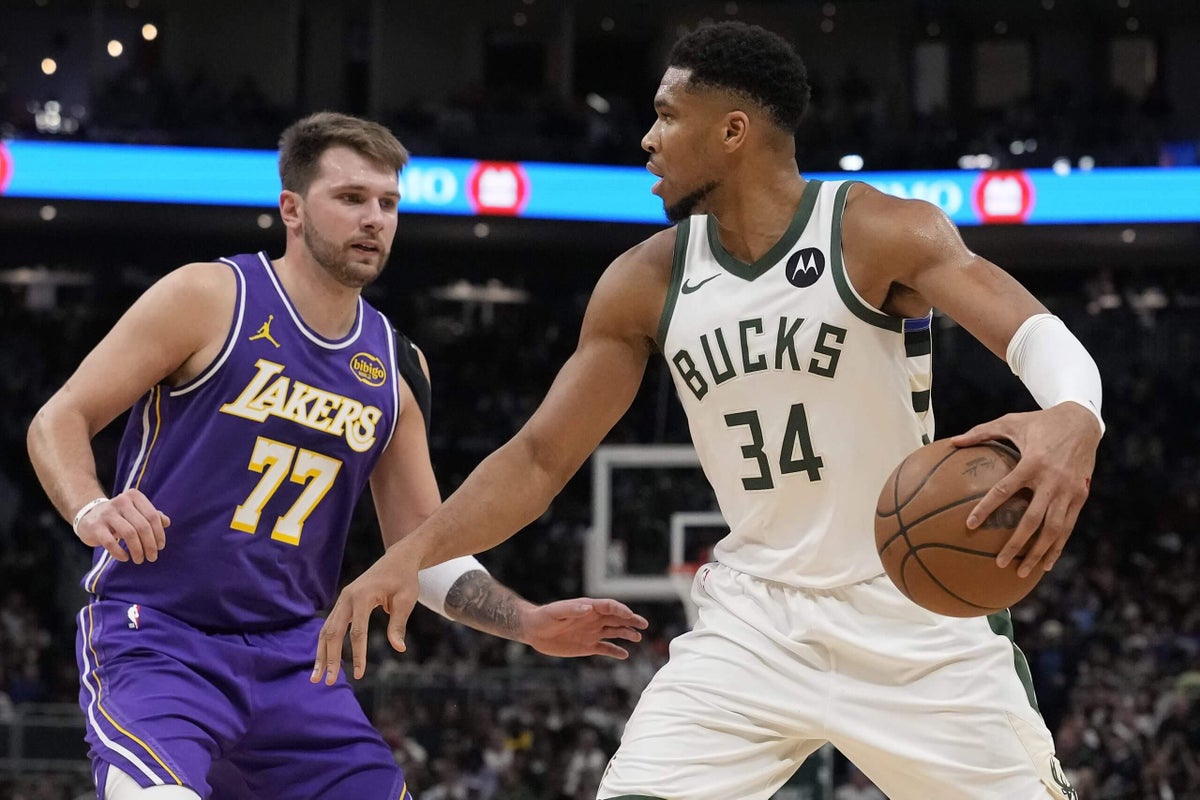
LOS ANGELES — The Lakers all but made it official this week: This summer, they plan to chase Giannis Antetokounmpo.
They shouldn’t — and won’t — allow it to be the plan. It’s the only way the stressors they’ve willingly introduced this season will be worth it.
As the Lakers trudged through the middle of their schedule, coach JJ Redick looked for reasons why his team’s feet seemed stuck in the mud. A three-game in four-nights East Coast stretch (one where his star player jetted to Slovenia for the birth of a child) zapped a ton of energy from the players and the staff. An injury to Austin Reaves shortly thereafter furthered their descent into whatever-dom.
More so than any other point this season, the Lakers entered this zone where either they’d beat a bad team or get the doors blown off them by an equal or superior.
It was ugly. And on Jan. 22, after the Clippers blew out the Lakers for the second time in a month, Redick pointed to one culprit.
The present becomes inherently destabilized when the priority is so clearly tomorrow — and the Lakers, while not in a gap year completely, have their eyes on the future. They’re in position to chase a star.
“It just goes back to the human element of everything,” Redick said. “And guys are worried about their futures. And that’s what happens when you got a team full of free agents and player options.”
Of the 14 full-time players on the roster that night, only five had contracts set in stone for next year. LeBron James is an unrestricted free agent. Austin Reaves has a player option he’s certain to decline. Deandre Ayton and Marcus Smart both have player options. Rui Hachimura will be a free agent. So will Jaxson Hayes.
The Lakers’ plans from that list include Reaves, and of course Luka Dončić. But beyond that, no one else can be sure.
And that puts them in a bit of a strange spot.
The NBA trade deadline came and went without the Lakers being pushed off their chosen path. If maintaining cap space in the summer of 2026 wasn’t the very top priority, it was the pressure point pushed on every scenario or decision considered by Rob Pelinka, new majority owner Mark Walter, governor Jeanie Buss and consultant Andrew Friedman.
The Lakers landed on trading one future free agent, Gabe Vincent, for another in Luke Kennard, surrendering the only second-round pick they had to offer. They were unable to offload any other players, including Dalton Knecht, who league sources say the Lakers shopped aggressively.
Next will be evaluating a group of buyout candidates. Team and league sources say wing Haywood Highsmith is a player of interest provided his knee issues are resolved. His former Nets teammate, Cam Thomas, is another more polarizing option.
Neither would affect the Lakers 2026 plans. And those long-term plans, at least somewhat, have to include an Antetokounmpo pursuit. On draft night, the team will have three first-round picks available to make their best offer.
Rival scouts and executives don’t believe it’ll be enough, but the Lakers can and should try. It, also, cannot be the cornerstone of their offseason plans. And this all assumes that Antetokounmpo’s Wolf of Wall Street post on Thursday is a temporary, not permanent position.
The summer presents an opportunity, armed with significant cap flexibility, to start building the necessary components of a modern front office and reap early benefits. League sources say that includes a significant number of hires this summer to a wide range of front-office positions, with the Lakers’ expected to model their front office after the World Series-winning Los Angeles Dodgers.
“It’s going to be scary,” one rival executive said when asked about the potential of the fully built-out front office the Lakers are expected to assemble.
Different from past star pursuits, there seems to be a more clear-eyed approach to this summer. Because the Lakers have more cap space than any other competitive team, they can be aggressive in acquiring players who fit their needs. The center position, again, remains a priority. They could engage with restricted free agents like Denver’s Peyton Watson and Houston’s Tari Eason. And while restricted free agency comes with complications tied to offer sheets and prior teams’ rights to match, the Lakers could try and bypass those steps with draft capital in sign-and-trades.
Team sources have maintained that the Lakers won’t pursue a single pathway. That’s the luxury of the position they’re in. They can and should pursue Antetokounmpo. They can and should explore high-level role players who they can trade draft picks for and absorb into space. They can and should look into aggressive ways to pry one of the top restricted free agents loose.
And they can and should build the kind of front office that can put the team in advantageous situations, whether it be for top-name stars, expensive free agents, minimum contracts or second-round picks.
Of all the moves the Lakers can make this summer, this is the one that’ll matter most.