
CLEVELAND, Ohio — The trade deadline always arrives with a sense of finality. Doors close. Windows narrow. For the Cavs, they acknowledged theirs.
In a matter of days, the Cavs moved on from three rotation players — all averaging at least 20 minutes per game — who also carried the team’s three worst net ratings: Darius Garland (minus-3.0 per 100 possessions), De’Andre Hunter (minus-0.9) and Lonzo Ball (plus-1.3).
The front office had to make a deliberate calculation about where this version of the Cavs needed to go and how quickly they needed to get there.
The arrivals of James Harden, Dennis Schröder and Keon Ellis sent an unmistakable message. Cleveland sees a wide-open Eastern Conference. Cleveland sees Donovan Mitchell’s timeline. The organization sees now.
And yet, beneath the win-now urgency, there was restraint.
Mitchell has one guaranteed year left on his contract before a looming player option that could tilt the franchise in either direction. In 2027, after his 10th season, he could sign a supermax five‑year extension worth more than $380 million. Or he could decide that Cleveland isn’t the place capable of helping him chase a championship.
The Harden trade was made with that reality front and center. Harden himself carries a $42.3 million player option after the 2025‑26 season. Even if he returns beyond that — even if Cleveland extends him — the future does not rest with a 36‑year‑old future Hall of Famer. This move was about compressing time, not borrowing it.
If Mitchell, 29, eventually walks, the Cavs will have to rebuild. That truth sits beneath every decision, even the bold ones. But Cleveland has already drawn a line around the two players it refused to part with if that day comes.
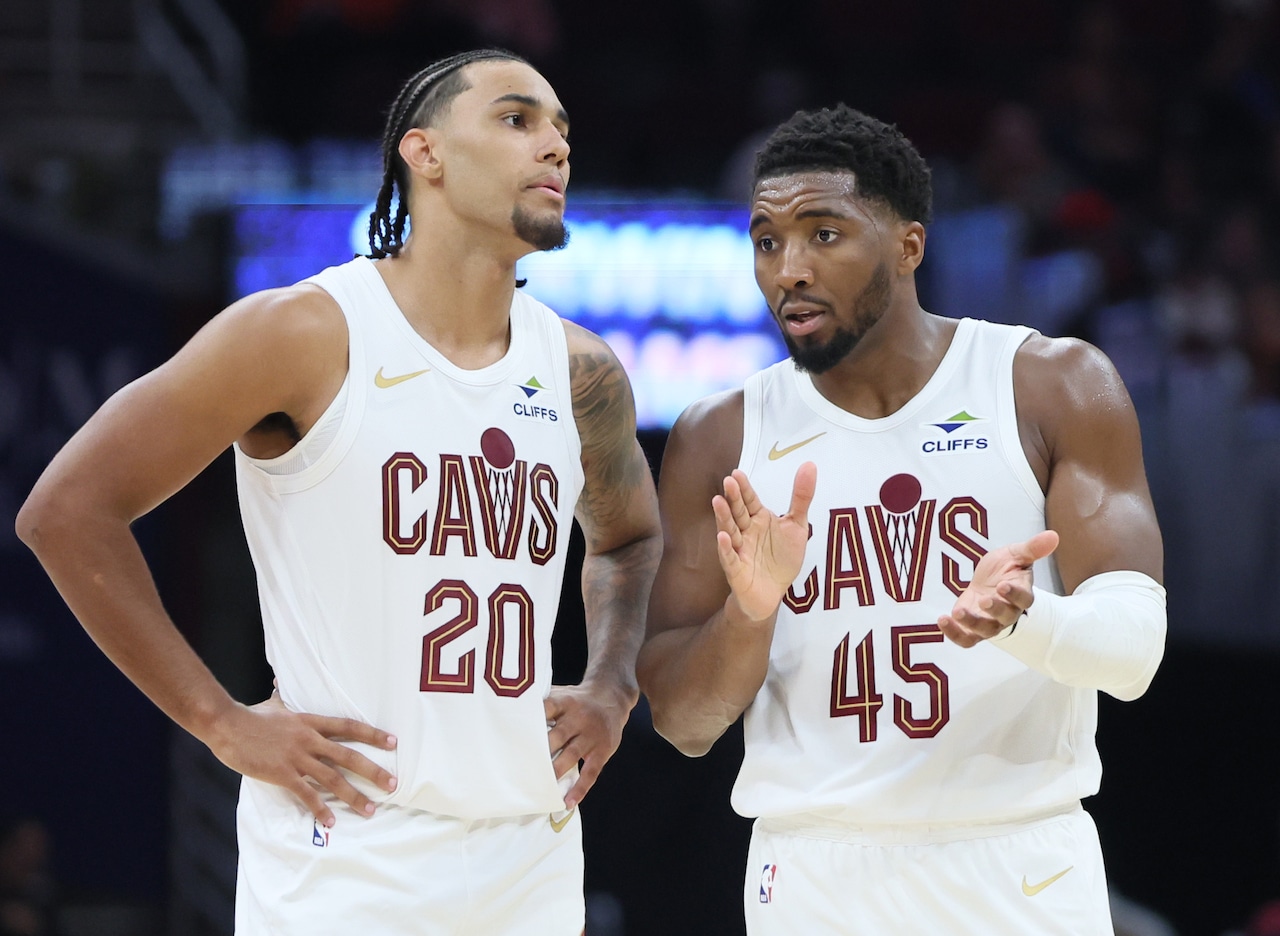
“Jaylon [Tyson] has been a revelation for us,” Cavs president of basketball operations Koby Altman said during his post‑trade deadline Zoom press conference on Thursday. “Creating a pathway for him to be successful, minutes for him to be successful certainly went into that decision‑making process [to trade De’Andre Hunter], and we couldn’t be more excited about him.
“We talk about Evan [Mobley] as our future. We really need to start adding Jaylon Tyson into that conversation.”
Tyson, in just his second NBA season, has already been stamped as a future pillar. Mobley has worn that label since the Cavs drafted him third overall in 2021. In five seasons, Mobley has become an All‑Star, an All‑NBA second team selection and the reigning Defensive Player of the Year.
The offensive leap Cleveland hoped would arrive by now hasn’t fully materialized. That reality, in part, drove the pursuit of Harden, who the Cavs hope can unlock another level of Mobley’s game. But the belief in the 24-year-old has never wavered.
Tyson’s rise has felt different. Faster. Louder.
His second-year leap, adaptability and multi‑faceted skill set have made him a fan favorite and an undeniable piece of the Cavs’ system.
“I’m blown away,” Cavs head coach Kenny Atkinson said on Jan. 28 after a win over the Lakers. “I’ve said this before, it really comes down to the front office to identify the player. And now he’s been put in a situation where he’s got to create some, and you don’t really know until you have it in your hands and you see it. But, at Cal he was that player. I think our front office identified that.
“Koby and Mike [Gansey] and those guys were telling me like, this guy can create, but he was down in the pecking order. But now he’s moved up. It’s great. It bodes really well for our future if we can get a 6‑foot‑7, 6‑foot‑8 wing, kind of secondary playmaker.”
Personality-wise, Mobley and Tyson are different.
Mobley is measured, introverted, cool and calm. The Cavs have pushed him to be louder and command space vocally, especially on the defensive end and in the leadership department. But his presence is what captures attention and deters offenses. His vertical gravity opens lanes no defender can fully seal. He doesn’t announce himself; the game does it for him.
Tyson, 23, fills rooms. He makes friends and earns the trust of everyone around. He brings a needed joy to a locker room, particularly with the departure of Garland.
But when the ball goes up, the smile fades. Tyson becomes a nuisance, a problem, a villain in someone else’s story. Defensively, he pressures with frustration as his goal. Offensively, he launches from deep in defenders’ faces or dunks on top of their heads and proceeds to let the opposition know about it after.
Yin and yang.
Together, they feel like something Cleveland could grow into if it has to. Over time, they could become the perfect fit as they learn to play alongside one another. That’s the runway created in case the stars around them don’t choose to finish their careers in Cleveland. Neither has reached their prime nor full potential, and if they continue to grow together, they could be a dynamic duo in the league.
Something that could convince its stars to stay.
In 38 games and 758 minutes together this season, Mobley and Tyson own a net rating of 8.5 per 100 possessions. Extrapolated across a full team context, that would rank third in the NBA. Among Cavs two-man lineups with at least 500 minutes, it’s the fifth‑best pairing. Mitchell and Tyson rank second as a duo, posting a net rating of 12.5 per 100 possessions over 791 minutes.
Maybe the development over the final 30 games of this season and into next year is what ultimately keeps Mitchell in the 216. Maybe this becomes the clearest vision of his best chance to compete for a championship, surrounded by players he helped mold.
And if it doesn’t? If the stars choose to leave?
Cleveland won’t be starting from zero.
The Cavs are leaning hard into a two-year championship window. They’re not pretending otherwise. But even as they chase the present with urgency, they’re still making sure the lights stay on for what comes next.