
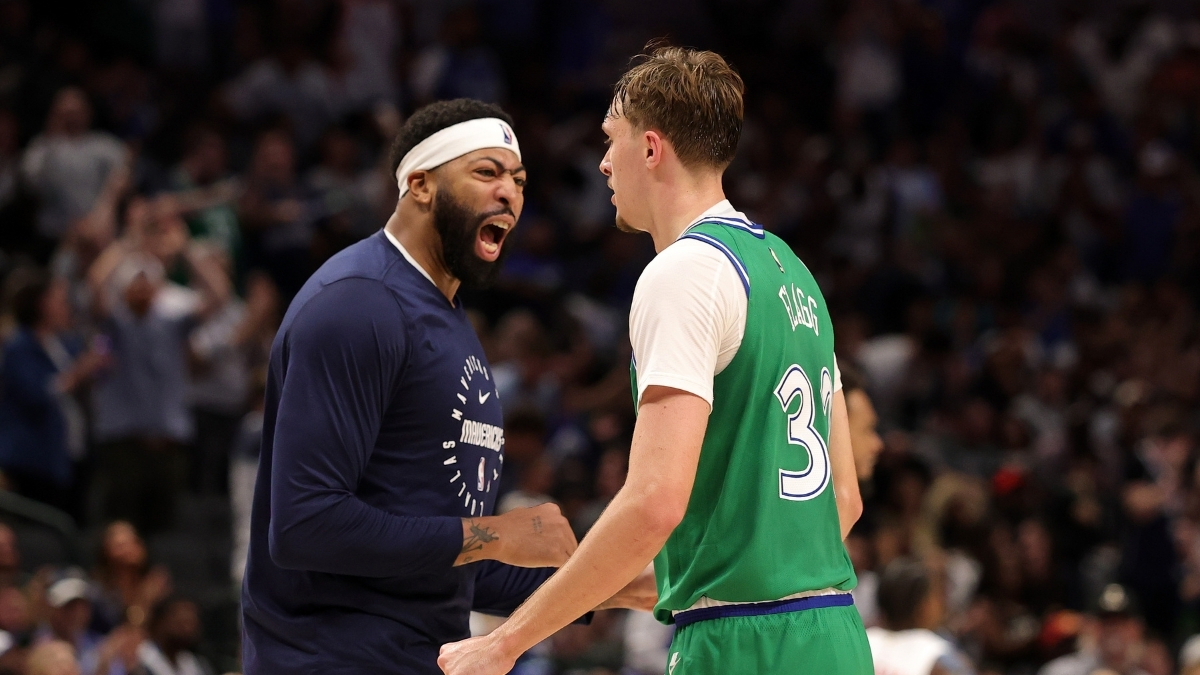
Anthony Davis moved quickly to correct the public narrative after being traded by the Dallas Mavericks to the Washington Wizards. What he did not move quickly to do was commit to the direction of the franchise that acquired him.
That tension — between clarification and commitment — has defined the early days of a deadline deal that surprised both the broader market and Davis himself, sources told DallasHoopsJournal.com.
Veteran NBA reporter Chris Mannix of Sports Illustrated reported that Davis “likely isn’t enthusiastic about joining the Wizards,” a sentiment he reiterated on a podcast. Multiple league sources independently shared with DallasHoopsJournal.com a similar read of Davis’ sentiment of the trade early Friday. However, the read is that an ideal outcome will require seeing it through for now, whether that involves succeeding with the Wizards or elsewhere.
Davis responded publicly and directly, disputing the notion that he views landing with the Wizards as an unfavorable outcome despite acknowledging he has yet to discuss the team’s plans.
“They said I said a lot of stuff in the other city, too, that I didn’t say,” Davis told The Athletic in a phone interview.
The response functioned as an attempt to reset the tone rather than a declaration of intent. While Davis pushed back on how his emotions were characterized, he simultaneously acknowledged that he has not yet heard Washington’s long-term plan and framed his outlook entirely around championship contention — a notable posture for a player traded to a team widely viewed as rebuilding and prioritizing draft position to retain a top-eight protected first-round pick owed to the New York Knicks.
National reporting surfaced — echoing what DallasHoopsJournal.com reported in the aftermath of the trade — that Davis is expected to be sidelined for the remainder of the season. Given Trae Young has yet to make his Wizards debut, Washington’s short-term path is clear. The focus is on draft positioning and asset management, setting the stage for a healthier, more deliberate reset in 2026–27.
A Deal That Didn’t Track With the League’s Expected Market
The trade’s surprise extended well beyond Davis.
Teams that had been linked to Davis in trade discussions did not have the Wizards on their deadline radar as a serious suitor for the 10-time All-Star, sources told DallasHoopsJournal.com. Rather than the culmination of a months-long, publicly telegraphed process, Washington’s emergence as the landing spot was viewed around the league as a late pivot that materialized quickly and caught multiple parties off guard.
That same lack of runway was reflected in the level of clarity between Davis and Washington prior to the deal.
Dallas acquired Khris Middleton, AJ Johnson, and Marvin Bagley III, along with a substantial package of draft assets. The Mavericks also received Tyus Jones from Charlotte as part of the multi-team transaction. In exchange, Dallas sent Davis, Jaden Hardy, D’Angelo Russell, and Danté Exum to Washington, while the Wizards routed Malaki Branham to the Hornets. The draft compensation included a 2026 first-round pick via Oklahoma City and a 2030 first-round pick via Golden State protected 1–20, along with three second-round picks: 2026 via Phoenix, 2027 via Chicago, and 2029 via Houston.
While Davis is eligible for a contract extension in August, there was no established extension framework or mutual clarity before the trade, sources told DallasHoopsJournal.com. Davis’ own comments aligned with that reporting. Even as he described a positive first visit with the organization, he consistently framed his stance as contingent on information he said he has not yet received.
“I need to talk with Will, Ted, Zach, and kind of figure out what the actual plan is,” Davis said. “I want to see the plan, hear the plan, see the vision.”
The distinction was clear. Davis was willing to dispute how his emotions were characterized publicly. He was not willing to define his long-term posture without first understanding Washington’s competitive roadmap.
Dallas Mavericks’ Pivot Focused on Cooper Flagg
From the Mavericks’ perspective, the door opened because the organization’s internal calculus changed — and it changed faster than originally anticipated. Injuries dismantled what had been envisioned as a defense-first contender. Kyrie Irving tore his ACL. Dereck Lively II was lost for the season. Davis himself appeared in just 29 games for Dallas while missing 54. Former general manager Nico Harrison was dismissed before Thanksgiving.
But beyond health, league sources told DallasHoopsJournal.com structural basketball questions had been mounting internally well before the deadline. Dallas increasingly viewed how Davis impacts spacing around Cooper Flagg as an area that would need to be solved. Flagg’s rapid development accelerated the need to optimize the team around his game soon.
In contrast, Irving is viewed as a strong complement to Flagg once Irving returns to competition, league sources told DallasHoopsJournal.com. Irving’s natural profile as a score-first guard — the role in which he thrived alongside Luka Dončić — enables Flagg to handle no shortage of ball-handling duties to allow Irving to do what he does best instead of facing a taxing share of initiation duties.
That same principle informed Dallas’ pursuit of Tyus Jones as part of the deadline sequence. League sources emphasized that Jones was not viewed as a marginal add-on, but as a functional stabilizer — a true organizing point guard capable of reducing the nightly burden placed on Flagg. Bringing the ball up every possession, managing tempo, and organizing half-court sets is physically and mentally taxing, particularly for a 19-year-old already carrying offensive gravity. Jones’ presence allows Dallas to structure possessions more deliberately and protect Flagg’s workload as the franchise builds forward.
Compounding matters, the league’s second-apron restrictions fundamentally altered the Mavericks’ strategic flexibility, sources told DallasHoopsJournal.com. Under the new CBA, incremental fixes were no longer viable. Regaining optionality required a decisive move rather than a series of marginal ones.
By moving Davis, Hardy, Russell, and Exum, the Mavericks cleared roughly $68 million in 2025–26 salary while taking back approximately $43.6 million in largely expiring money, led by Middleton’s contract. The move dropped Dallas below the luxury tax and both apron thresholds for the remainder of this season and left the team with roughly $150 million in guaranteed money next year — well below tax and apron lines.
At the time of the deal, Dallas was projected to be deep into the luxury tax and over the second apron for the 2026–27 season. League sources indicated the transaction allows the Mavericks to avoid nearly $200 million in combined salary and tax penalties in that year alone, restoring flexibility that had largely disappeared under the prior structure.
Just as significantly, Dallas removed more than $112 million in guaranteed future salary tied to Davis’ escalating contract. Davis is also eligible for a contract extension in August, and league sources told DallasHoopsJournal.com the Mavericks were not in a position to provide advance assurances on a new deal given their evolving timeline, making a trade outcome increasingly practical.
While the Mavericks are not projected to create traditional cap space, the deal reshaped how they can operate. Dallas now holds a newly created $20.8 million trade exception, a separate $6 million trade exception, and is positioned to use a projected $15 million mid-level exception this summer, giving the front office multiple avenues to add talent without reentering apron territory.
Washington had been exploring ways to move Middleton’s expiring contract for center upgrades, while Dallas remained open to moving Davis if the return restored long-term flexibility. Within that context, sources told DallasHoopsJournal.com the deal came together quickly. Mavericks co-interim general managers Matt Riccardi and Michael Finley were able to assemble the pieces rapidly once the opportunity emerged.
The transaction aligned two organizations moving in opposite directions: Dallas reopening its timeline, Washington taking on a high-variance swing.
Dallas Mavericks Speak on a Reset
In their first media availability following the trade deadline, Riccardi and Finley framed the organization’s decision as a necessary reset grounded in long-term championship goals rather than short-term turbulence.
Finley made clear that the decision reflected a collective organizational judgment.
“We decided, as an organization — front office and management — that we needed to do something to bring back the winning culture here in Dallas,” Finley said. “We thought that doing the move that we did puts us back in that conversation, gives the fans something to be excited about, and puts us in the mindset of having a championship atmosphere around here.
“That’s what it’s all about,” he added. “I think we’ve achieved that with this move that we just did, and we’ll continue to do what we think is best for the organization today and going forward.”
Riccardi echoed that framing, describing the move as the product of an internal reckoning rather than a reaction.
“We had to take an honest look at ourselves in the mirror and realize where we were and where we wanted to be,” Riccardi said. “Sometimes the path is not straightforward, and you have to go a little roundabout way to get where you want to go.
“But our goal here remains the same,” he continued. “We want to win championships, we want to build a championship roster, and we want to do everything we can to make sure we provide the players proper resources and staff to make that happen.”
When asked directly about balancing the desire to eventually see Davis, Irving, and Flagg on the floor together against the decision to pivot now, Riccardi acknowledged the appeal while explaining the alternative.
“I think as a fan you probably would want to see AD, Kyrie, and Cooper on the court together,” Riccardi said. “But we had an opportunity to do something that gave us ultimate flexibility in the future to help us build what we see as a championship contender.
“We felt that this was an opportunity to take advantage of that situation,” he added, “and that’s what we did.”
That philosophy aligned closely with how head coach Jason Kidd has framed the franchise’s direction throughout the season. Kidd has repeatedly rejected the idea that Dallas is operating on multiple timelines.
“I think you can look at it as a reset,” Kidd said earlier this season. “We’ve always believed it’s been one timeline, and that’s to find a way to win and develop. Nothing changes. We’re trying to win, and we’re developing. Hopefully those two things match. At the end of the day, the goal is to win a championship.”
Kidd also addressed Davis’ abbreviated tenure directly, underscoring how little continuity the roster ever achieved.
“It was unfortunate,” Kidd said. “His health — we never got to see everyone together. Not just AD, but Kai too. Unfortunately, we didn’t have that opportunity. But AD is an incredible basketball player and a great human being. We wish him the best in D.C.”
With that window closing, the organization’s long-term runway has become increasingly centered on Flagg — not as a future asset, but as a present cornerstone.
“I think the runway is long,” Kidd said. “He’s 19 years old. He’s developing an understanding of the NBA game, the schedule, the physicality. His game is very impressive. Now it’s for us to find the pieces that fit, and we believe we already have some of those pieces.”
Finley made clear that the draft capital and financial flexibility acquired in the trade are tools meant specifically to serve that purpose.
“When you have an unbelievable player in Cooper Flagg, it’s our job to put the right pieces around him,” Finley said. “When you have that type of draft capital, it gives you the ability to go out and put the proper pieces around him to make our team a championship contender.”
Those “pieces,” Finley added, are defined less by archetype than by identity.
“We want guys that embody what Cooper embodies — toughness, high IQ, unselfishness, hard-nosed defense, and caring about the team more than themselves,” he said. “Those are the guys that win in this league.”
Flagg, for his part, has experienced the reset from inside a season defined by losses, turnover, and constant adjustment — a reality he has not minimized.
“It was tough at first, obviously losing that much,” Flagg said. “I’m a competitor. For me, it’s about learning from the losses and taking positives away.”
Balancing competitiveness with patience has been a learning curve.
“It’s been mentally and physically tiring this year,” Flagg said. “It hasn’t been easy. I love to win more than anything — that’s my end goal.”
Still, Flagg pointed to continuity and belief inside the locker room as reasons for optimism.
“I think we still have some really great guys here,” he said. “I think we have a really bright future and can continue to keep competing and getting better every single day.”
When asked about the significance of the franchise openly committing to build around him so early in his career, Flagg framed it as confidence without pressure.
“Yeah, sure, it gives me a lot of confidence,” he said. “Honestly, it doesn’t really change much. I’m just going to go out there every night and try to be consistent.”
Taken together, the Mavericks’ messaging has been consistent across ownership, front office, coaching staff, and locker room. This was not a retreat from contention, but an acknowledgment that the path forward now runs through development, flexibility, and fit — with Flagg at the center of a timeline the organization believes can still lead to championships.
Anthony Davis Praised the Welcome, Then Repeated the Same Requirement
Davis’ interview with The Athletic took place during his first visit with Wizards ownership and basketball leadership, including Ted Leonsis, Zach Leonsis, Michael Winger, Will Dawkins, and John Thompson III.
He described the reception as positive and used that experience to push back on public characterizations of his reaction to the trade.
“The visit’s been great,” Davis said. “They definitely welcomed me with open arms. It’s totally different from what they make it seem.”
He also acknowledged Washington’s reputation.
“I know it’s like, oh, they have the stigma of they’re not a good team,” Davis said.
But the praise came with clear limits. Davis did not frame early hospitality as evidence that competitive questions had been answered. Instead, he separated the welcome from the conversations he said still need to occur — and from the criteria that will ultimately shape his future.
“Obviously, at this time, every year, you want to compete for championships and stuff like that,” Davis said.
He then stated the core reality shaping his outlook — a sentiment echoed by multiple league sources.
“At this point in my career, I want to compete for a championship,” Davis said. “Whether that’s here or elsewhere, I have no idea.”
Davis said his posture depends on what Washington presents.
“It’s hard to say (I would definitely stay in D.C.) without the proper plan,” he said.
He also acknowledged the Wizards’ current standing.
“Obviously, it’s tough right now with the team,” Davis said. “It shows with their record.”
With Davis expected to be shut down for the season and Young still sidelined, Washington’s present-day results carry little weight relative to the longer view. The organization appears comfortable letting this season serve as a tanking year, with the expectation that a healthier Davis can reenter the picture during the 2026–27 season — the intended inflection point of the gamble.
The “Wash” Strategy and a Dual Evaluation
In league circles, sources explained to DallasHoopsJournal.com what Washington’s approach is in blunt terms: acquiring Davis as a distressed asset, restoring his on-court value through usage and health, then reassessing whether he fits long-term or becomes a trade centerpiece for a contender.
As one source described it, the Wizards are going to “put him through the wash.”
That framing casts the Wizards’ move as both a basketball decision and an asset-management play — and it aligns with the current ambiguity. Davis is evaluating Washington. By that same description, Washington is evaluating Davis.
Unlike situations where alignment precedes a move, Davis arrived in Washington without extension clarity, without market signaling that the Wizards were emerging as a suitor, and without a defined competitive roadmap presented in advance.
Davis’ agent, Rich Paul, struck a similar tone. Paul said extension talks have not begun. He acknowledged he was not informed before the deal was finalized and characterized that as procedural, which aligns with how league sources described the transaction process to DallasHoopsJournal.com.
“They don’t have to do it,” Paul said.
Paul framed Washington’s appeal in terms of capacity rather than commitment, citing ownership’s willingness to spend once a contender is built.
“It starts at the top,” Paul said. “Ted Leonsis, Zach Leonsis… you want them to be able to do one thing for you: be willing to pay the (luxury) tax once we put something on the floor that is taxable.”
Taken together, the comments from Davis and Paul reflect the same stance: openness without obligation, optimism without attachment, and no long-term posture formed in the absence of a defined plan.
The Core Issue Remains Unresolved
Davis’ initial public response has been measured, but it has not resolved the central question surrounding his future. He disputed reports suggesting dissatisfaction. He did not dispute the absence of clarity.
“I want to see the plan, hear the plan, see the vision,” Davis said.
For Dallas, the trade marked a definitive shift — closing the Davis window and committing fully to a longer-term approach built around Flagg amid injuries, structural limits, and a changing CBA landscape.
For Washington, it created a high-stakes evaluation period — one that will determine whether Davis becomes a foundational piece or a rehabilitated bridge to something else.
Until that plan is presented and evaluated against Davis’ championship timeline, the most consequential part of this trade remains unsettled. Not the quotes. Not the optics. But whether Washington can offer a path that aligns with where Davis is — and where he wants to go — next.
Latest Dallas Mavericks News & Trade Rumors