
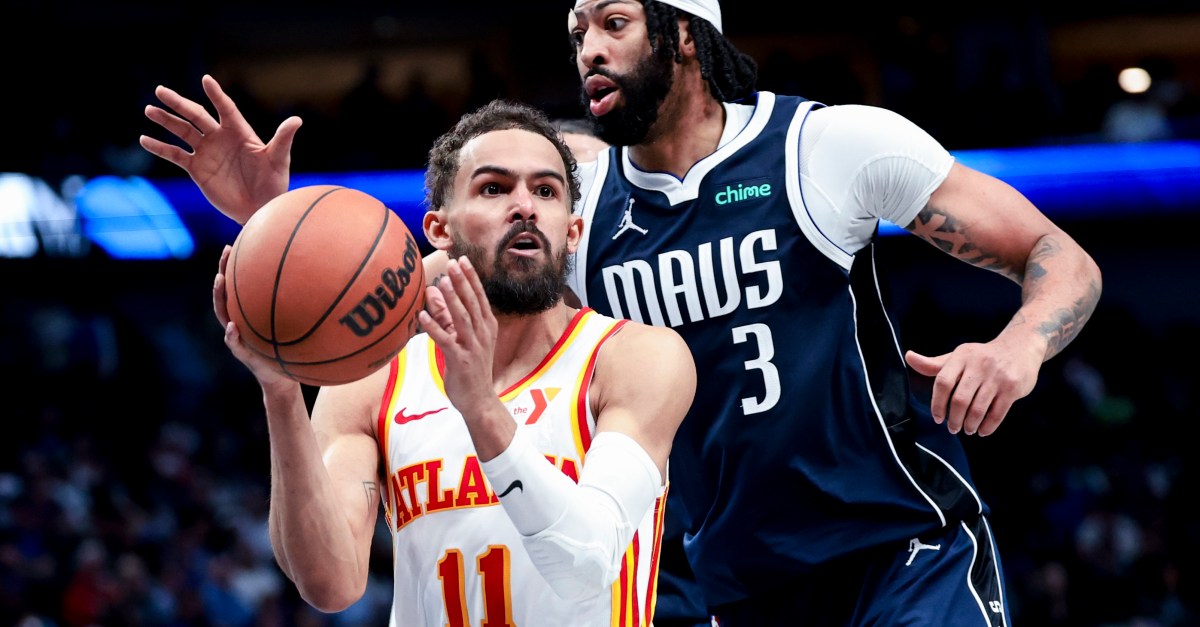
The pressure is on for the Washington Wizards to be competitive during the 2026-27 season after two bold moves to acquire perennial All-Star point guard Trae Young from the Atlanta Hawks and future Hall of Fame big man Anthony Davis from the Dallas Mavericks.
On the flip side, both Young and Davis are currently dealing with injuries. Both players are expected to “play very little, if at all” throughout the rest of the season according to ESPN’s Tim Bontempts. NBA Insider Chris Haynes confirmed on Friday that Davis is not expected to play the rest of the season. That, along with C.J. McCollum and Khris Middleton both being in the moves that allowed the Wizards to acquire Young and Davis, means that the tank is on and the Wizards are going all-in on their young core to try and develop them and ensure they have the best possible odds at picking at the top of the 2026 NBA Draft. There is currently very little risk in their top-eight protected pick not converting.
With more short-term expectations and a more inflexible roster that does not necessarily lend itself to just picking the best player available, how should the Wizards approach the draft?
The first things to look at are Young and Davis’ contract situations. Young could technically become a free agent after this season, but will likely accept his player option and enter free agency after 2026-27. Davis will be under team control next season, then will have a player option for the 2027-28 season.
It would be very surprising if Young does not accept his player option. After an injury-plagued season this year and a relatively negative perception around the league, Young will likely be jumping at an opportunity to be the Wizards’ first option and try and rehabilitate his image. But then again, even if Young accepts the player option, he is only guaranteed to be around for one season unless he signs an extension.
Davis is about to turn 33 and has struggled to stay on the floor throughout his career, especially over the last few years. Last season, he strained his left adductor in his first game after the infamous trade that sent him to the Mavericks and suffered an eye injury that would end up requiring offseason surgery. Last month before the trade, Davis suffered ligament damage in his left hand. Earlier in his career, Davis also dealt with injuries to both ankles, both shoulders, his left calf, left knee, tailbone and left hand.
This is all to say that given Young and Davis’ injury histories and contracts, they should not necessarily be counted on as long-term fixtures in D.C. When it comes to the draft, the Wizards should still absolutely be looking toward the future and almost certainly draft the best player available regardless of fit at the top of the draft.
If I was Wizards general manager Will Dawkins, here is what my big board would look like post-trade deadline (only going eight deep because of the top-eight protection):
Darryn PetersonAJ DybantsaCameron BoozerKingston FlemingsCaleb WilsonKeaton WaglerMikel Brown Jr.Labaron Philon
Darryn Peterson, the 6’6” freshman combo guard from Kansas and AJ Dybantsa, the 6’9” freshman wing from BYU are my top two players in the draft and would instantly slot into the starting lineup next season alongside Young and Davis. Both Peterson and Dybantsa have the ability to be high-level starters on a competitive team as rookies, and could get that chance if they end up on the Wizards.
The first question mark comes with Duke freshman forward Cameron Boozer. At 6’9”, 250 pounds, Boozer projects to primarily play the power forward position while occasionally playing some small-ball center in the NBA. But, with Davis and Alex Sarr already on the team, it would be difficult for Boozer to earn a starting spot. Despite that, Boozer is still an impressive enough prospect to earn consideration despite the imperfect fit over the next tier of players–Kingston Flemings and Caleb Wilson.
Boozer, Davis and Sarr are all able to play both the four and five and have very different and complimentary play styles. If all three are healthy, they could each end up playing about 30 minutes per game even with Boozer or Sarr coming off the bench. Boozer would allow the Wizards to be extremely conservative with Davis’ playing time, making it a lot easier for him to take games off for load management knowing a player of Boozer’s caliber is able to step in.
It would be foolish of the Wizards to not consider drafting a player as talented as Boozer just for one guaranteed year of Davis.
Going down the draft is where things get a bit more tricky. I view Flemings, the 6’4” freshman guard from Houston and Wilson, the 6’10” freshman forward from North Carolina, very similarly. If the Wizards fall in the lottery, this is where they could begin looking more towards fit instead of pure talent. At this point, Wilson is a non-shooter. While he has been taking and making more threes over his last few games, it should still not be considered a part of his game. Wilson’s defensive potential is tantalizing and in a vacuum, he is probably more talented than Flemings. But, what Flemings has shown this year as the floor general for an elite Houston team can not be ignored. Flemings and Young would immediately become one of, if not the best playmaking backcourts in the entire NBA. Flemings’ defensive abilities would help mask some of Young’s inefficiencies and Young’s superb playmaking would take the pressure off of Flemings that many young point guard face and allow him to grow into his role as a lead ball handler in the NBA.
This is pure speculation, but one thing that could now be on the table for the Wizards if their pick falls in the draft is for them to consider a trade. With Davis and Young, the Wizards’ timeline has moved way up. There are now real expectations for them to be competitive. If there is no player they are absolutely in love with available where they are picking, likely if their pick falls in the six through eight range, it would not shock me if they try and find a deal for another young player, or even a more established veteran if they want to go all-in on next season.
6’6” Illinois freshman guard Keaton Wagler has had a shocking ascent up draft boards and is looking like an elite scorer. Louisville freshman Mikel Brown Jr. and Alabama sophomore Labaron Philon have very high upside and project to be above-average starting guards in the NBA. Other players like Arizona freshman forward Koa Peat, Tennessee freshman forward Nate Ament and Michigan senior forward Yaxel Lendeborg are endlessly talented, but would be clunky fits alongside a Davis-Sarr frontcourt. A trade would be shocking, and difficult to pull off with the Wizards no longer having as many tradable contracts, but should not necessarily be counted out if they fall in the lottery.
Look at the Indiana Pacers, who traded their first round pick this year that is protected from picks 1-4 and 10-30 to the Los Angeles Clippers for center Ivica Zubac. With Tyrese Haliburton expected to return next season from a torn achilles he suffered during last season’s NBA Finals, the Pacers have no need for a point guard. They likely view Wilson four on their big board, and understand that the next bunch of players after him would be ball handlers. It would not necessarily be unprecedented for the Wizards to make a deal if their pick falls in a similar range, especially if they agree to an extension with Young.
The way the Wizards acquired Young and Davis is a masterclass in asset management. But there are certainly risks in expediting the rebuild. The upcoming draft is still the most important factor in building a sustainable contender, and the Wizards should be very cautious about sacrificing any part of their future for short-term gain.