
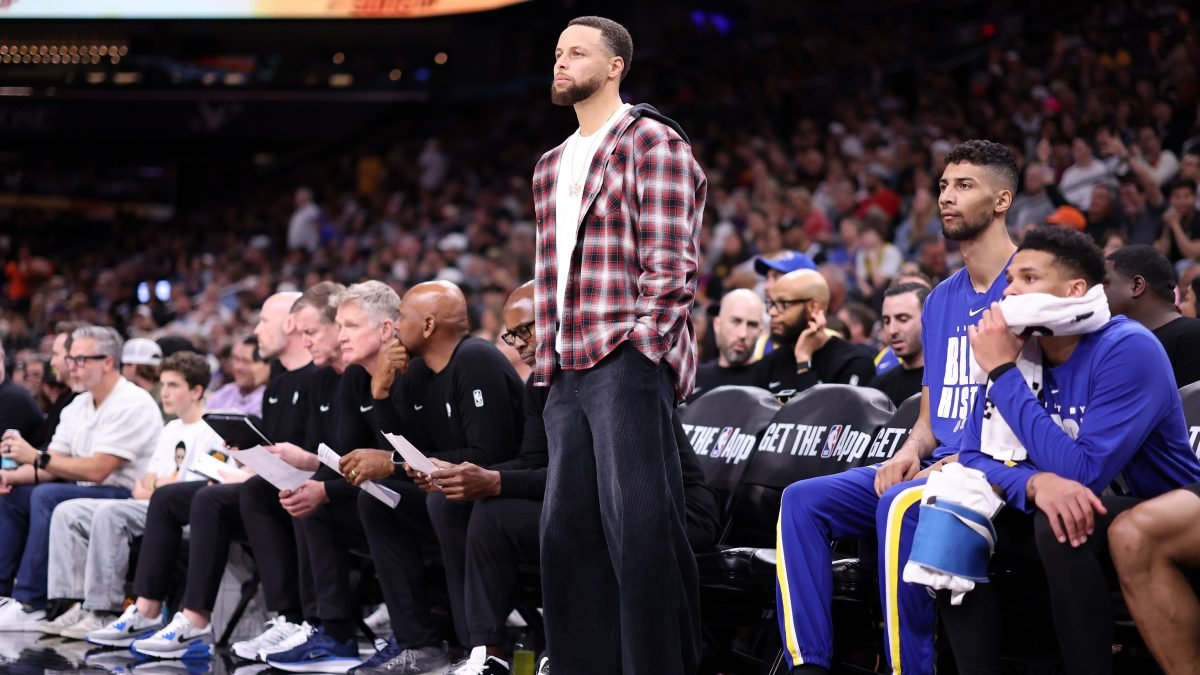
With the Warriors three months into a 2025-26 NBA season now certain to land far short of their expectations, there should be zero doubt about how to proceed with Stephen Curry’s tender right knee.
Put it on ice. Literally and figuratively.
For an extended period. At least a month.
“I think there’s a good chance that he doesn’t play ‘til after the break,” coach Steve Kerr told reporters Saturday before the Warriors and Lakers tipped off in Los Angeles.
That’s prudent. Curry has hobbled through various levels of discomfort since banging his right knee in November. He took another blow on Jan. 30 that so aggravated it he was forced from the game. He was diagnosed with “runner’s knee,” which generally requires at least three weeks to subside.
It sometimes takes as much as two months.
Sitting Curry through the Feb. 12-18 NBA All-Star break will provide him with a full 20 days of recovery. The bare minimum. Which is not enough.
There are two explicit reasons to slow-play Curry’s return than to simply alleviate the discomfort to accelerate his return. The first being Steph’s basketball future not only for the rest of this season but beyond it.
The second, which links directly with the first, is the state of the Warriors.
When Jimmy Butler III went down with a torn right ACL on Jan. 19, it torched any realistic chance of Golden State making a deep NBA playoff run. Curry knew it, as did anyone else in the locker room, the coach’s quarters or the front office. The Warriors immediately became a marginally better squad than they were before acquiring Butler last February. With 17 days remaining before the NBA trade deadline, CEO Joe Lacob and general manager Mike Dunleavy set out to remedy that.
Jonathan Kuminga wanted out, and the Warriors wanted to honor that request. Knowing they couldn’t replace Butler, they sniffed around the league in hopes of finding a deal that would allow them to at least improve on what they call “the margins.”
That plan was scrapped on Jan. 28, when Milwaukee Bucks superstar Giannis Antetokounmpo essentially put himself on the market. The Warriors, visualizing a partnership with Curry, prepared an offer that was rejected by the Bucks.
What now? With Curry already sidelined for an indefinite period, the Warriors pivoted and traded Buddy Hield and Kuminga to the Atlanta Hawks for 7-foot-2 big man Kristaps Porzingis and his abundant injury history.
Porzingis, according to Kerr, won’t be available until sometime after the All-Star break.
The 27 games that follow the break will not define this season for the Warriors. They’ll be in eighth place in the Western Conference, and more likely to drop than climb. A top-four finish, already a fantasy, is out. A top-six finish, achievable before Butler went down, is profoundly implausible.
To expect Curry and Porzingis – assuming both are healthy when the season resumes on Feb. 19 – to rescue a scrappy but certifiably sub-mediocre roster is an unfair proposition.
While there are reasons to play a healthy Porzingis, mostly to evaluate him for purposes beyond this season, there is no need for that with Curry. To bring Steph back for the final six weeks is to wonder what, exactly, is Golden State’s goal?
Looking at their place in the conference hierarchy, it’s logical for the Warriors to take the long view, as in 2026-27. To consider playing Porzingis sparingly and Curry even more sparingly after the break.
They won’t like it, but they’d likely understand it.
Download and follow the Dubs Talk Podcast