
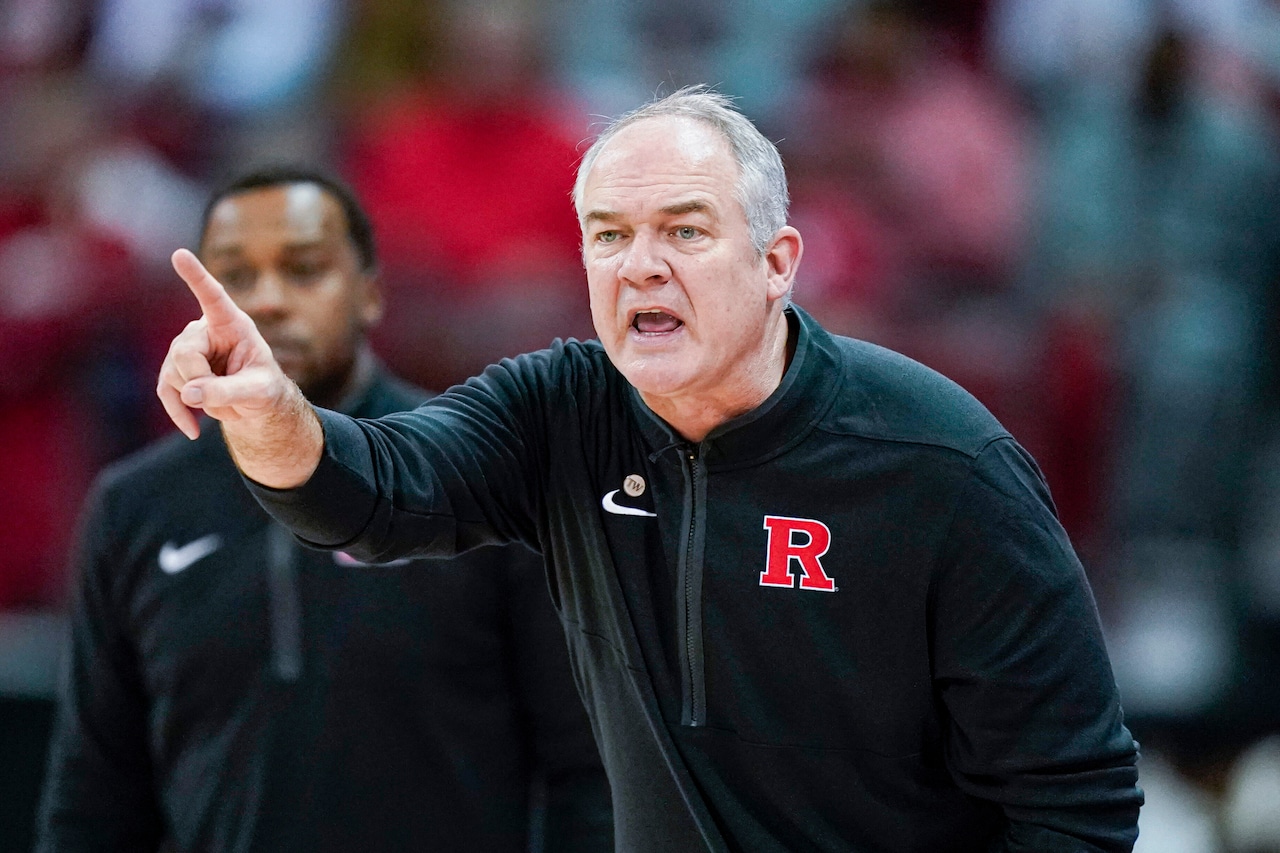
Rutgers basketball coach Steve Pikiell is sitting on an old counter in the bowels of Jersey Mike’s Arena talking to me about money. What else, right?
We have had this conversation, or some variation of it, several times before. He must be sick of it. I know I am. A rival head coach, UCLA’s Mick Cronin, lumped his program into the “have nots” of college basketball during a game in Los Angeles last week, just after his boss, athletic director Keli Zinn, promised to finally change that during an appearance on the team’s radio broadcast.
Rutgers fans are divided. Some think money — i.e., the NIL funding needed to pay better players — is the only thing that can save Pikiell. Others are convinced that money — i.e., the $20 million left on his contract through 2031 — is already the only thing saving him.
Both have a point, and I’ll split the difference. It is indisputable that Rutgers hasn’t given Pikiell the resources to compete in the Big Ten. But a much-awaited cash infusion this offseason won’t offset other issues — starting with an archaic offensive strategy, poor roster management and his stagnant coaching staff — that are holding the program back.
Pikiell has to make changes, too. I present my theory to him after his team’s seventh straight loss that money alone won’t be his salvation after what is likely going to be the worst of his 10 seasons in Piscataway.
He agreed — to a point.
“I have to evaluate everything,” he said. “We will evaluate everything. But I do like the fact that maybe we’ll be able to swim with some of the sharks in the portal. You know what I mean?”
That is finally the expectation. Zinn has told people around the program that Pikiell will have more than $8 million to build his roster for next season — roughly $3 million from the revenue sharing pool and $5 million more from the “above the cap” name, image and likeness money that truly separates the haves from the have nots in college basketball.
If that’s not enough, well, Pikiell is toast. If Rutgers were the kind of athletic department that didn’t care about an eight-figure buyout, he might already be gone. Of course, if Rutgers was that kind of program, it would have given him the NIL he needed to build out a roster — preferably, of course, when he had two NBA lottery picks in the starting lineup. Round and round we go, right?
This everyone can agree on: The product Pikiell is putting out on the court is not nearly good enough. The Scarlet Knights (9-15, 2-11 in the Big Ten) trailed Nebraska by double digits for most of the game on Saturday afternoon before falling, 80-68, and it was hard to pinpoint what was most galling about their performance.
Was it taking just eight shots at the rim with mid-range jumpers, the bane of basketball analytics, making up 46 percent of its attempts? Was it a poor defensive performance that continues a season-long trend and goes against Pikiell’s promises that his team would get back to its roots? Was it the glaring lack of energy and effort that left Jersey Mike’s, once a feared venue, dead from tip to buzzer?
The answer is “none of the above.” The hardest part to swallow for Rutgers fans had to be watching the efficient, easy-on-the-eyes play of the opposing team. The ninth-ranked Cornhuskers (21-2, 10-2) are one of college basketball’s best stories this year, and much worse for the money-is-everything narrative, they’ve earned that status without a massive bankroll.
Fred Hoiberg’s team is believed to be among the Big Ten’s bottom three or four programs for NIL support. It helps that his son, Sam, is one of the team’s best players.
“We got lucky to start out with,” Hoiberg said. “My wife was really hard to deal with on Sam’s NIL deal, but we ended up getting him on a pretty good deal.”
But the rest is just smart program building. Hoiberg said the Huskers “really identified the right people that we thought fit with our system,” then smartly used NIL to add pieces — Iowa sharpshooter Pryce Sandfort chief among them — while retaining their core.
“It’s a tough thing to navigate in today’s climate,” Hoiberg said — which, as any Rutgers fans know, is a quite an understatement.
Pikiell has not navigated it. His portal haul was limited to players he recruited (and missed on) out of high school or, in guard Tariq Francis, one who starred at nearby NJIT who is a close family friend of assistant coach Brandin Knight. The explosive Francis has turned out to be a keeper, but with the exception of freshman guard Kaden Powers and junior forward Darren Buchanan Jr., this roster needs a complete overhaul.
That has to happen on April 7 when college basketball’s transfer portal opens. Pikiell told me Rutgers will be far more prepared thanks to new general manager Rob Sullivan, who is doing the important dirty work behind the scenes to make sure the Scarlet Knights are not eight steps behind the competition again.
“He’s been on the phone every day with agents, and it’s been like a breath of fresh air to see we’re heading in a direction,” Pikiell said. “And then I remind people, too, this is what (other programs) had four years ago.”
Sullivan’s arrival was far too late to make an impact on this season, and that’s on Rutgers. But when asked directly Pikiell would hand over the important roster-building and personnel decisions to his GM, he said bluntly, “No, I’m not handing (over) anything.” Any future success, then, will depend on the head coach improving in a crucial area of modern college sports in which, so far, he has failed mightily.
He points to Nebraska as hope. The Cornhuskers failed to qualify for the Big Ten Tournament, much less the NCAAs, a year ago as Hoiberg was squarely in fans’ crosshairs. A year later, they look capable of making a deep run in March with hot shooting and a little bracket luck.
As the 50th anniversary of the Scarlet Knights’ lone trip to the Final Four approaches, Pikiell doesn’t need anything like that to keep his job. But when university president William Tate ends an op-ed this weekend with a single word — win — it is clear his job depends on a significant turnaround next season.
“I’m thankful moving forward that there’s a real plan in place and people waking up every day thinking about it,” he said. “This is a league of haves. A lot of teams have innovative resources, and we have to be one of them too.”
The improved resources only will pull Rutgers even with some programs and close the gap with others. His current team is underachieving even when factoring in those low resources, with a loss to Central Connecticut State and a KenPom rating (161) that is dead last by a mile among Power Four teams.
Money is the biggest determining factor in college sports today, and finally, Pikiell will have some. But the ability to swim with the sharks alone won’t save him. Is he willing to make the kind of changes that will?