
You know this by now: I love discovering and learning new things related to basketball or related to the Suns. I’ve already talked about it here, but once again, it’s a video from the Dreamcast Show that inspired me in the production of this article about maximizing possessions (a domain that is important in Jordan Ott’s playing philosophy).
This season, the Suns don’t win because they shoot better, but because they shoot more. Phoenix is not elite in shooting (15th in shooting efficiency this season), but Phoenix — and some of its players — is a team that manipulates the volume of play.
You know this: a possession is gained and preserved in three different ways.
Advertisement
First, by securing an offensive rebound. Phoenix grabs almost 13 offensive rebounds per game, with an Offensive Rebound% of 31%, which places them near the top of the league in that area. A possession is also gained by forcing a turnover, and Phoenix is also very well positioned in that category, ranking top 3 in steals per game (10.4), but also top 3 in Opponent Turnovers% with 17.1%. The quality of this team in these two areas is no longer in question, but what often hurts them is converting those opportunities (because of major shooting inconsistency).
Finally, it’s good to gain a possession, but it’s even better if it is preserved so you can attempt a shot. Here, the Suns are less good: 19th in offensive TOV% and 15.4 turnovers per game, which is huge for a team that creates so many “easy” situations.
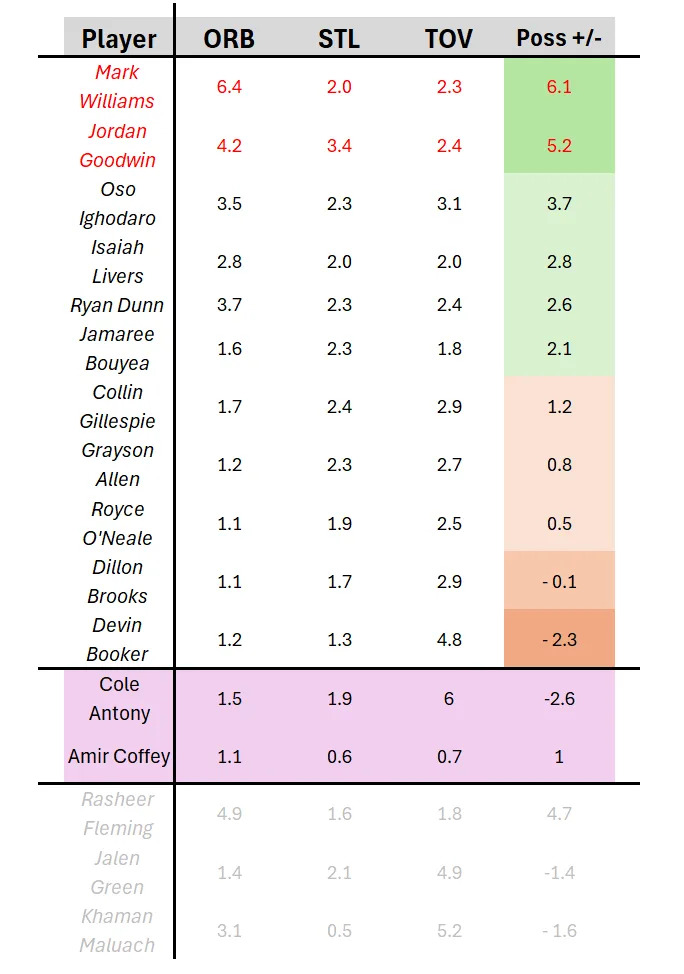
To better visualize this possession gain, I imagined a small formula: (OREB/g + STL/g) – TOV/g — it’s not perfect science nor an absolute truth, but a trend indicator with a margin of error. And with this formula, the Suns gain on average +7.8 possessions per game.
For comparison, the best defensive team in the league, OKC, is at +6.3. Houston, who are the best offensive rebounders, are at +9.8. The Celtics, who are the team that loses the ball the least this season, are at +8.2. And finally, the Pistons, who are the most balanced team in this area, are at +7.8.
Advertisement
Phoenix doesn’t need to be perfect to win; they have a structural engine that gives them 6–10 extra possessions per game. But unfortunately, a big lack of shooting success on some nights places them in the Play‑in zone even though they generate as many extra possessions as the top‑3 teams.
But how is the team organized to generate so many extra possessions? Well, they rely on a clearly defined system and style of play: a constant physical presence in the dunker spot, combined with a sort of all‑in approach to maximize the chances of grabbing the offensive rebound. We can see it clearly in the action below: it starts with a pick and roll between Mark and Devin to swing the ball to Dillon in the corner, Booker positions himself in the dunker spot while the rest of the team comes to support him in that task. As a result, Embiid is focused on Devin Booker, which leaves Mark Williams free to do his job.
Then the team also relies on a super aggressive and oppressive defense that is not afraid to jump passing lanes or closeouts. The system is disruptive, which allows Phoenix to force many turnovers, like here against the Blazers: they try as much as possible to poke the ball loose (on passes or on-ball) while staying close to their matchup, Jordan Goodwin succeeds, and can go straight into transition.
Speaking of Jordan Goodwin, the wing ranks among the best in the league in this possession‑maximization profile. If we take the raw formula from earlier and standardize it per 100 possessions to make it more representative, Goodwin alone generates +5.2 extra possessions per 100 possessions. And that’s not all: among all players with +250 minutes this season (yes, that’s a lot of players…), Jordan Goodwin is the only one combining +7% OREB% and +2% TOV%. If there is one player whose value is underestimated, it’s him. At the end of the season, he should be one of the priorities when salary negotiations begin.
Phoenix doesn’t dominate through pure talent, but through volume. And it’s clear that the day efficiency matches intention, this team will move into another category.