
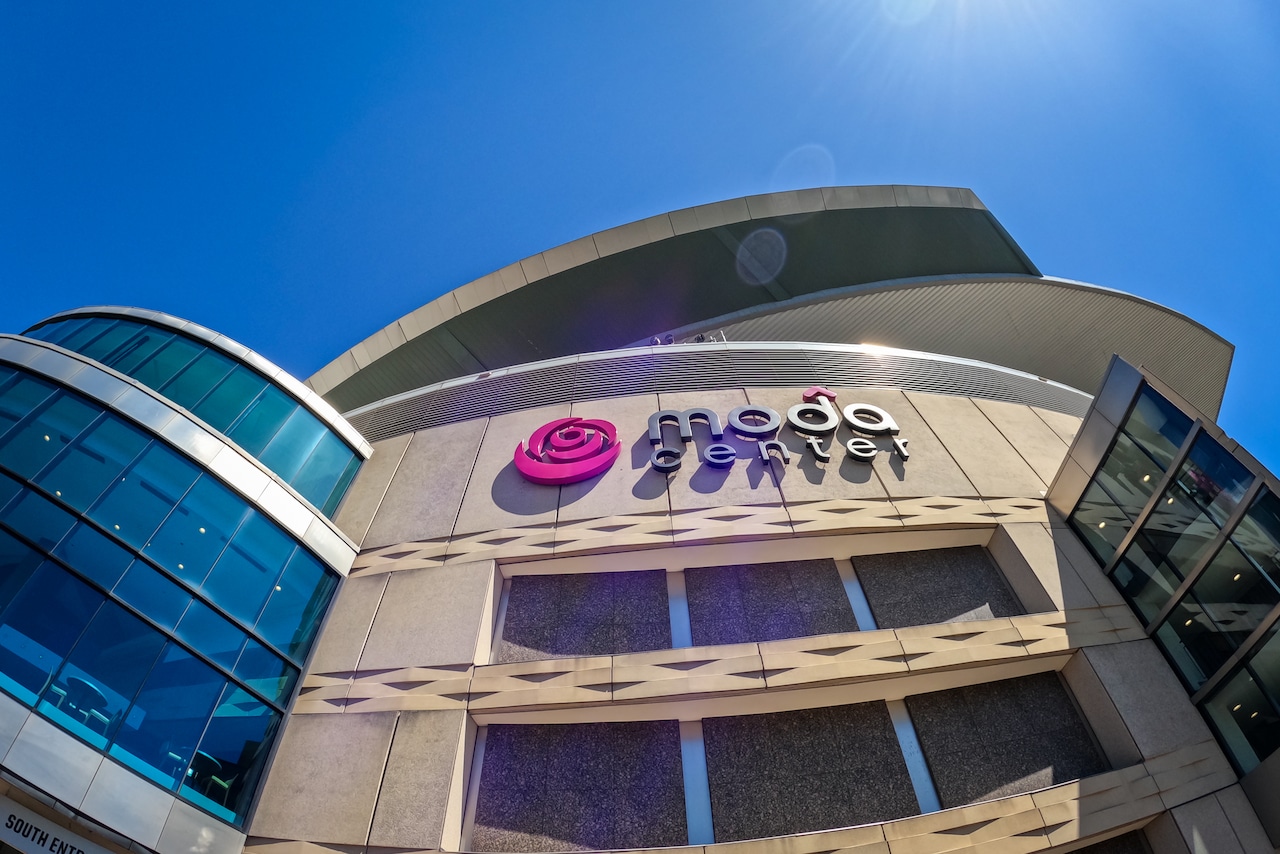
Efforts to secure public funding to renovate the aging Moda Center formally ramped up on Monday with the introduction of a bill in the Oregon Senate that drew widespread support from government leaders, including Gov. Tina Kotek.
The legislation, Senate Bill 1501, would divert income taxes from performers and athletes, including the high-paid Portland Trail Blazers, to a new Oregon Arena Fund and give the state joint ownership of the building with the city of Portland.
“The Moda Center, with the Portland Trail Blazers as its anchor tenant, is a source of civic pride and is critical to the strength and continued growth of our local, regional, and statewide economies,” said Senate President Rob Wagner, who sponsored the bill. “Renovating Oregon’s Arena is the best investment we can make in Oregon’s economic future.”
As part of the bill’s rollout, the Trail Blazers launched a website in support of the project; NewModaCenter.com explains the proposal and shows some preliminary renderings of a reimagined arena, including an open concourse design that would allow visitors to see into the building’s bowl when walking around the arena.
Shortly after the bill was introduced, Kotek issued a joint statement with Wagner, House Majority Leader Ben Bowman, Portland Mayor Keith Wilson, Portland City Council Jamie Dunphy and Multnomah County Chair Jessica Vega Pederson demonstrated broad, intergovernmental support for the proposal, saying they were “fully aligned.”
“The key to ensuring Portland remains Rip City for years to come is a significant renovation of Moda Center, the oldest venue where the NBA plays that has not undergone a major renovation,” the leaders wrote. “We must invest in this publicly-owned, community asset that serves as an economic engine for our state and brings millions of Oregonians and other visitors together each year for concerts, family shows, and community events.
“This is so much bigger than basketball. A renovation of Moda Center will ensure our largest city, and therefore the state, can be competitive in attracting stops for national concert tours, as well as future marquee athletic events like the NCAA Women’s Final Four, which Portland will proudly host in 2030.”
The proposal marks a step forward in the scramble to secure funding for Moda Center upgrades before Texas businessman Tom Dundon takes over control of the Trail Blazers later this spring. NBA Commissioner Adam Silver expressed last year that Portland would soon be in need of a “new arena.”
The Blazers lease with the city extends only through 2030 and without major renovations to the arena it is widely assumed that Dundon would exercise his leverage to consider relocation.
The proposed legislation states that the funding for the arena will only be provided as long as “a men’s professional basketball team has entered a legally binding agreement to lease the Moda Center for a specified term,” generally understood to be 20 years.
The joint statement was unambiguous about the intention of the effort: “As we vet this proposal in a full public process, we are confident that lawmakers of all backgrounds and party affiliations can agree: Keeping the Blazers in Portland for years to come is a top priority for our economy.”
The bill introduced on Monday did not lay out specific numbers for the project, but multiple sources have told The Oregonian/OregonLive that the state is expected to provide $360 million in bonding toward what the Blazers hope will be a $600 million project.
A spokesperson for the city said last week that Portland would contribute roughly $125 million to the project up front plus roughly $12 million annually toward ongoing capital projects and operating costs for a total of $365 million over the lifetime of the investment. The city’s proposed contribution is expected to include $75 million in funds secured through the city’s clean energy fund. That may prove controversial as the process unfolds.
Multnomah County leaders have signaled a willingness to contribute just over $75 million to the project but their inclusion of approximately $40 million in additional tax revenue generated by the eventual sale has been a sticking point in negotiations.
Creating the joint operating fund allows the state to access general obligation bonds over 20 years to fund the project.
Moda Center first opened as the Rose Garden in 1995. The original project cost $262 million, including $34.5 million from the city and $46 million directly from Paul Allen. The rest of the project was funded by private lenders.
Ownership of the arena transferred to the city last year as part of the Blazers bridge lease agreement through 2030. That creates a relatively tight window for the scale of renovations the Blazers envision and the NBA is likely to demand.
Team leaders have proposed renovations over three consecutive summers beginning in 2027, a plans that sets up the NCAA Women’s Final Four in 2030 as the coming out party not only for a updated building and a rebounding city.
According to Wagner’s announcement of the bill, 1.6 million people visit Moda Center annually with a regional economic impact of $670 million and the arena supports 4,500 jobs.