
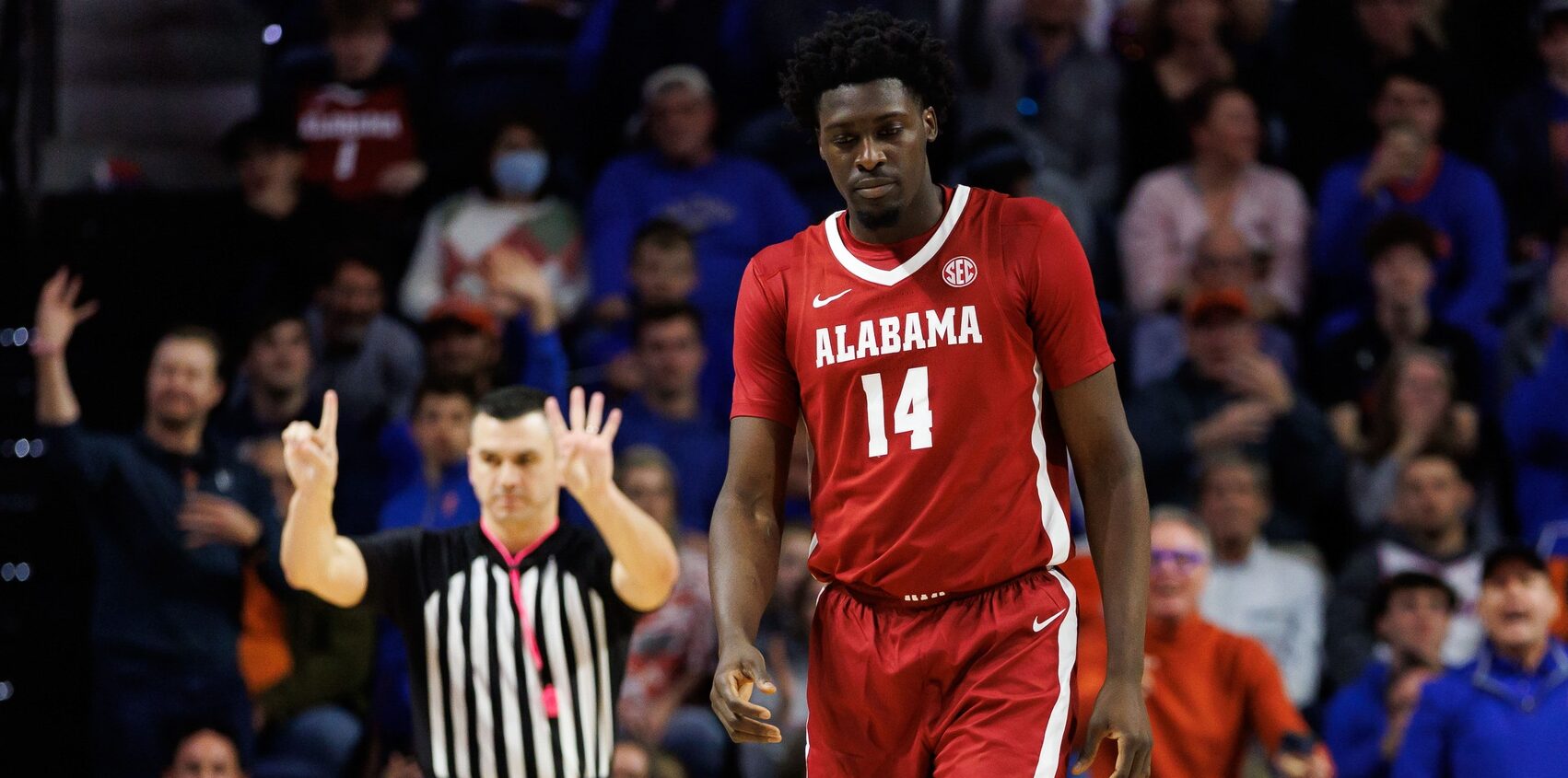
Tuscaloosa County Circuit Court Judge Daniel Pruet ruled against Alabama center Charles Bediako in his eligibility case versus the NCAA after Friday morning’s injunction hearing. Bediako was seeking preliminary and permanent injunctive relief after the NCAA previously ruled the former NBA G League player ineligible to return to college basketball last month.
Friday’s injunction hearing represented a pivotal moment for both Bediako and the NCAA, which is currently facing a multitude of legal challenges to its eligibility rules. Next week alone, NCAA lawyers are due back in court for three similar preliminary injunction hearings — the Diego Pavia class action suit on behalf of ex-JUCO players (Feb. 10) and separate suits involving Ole Miss QB Trindidad Chambliss and Tennessee QB Joey Aguilar in their effort to play in 2026 (Feb. 12 and 13, respectively).
During the Feb. 6 hearing, Bediako’s attorney, David Holt, revealed Bediako made $530,000 in two full years playing in the G League, but would not reveal any potential NIL deal the 7-footer may have in the works at Alabama, only suggesting it’d be variable based on further exposure while playing this season.
Meanwhile, NCAA attorney Taylor Askew argued Bediako’s case is “about money,” not academics, and an injunction would be an “extraordinary remedy” and suggested it could lead to “50 more lawsuits” and further “chaos” for the NCAA. Askew also suggest Bediako’s four-year eligibility window has already expired after playing two years at Alabama and two years in the G League.
The NCAA’s case against granting the 23-year-old Bediako eligibility stems from his decision to enter the 2023 NBA Draft following the 2022-23 college basketball season, as well as the fact that he subsequently signed multiple professional contracts with three NBA teams. That includes a two-way deal with the San Antonio Spurs in 2023 that would have made him eligible to play in the NBA if the team elevated him from the G-League. Prior to entering the NBA Draft, Bediako played 68 career games across two seasons (2021-22 and 2022-23) in Tuscaloosa.
Prior to Friday’s hearing, SEC commissioner Greg Sankey took the unprecedented step of siding with the NCAA against a player from his own conference when he submitted a legal affidavit as part of the NCAA’s 48-page motion opposing Bediako’s injunction request that was submitted Thursday.
“I respectfully ask the Court to uphold the NCAA eligibility rules challenged in this case,” Sankey wrote, according to documents obtained by On3’s Pete Nakos, “which are essential to the integrity of college sports, to the educational mission they serve, and to the opportunities they provide for current and future student-athletes.”
A prior judge granted Bediako a temporary restraining order (TRO) on Jan. 20, as well as a subsequent 10-day extension, that deemed him eligible to play in the Crimson Tide’s last five basketball games over the past two weeks. The 7-foot former professional re-enrolled at Alabama last month after three years in the NBA G-League with the hopes of completing the final season of his five-year collegiate eligibility window that began when he first enrolled in 2021.
Since being granted an original TRO, Bediako has started two of his five appearances for the Crimson Tide (16-7, 6-4 SEC), averaging 10 points, 4.6 rebounds and 2 blocks per game. Yet, despite Bediako’s presence, Alabama fell from the Top 25 rankings last week after dropping two of the first three games in which he appeared.