
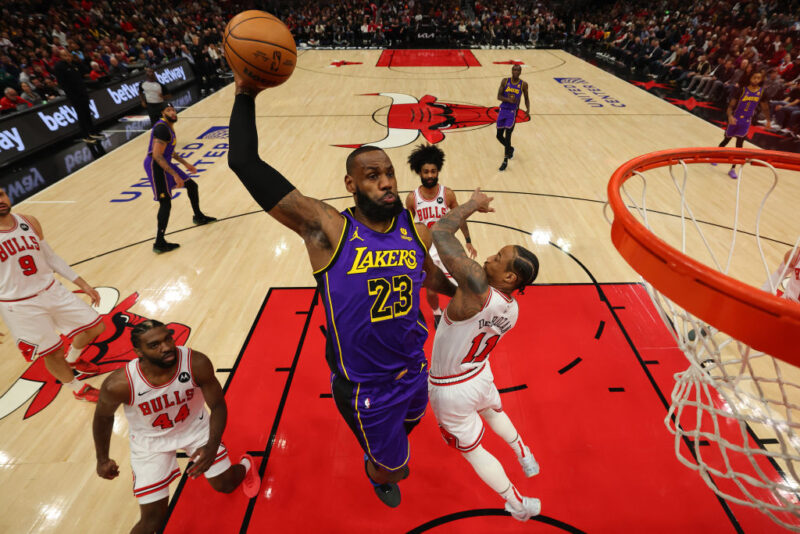
How the NBA’s rule changed the meaning of durability
LeBron James saw his 21-season All-NBA streak end Tuesday when the Los Angeles Lakers ruled him out against the San Antonio Spurs with left foot arthritis.
As a result, the absence dropped James below the NBA’s 65-game minimum for postseason awards. Under league rules, players must meet that threshold to remain eligible for major honors.
In recent seasons, the regulation has played a central role in how the league evaluates player value and durability. Award voters increasingly prioritize consistent availability alongside statistical production. A player’s impact over a full season now matters as much as peak performance. The rule reflects the league’s effort to reward reliability and discourage strategic absences. As a result, durability has become a defining measure of modern excellence.
Still, James’ streak represented far more than simple availability. He first earned All-NBA honors in 2005, his second professional season. He qualified every year across stints in Cleveland, Miami, and Los Angeles. Along the way, he played under multiple head coaches, including Tyronn Lue in Cleveland, Erik Spoelstra in Miami, and Frank Vogel in Los Angeles. Each emphasized different systems, from high-tempo offenses to defense-first structures.
Yet roster turnover never disrupted his consistency. In Cleveland, James first led young rebuilding rosters, then later guided veteran championship groups built to contend immediately. His move to Miami placed him in a star-driven system alongside Dwyane Wade and Chris Bosh, where he learned to balance scoring with shared leadership. With the Lakers, James adjusted again as the roster shifted around Anthony Davis and developing role players, proving his ability to adapt to changing personnel and expectations.
Throughout his career, LeBron James adjusted to evolving offensive identities. In his early Cleveland seasons from 2003 to 2010, offenses relied heavily on isolation and downhill drives, with James creating most scoring opportunities himself. During his Miami years from 2010 to 2014, systems emphasized pace, spacing, and structured pick-and-roll actions. Later stints in Cleveland and Los Angeles featured motion-based sets and spread floor attacks, where he operated as a primary facilitator. In recent seasons, he has functioned as a point forward, controlling tempo and directing half-court offense. That ability to adapt across systems and eras kept him among the league’s elite for more than two decades.
Over time, James reshaped his game to match each stage of his career. Early on, he relied on strength and explosiveness to attack the rim. As defenses adjusted and his athleticism declined, he expanded his skill set. He became a primary ball handler who controlled tempo and spacing. He learned when to slow possessions and when to attack mismatches. That understanding of timing and defensive coverage extended his prime and preserved his elite impact.
Even now, James continues to produce at a high level. He averages more than 20 points and ranks among the team leaders in assists and rebounds. Late-clock possessions still run through him.
Scroll to continue reading
For Los Angeles, he remains the primary offensive connector. He runs pick-and-roll actions with Davis. He reads help defenders and finds shooters on the weak side. Control of spacing and tempo remains central to his role.
In half-court sets, James hunts mismatches and forces switches. Smaller defenders face post-up pressure. Slower big men struggle to contain his drives. As a result, his scoring emphasizes efficiency over volume.
Meanwhile, availability now outweighs raw output. League officials introduced the rule to limit excessive load management and protect competitive integrity. Teams must balance long-term health with award eligibility, seeding position, and public expectations.
That balance presents a major challenge for the Los Angeles Lakers. They need LeBron James healthy for postseason play, but they also need continuity to build chemistry and execution. Extended absences disrupt rotation patterns and limit lineup data for playoff preparation. When James sits, transition efficiency declines and early offense opportunities decrease. Half-court spacing tightens without his gravity and playmaking. Defenses load up on primary scorers, forcing role players into higher-usage situations. As a result, shot quality drops and offensive predictability increases.
On the defensive end, his absence affects communication and structure. James regularly calls out coverages and directs teammates into position. Anticipation of passing lanes limits open threes and backdoor cuts. When he sits, rotations arrive later, and breakdowns occur more often.
Ultimately, the streak’s end reflects modern career management. Longevity now depends on medical planning and selective usage. Durability requires strategy, not just toughness.
Even so, James remains an elite influence. His vision and leadership continue to shape winning possessions. Rather than signaling decline, the milestone highlights adaptation.
For Los Angeles, success now depends on timing his peak rather than maximizing appearances.