
Former NBA combo forward Robert Horry knows a thing or two (or seven) about winning.
MORE: 3-time All-Star, Lakers champ breaks down insane 2000 NBA Finals run
The 6-foot-10 University of Alabama product enjoyed one of the most decorated careers in league history. Horry is the only player unaffiliated with the Bill Russell-era Boston Celtics to have netted seven NBA titles. He won back-to-back championships with the Houston Rockets in 1994 and ’95, three titles in a row for the Los Angeles Lakers from 2000-02, and a final pair with the San Antonio Spurs in 2005 and ’07.
Wherever Horry went during his 16-season career, he won. His teams advanced to at least the second round of the playoffs across all of those 16 seasons.
Robert Horry Gearing Up for 2026 All-Star Weekend in Los Angeles
Now a commentator for Spectrum SportsNet, Horry will be on hand for 2026 NBA All-Star Weekend festivities in his backyard of Los Angeles.
“I’ve always felt like it was a basketball town. You think about a city that has a great NBA and a great college team — you think of UCLA, you think of the Lakers. So you think about all the great players that have come out of the LA area,” Horry tells The Sporting News.
Los Angeles has long been a key resource for elite hoops talent. That remains the case in the modern game. Horry takes pains to cite several future Hall of Famers who stem from Southern California.
“You think about who’s in the league now — you think about [Russell] Westbrook, [James] Harden, DeMar DeRozan, Paul George — and so it’s a basketball city, man. You think about all the great football teams and hockey teams that’ve come through here but at the end of the day, I think basketball is king.”
Among this group, six-time All-Star DeRozan hails from Compton, nine-time All-Star George calls Palmdale home, 2018 MVP Harden was born in Compton and went to high school in Lakewood, and 2017 MVP Westbrook remains the pride of Long Beach. DeRozan and Westbrook stayed local for college, plying their respective trades for USC and UCLA before declaring for the league.
All three of Harden, George and Westbrook have played for their hometown Los Angeles Clippers (along with two-time Finals MVP Kawhi Leonard, another LA native). For extra credit, Westbrook also spent a year and a half with the Lakers prior to his Clippers run.
During Horry’s own Lakers years, from 1997-2003, the ahead-of-his-time stretch forward made quite the impact on the city. Though he himself was never named an All-Star, the skilled marksman proved to be such a critical cog for three very distinctive multi-time championship squads that his clutch playoff buckets earned him the nicknames “Big Shot Bob” and “Big Shot Rob.”
When The Sporting News addresses him as Big Shot Bob, he seems to approve.
One commonality that Horry’s Rockets, Lakers and Spurs title teams shared? All were anchored by a dominant, Hall of Fame-caliber big man.
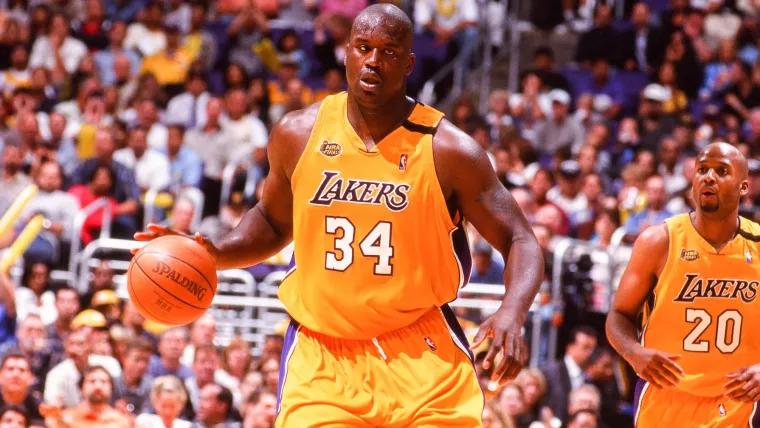
In Houston, that was 1994 MVP center Hakeem “The Dream” Olajuwon, known for his impeccable footwork and relentless interior presence. With the Lakers, 2000 MVP center Shaquille O’Neal was so strong and powerful in the post that even triple-team defensive coverages couldn’t really contain him at his absolute apex.
Finally, two-time MVP San Antonio power forward Tim Duncan’s sneakily un-flashy skill set, heavy on fundamentals that extended from play around the rack to a scarily efficient midrange game, wore down the opposition.
Horry provided a crucial release valve on offense to all these players as a scorer off the catch. The MVP bigs would draw the defensive attention, and kick out the basketball to the prolific Horry.
How did these superstars approach the game and their roles as the leaders of their respective clubs?
In a revelatory insight, Horry insists that all opted to guide teammates with their actions on the floor, and weren’t nearly as vocal as one might naturally expect all-time greats to be.
“I think when you look at the way Dream and Tim played, it’s kind of the same, they kind of led by example. And they were both quiet guys, but in the locker room, between players, they would say stuff,” Horry reflects. “They weren’t rah-rah guys. Shaq was not a rah-rah guy, but when he was pissed off and wanted you to get him the rock, he would let you know.
“And Dream was like that a little bit, and Tim wouldn’t say anything. I would have to stand up for Tim, like, ‘Get the ball inside. We’re shooting too much Tony [Parker], we’re shooting too much Manu [Ginobili]. Get the ball to Tim.’ Because I’m all about whoever has the greatest advantage offensively, that’s who you go to,” Horry adds. “And you think about those bigs that I played with always had the greatest advantage, because there’s really nobody [that] could guard them. And I think that is the one key that’s always made those guys great, because they led by example.”
Quiet confidence was the name of the game, Horry insists. In fairness, letting their games do the talking helped Olajuwon, Duncan and O’Neal nab a combined 11 titles over the course of their careers — of which, again, Horry was a part of seven.
“With Tim, with Shaq and with Dream, they weren’t boisterous,” Horry says, “Shaq would just dunk on someone, that would get us excited. Dream would just Dream Shake someone, Tim would just bank [over] someone… If you’re a great player, you don’t need another player to amp you up. The only person you need to amp you up is the man in the mirror.”
At the All-Star Game this weekend, plenty of superstars will continue to build on their legacies and cement their legends. When it comes to apparently quiet MVP big man leaders, the clear descendant of that school is three-time MVP Denver Nuggets center Nikola Jokic, who often shows more emotion overseeing offseason horse racing than he does making deep playoff runs.