
TORONTO – It was clear before tipoff that the story of Wednesday’s game would, some way or another, come from the centre position.
The return of Jakob Poeltl, giving the Raptors their planned starting five for the first time since Nov. 21. The suspensions of Jalen Duren and Isaiah Stewart, destabilizing one of the best frontcourt rotations in the NBA this year. A thumb-related absence for Collin-Murray Boyles, the second game as a Raptor for Trayce Jackson-Davis, or hell, even a rare appearance from Pistons G League standout Tolu Smith.
No shortage of angles. No shortage of wrong answers. Early in Wednesday’s 113-95 loss for the Raptors, it was all about the fill-in Pistons starting five, for years the crown prince of League Pass Twitter: B-Ball Paul.
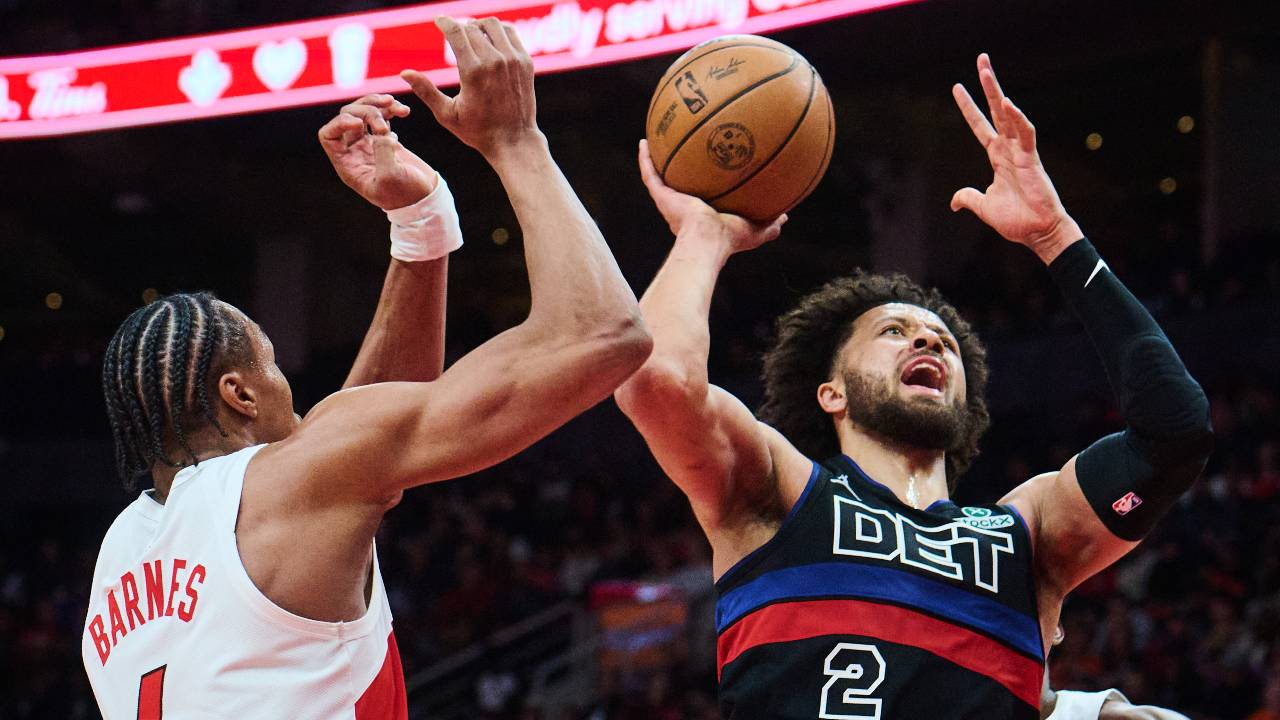
Sure, Poeltl’s return is a more important development, and dual suspensions for the Dawg Pound bringing physical hoops back to Detroit are newsier, and Cade Cunningham was unbelievable.
But it was Reed who ran with the opportunity, both in his rotation placement and against a Raptors frontcourt that didn’t know what to do with him. He’d scored 11 points by Darko Rajaković’s first timeout less than five minutes into the game, then helped force another, angrier timeout 26 seconds of play later. By the end of the first quarter, he’d scored 16, and he’d finish with 22 on 10-of-17 shooting with five rebounds, three assists, four blocks, and two steals.
That the Raptors had no answer for Detroit’s third centre highlights a few things, beyond just the great fortune of even having a third centre when some teams can’t find two. Murray-Boyles was probably the matchup piece who was most missed, as his physicality and rebounding acumen – plus his ability to switch some pick-and-rolls and delayed cuts where Paul was fed by Cade Cunningham – could have helped neutralize him. Jackson-Davis, meanwhile, had a nice debut Sunday and a shakier follow-up, with some of the weaknesses on the scouting report (namely, his hands).
As for Poeltl, far more important than any matchup or outcome is that he was back on the floor. Sidelined since Dec. 21 with a nebulous back issue that went from day-to-day to week-to-week, required visits with specialists, and seemed to frustrate as much as perplex, Poeltl crossing the hurdle to live, active play is huge.
“It was encouraging that he was able to finally come back and play 20 minutes, as we had planned for him, and it was good to see that he did not have restrictions on the court,” Rajaković said.
The Raptors have hung in well during his absence, succeeding defensively with a smaller, switchier approach that dials up the aggression and trades some floor for ceiling. Poeltl, if healthy, offers more stability, the option to go a bit more conservative in the name of reliability, backline communication, and a place to funnel drives. It’s been on the offensive end where his absence has been more noticeable, with the Raptors thin on high-end screen-setters with roll gravity. Their system is designed in part with Poeltl in mind, and while Murray-Boyles is an adept passer and Scottie Barnes Is a positional chameleon, Poeltl operating near the top of the floor opens up hand-offs, cuts, and the pick-and-rolls that have followed a league-wide trend of declining usage.
Poeltl’s absence has hung over things for weeks. A vague back problem for a 30-year-old 7-footer makes the extension he signed last summer difficult to add into trade machinations, and that’s before getting to the well-what-if of a healthy Poeltl plugging some of the holes a trade would have aimed to. Poeltl isn’t going to start banging threes for the Raptors, but when he’s right, everything makes a bit more sense. Now, presumably, that is behind them, and behind him.
“I just try to be myself, if I know I’m gonna come out in a couple minutes anyway,” Poeltl said before his return. “Honestly, I think these first couple games, I’m just going to go out there and try to play as free as possible. Try not to focus on any of the back stuff that’s been going on, just try to go out there and play my game. And I think the rest will come naturally.”
Poeltl played 20 minutes over four shifts. He finished with nine points, six rebounds, and one turnover. He at times looked slow and stiff, at others more comfortable than he had in December. In other words, what you might expect after a moderate layoff.
“It felt pretty good. Obviously, not perfect,” Poeltl said after the game. “Still trying to find a bit of a rhythm, get my lungs back, trying to find myself again within our offence. But my back felt good, so I’m happy about that, in general. I felt okay just getting up and down. Those are the positives I can take away from the game.”
The results, if you care to evaluate them in a return game, were mixed. On paper, the Pistons missing Duren and Stewart could have been an easier landing spot for Poeltl’s return, taking away two brutes to bang with. Instead, Reed and a series of undersized forwards-at-centre spaced Toronto’s defence out, asking Poeltl to cover more space and run in transition. It left jumpers open for Cunningham, rim-runs open for Reed and, in general, the Raptors looked like a defence that had grown unfamiliar with this style rather than the smaller identity they’d had to play with of late.
On the other end, Detroit mostly handled Poeltl in the dunker spot with whoever was nearby, and while a few of his screens resulted in opportunities rolling to the rim, he’ll have to rebuild some chemistry with teammates who have played extensively without him.
“In theory, a lot,” Rajaković said Saturday of what Poeltl (and Jackson-Davis) can add for the offence. “We still have to see how the chemistry between those guys is going to develop. I want everybody to understand that everything starts with us on the defensive end before we talk about offence. … And from there, we’re going to be learning how to best use those guys on the offensive end and what it’s going to do to our spacing. Experience has taught me that a lot of times what you have planned, and what you’ve based on the film, it’s not necessarily what works in real life.”
An aside on chemistry: Missing key starters in Poeltl and RJ Barrett has a real effect. Redeveloping chemistry after absences is now, unfortunately, a necessity for any good team in the league. Consider that the Raptors hadn’t had their main starting five together in almost two months, that this was just the 13th time they’ve played together this year, and yet still they are top-20 in minutes played this year among all NBA lineups. Injuries, load management, building versatility; whatever the case, the NBA in 2026 requires figuring this stuff out in a hurry. (A positive: Entering Wednesday, that fivesome was above-average at both ends of the floor, a nice start for a small-ish sample.)
The bigs were, obviously, not the only story. Cunningham scored 28 points in 30 minutes on surgical efficiency, adding seven rebounds, nine assists, and three steals for good measure. He seems to take all of his matchups against his 2021 draft class peers the same way Barnes sizes up Evan Mobley, which is a fun subplot in Cunningham’s ascension to stardom.
Barnes did an admirable job when matched up on him in the first quarter, but using Barnes on a perimeter player removes his defensive playmaking strengths from the lower third, and nobody on the team can replicate that. Nobody could replicate it on-ball against Cunningham, either, and Cunningham had some fun in the minutes Barnes sat, exacerbated by Barnes’s first-half foul trouble.
The Raptors, who never once led, offered little resistance as the lead swelled as large as 23 in the third. Brandon Ingram faced extra attention that took away some of his opportunities and seemed to lead to a lot of passiveness elsewhere. Toronto had a characteristically light shooting night. The bench provided minimal scoring and even less from a positive lineup perspective. It’s hard to find an area Detroit didn’t outplay Toronto, including the battle for points in the paint, which is consistently a harbinger of Raptors outcomes. That includes 17 offensive rebounds to a team down two centres.
A week ago, this game looked like a big measuring stick for the Raptors. They are aware, in the locker room, that they have not played their best basketball against the league’s best teams. As the playoffs draw nearer, seeing how they stack up against potential playoff opponents is good information, motivation, or affirmation. Even with a few missing pieces – and maybe even more so, given who they were – this lays clear the Raptors have plenty of work left to do.
The lose drops the Raptors to 4-13 against the league’s top 10, with three of those wins coming early in the season against the Cavaliers (who only recently entered the top 10 after a few months of malaise).
“That says we’re 4-13 against really good teams. That’s what it says,” Rajaković deadpanned.
That record is 1-10 against the top six. Toronto will get two more cracks at Detroit as part of a much more difficult March schedule that will give them plenty of iron against which to sharpen themselves for April.
They will need to be tougher, with a bit more resolve, against the league’s best. It was noticeable in second-half collapses against New York and Orlando in recent weeks, too, and the Pistons will only grow more physical when fully staffed. The all-star break is well-timed for a Raptors team inching closer to full strength, but they’ll need that health to lead to renewed chemistry, and, somehow, greater toughness, quickly.