
Finally, the Chicago Bears’ offseason won’t center on mock drafts.
With top-10 picks in each of the past three years, almost every option was analyzed as we wondered if the Bears could find a long-term difference-maker in the draft.
So far, it looks pretty good with right tackle Darnell Wright, quarterback Caleb Williams, wide receiver Rome Odunze and tight end Colston Loveland.
Coming off an 11-6 season and a trip to the divisional round, the Bears’ short-term future doesn’t hinge on a draft pick. They aren’t selecting until No. 25, their latest first-round pick since 2011.
While the sense of urgency to select a blue-chip player isn’t as high with a later pick, hitting in this draft remains critical. The Bears’ salary-cap situation isn’t going to get much better in the short term, especially when it’s time for general manager Ryan Poles to extend his top players. Having productive players on rookie contracts allows him to keep the team’s trajectory pointing upward.
This is our first Bears mock draft, an exercise in getting to know prospects who could fit the Bears at positions of need. We relied on colleague Dane Brugler’s top 100 to help find players for Rounds 1-3. Pro Football Network’s mock draft simulator aided the Day 3 picks. It’s too early to know if a player will be available at any of these slots. Consider this an introduction to prospects who could be in play for the Bears as we prepare for the 2026 combine.
Note: Until the compensatory picks are announced, the selection numbers for Rounds 4-7 are TBD.
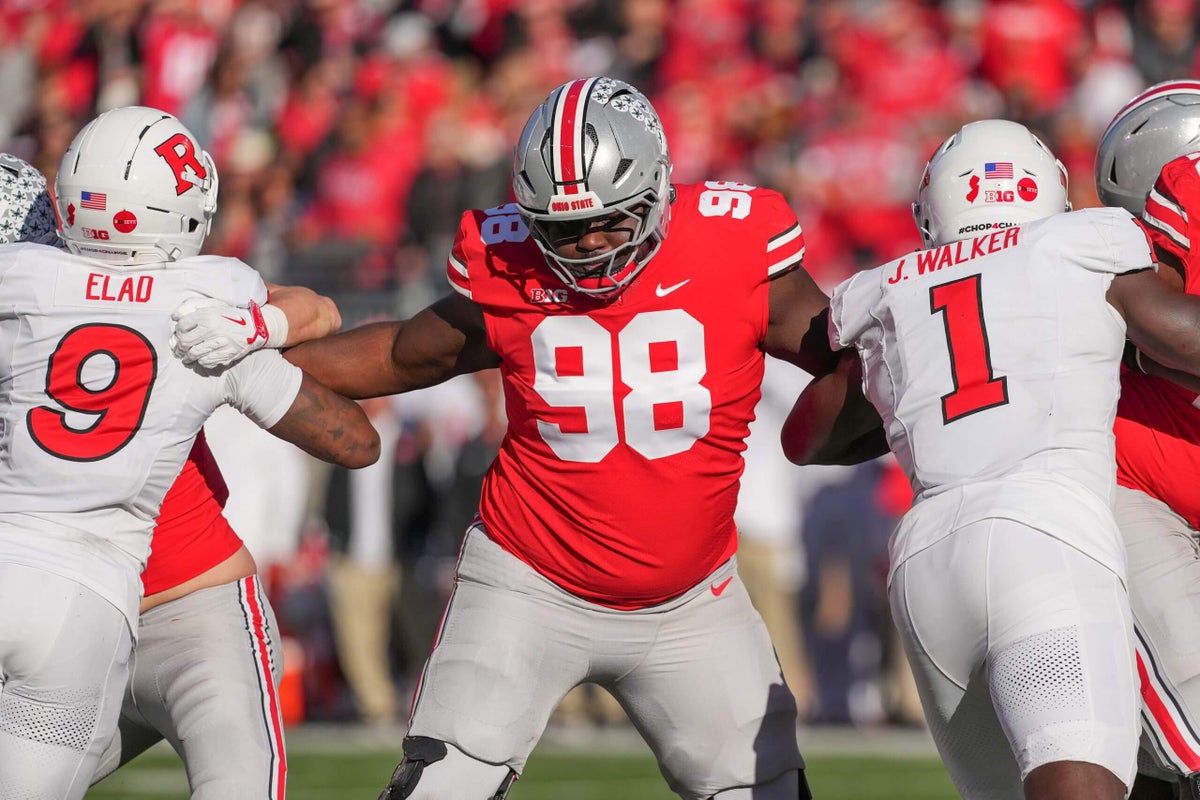
Round 1, No. 25 — Kayden McDonald, DT, Ohio State
McDonald seems to be the most popular selection for the Bears in these early mock drafts, and it’s hard to argue. He has the size (listed at 6-foot-3, 326 pounds) and had nine tackles for loss and three sacks last season. Brugler’s 26th-best player “is at his best as a run stuffer,” and that’d be welcome for a defense that gave up 5.0 yards per carry, 29th in the league and the franchise’s worst total since 2013.
McDonald will be only 21 this season, and with Grady Jarrett, Gervon Dexter and Shemar Turner returning, the Bears don’t have to rush McDonald into the rotation. Dexter is entering the last year of his rookie contract. Jarrett didn’t live up to his three-year deal, though he played better down the stretch after a September knee injury. Turner was playing more at defensive end before his injury. McDonald can be part of the present and future of a defensive interior that has to improve drastically.
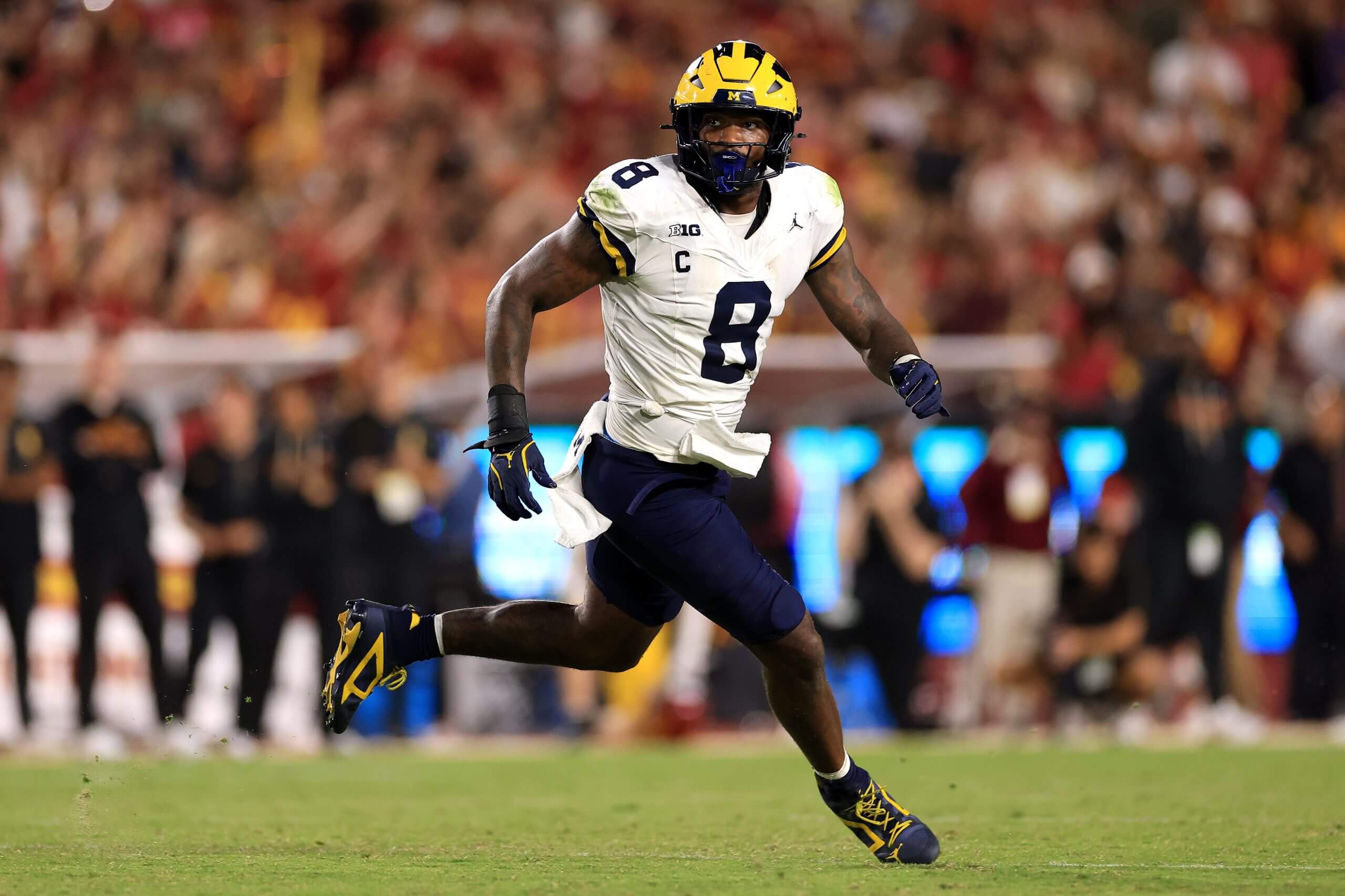
Michigan’s Derrick Moore could make sense for the Bears in the second round. (Luke Hales / Getty Images)
Round 2, No. 57 — Derrick Moore, Edge, Michigan
After two picks, the Bears have united a Buckeye and a Wolverine as reinforcements for a defensive front that needs more quality depth and is looking for added production in 2026. Defensive coordinator Dennis Allen leans toward pass rushers who are big, fast and long, and Moore (6-3, 254) seems like a prospect Allen could rally behind, particularly as he develops within a rotation that should also include Montez Sweat, Dayo Odeyingbo, Austin Booker and Turner.
Moore was a three-time All-Big Ten performer in Ann Arbor and also a team captain as a senior. He had 10 sacks last fall, showcasing his disruption potential as a bull rusher while turning heads with his motor and finishing prowess. His ability as a run defender will need improvement, but Moore plays to his strengths well.
Round 3, No. 89 — Keyshaun Elliott, LB, Arizona State
Defense is going to be the theme all offseason, and if the Bears choose to part ways with linebacker Tremaine Edmunds — thus creating $15 million in cap space — there will be a serious need at linebacker. Even if they keep Edmunds, he’ll be entering the last year of his four-year contract, and Day 3 draft picks Noah Sewell and Ruben Hyppolite have not panned out. Sewell emerged last season, but injuries continue to be an issue, and 2026 will be the last year of his rookie deal. D’Marco Jackson is set to become a free agent in March.
Enter Elliott, No. 85 on Brugler’s board. “With his ability to pick up pre-snap clues, Elliott diagnoses quickly versus the run and has the speed to chase down plays,” Brugler writes, adding that character is a plus for Elliott, which usually resonates well with Poles. He had 14 tackles for loss last season, to go along with seven sacks, outstanding production in the opposing backfield. Elliott could start alongside T.J. Edwards or begin his career as the No. 3, strongside linebacker.
Round 4 — J.C. Davis, OT, Illinois
The Bears’ left tackle opening is one of the most pressing needs of this offseason. It will not be a surprise if Johnson and Poles seek a veteran in free agency to join the competition for the starting role. But finding a younger, talented player in the draft to develop may also make sense.
In college, Davis was a three-year starter at left tackle, first at New Mexico and then, last season, at Illinois. Davis showcased his versatility at the Senior Bowl in January. Talent evaluators have been impressed with his combination of quickness and agility as a pass protector. He exhibits a good feel for the position and brings an edge to his run blocking. There may be something to work with here as the Bears seek solutions both short and long term up front.
Round 5 — Jalen Huskey, S, Maryland
Like with all positions, free agency will help dictate what kind of priority safety is heading into the draft. Barring the unlikely moves of re-signing all four safeties who are out of contract — Kevin Byard, Jaquan Brisker, Elijah Hicks and Jonathan Owens — it’s hard to see the Bears exiting the 2026 draft without a safety.
Huskey had 11 interceptions combined from 2023-25. A 6-2, 201-pounder, Huskey was second-team All-Big Ten last season and was Maryland’s defensive player of the year, in addition to being a captain. Size, ball skills, college captain — check, check, check. Taking a safety on Day 3 definitely helps special teams with the hope that he can develop into a starter down the line.
Round 7 — Barion Brown, WR, LSU
Deep into Day 3, the Bears have the opportunity to roll the dice and scratch the itch on special teams with the selection of a speedster. Brown is a return specialist who figures to test well at the combine. At 5-11 and 176 pounds, concerns about his size are merited. But his burst and athleticism jump off the screen. Over three seasons at Kentucky and one at LSU, he set an SEC record with six kickoff return touchdowns.
Brown is Kentucky’s career record-holder for kickoff return average (30.3 yards). In his college finale at LSU, he took a kickoff 99 yards for a score against Houston in the Texas Bowl. With Devin Duvernay coming out of contract, the Bears have the opportunity to add sizzle to their return game and can develop Brown in a specialized role.
Round 7 (from Eagles via Browns) — Markel Bell, OT, Miami
This is the exact part of the draft to select a tackle who is a shade under 6-9 and weighed 358 pounds at the Senior Bowl. Bell’s size alone is worth taking a chance on late in the draft as a developmental tackle prospect. He started for a Miami team that made it to the College Football Playoff championship game. There’ll be plenty of tape on Bell in big-time games. Tackle is a position to always keep an eye on restocking, as we wait to see how the Bears handle left tackle with Ozzy Trapilo recovering from a patellar tendon injury.