
If point guards are evaluated by how they create for themselves and others, then Darius Acuff Jr. deserves real consideration as the top guard among the 2026 NBA Draft Class.
I could start this article off by listing off some of the other guards within this class, but I would be doing to Darius Acuff Jr. what many have done to this point of the 2026 NBA Draft cycle:
Start a list of guards and maybe list him somewhere in the third through seventh spot.
I’m not going to do that. Instead, I want to spend this article explaining why Darius Acuff Jr. has been the “PG1” atop my Big Board for a couple of months now.
Darius Acuff Jr. has been awesome to start this season—and that’s with some lofty expectations. Coming out of Detroit, Michigan, Darius comes from a basketball family. His dad, Darius Acuff Sr., and his uncles were all immensely talented hoopers. Darius Acuff Jr. began training at a very young age (reportedly at three years of age). As his father imparted wisdom and continued to train him, Acuff Jr. was playing 12U basketball at the ripe old age of seven!
As Darius grew in age and in class, he would continue to be one of the more promising, ascending prospects. As a sophomore in high school, he won a Division 1 title with Cass Tech—averaging 21.4 PPG and 5.7 APG. Acuff Jr. was also named the MaxPreps Michigan High School Player of the Year and made the MaxPreps Sophomore All-American Team. During the 2023-2024 season, Darius led the EYBL Scholastic tournament (12 games) with 21.4 PPG. That same season, he played for his new team, IMG Academy, where he averaged 20.4 PPG and 5.5 APG.
2025 was a huge year for Acuff Jr., as he was a part of the USA Nike Hoop Summit team, was a McDonald’s All-American, a participant in the Jordan Brand Classic, was the 2025 EYBL Scholastic Player of the Year, and was the 2025 Allen Iverson National Player of the Year. All of Acuff’s hard work led to a slew of college basketball programs vying for his services. Kansas, Michigan State, Houston, Michigan, Kentucky, and UConn were among the top schools that offered Acuff a scholarship and recruited him, but Darius would opt to play for Coach John Calipari and the Arkansas Razorbacks.
Darius chose John Calipari—a coach synonymous with preparing young guards for the NBA.
Darius Acuff Jr. has been one of the better freshman prospects within this entire class.
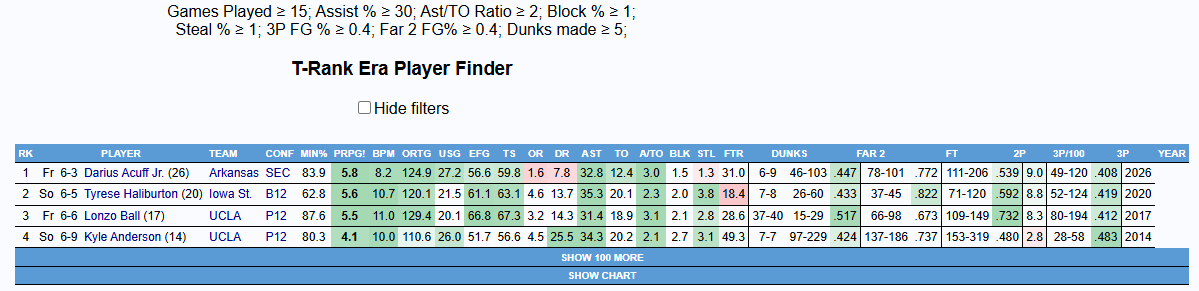
This query was run to see how Acuff Jr. compares to players of years past—among all players within the entire Bart Torvik database (dates back to 2008). This query is meant to highlight his cognition on both ends of the floor (Steal Percentage, Block Percentage, ATO, and Assist Percentage), his touch (Three Point and Two Point Percentages), and his athleticism (Dunks and Block Percentage). Since 2008, only four players in the “BT database have met the following thresholds:
Assist Percentage of at least 30.
Assist-to-Turnover (ATO) ratio of at least 2.0.
Block Percentage of at least 1.0.
Steal Percentage of at least 1.0.
Dunks Made of at least 5.
Far Two-Point Percentage of at least 40.
Three-Point Percentage of at least 40.
The only others: Tyrese Haliburton, Lonzo Ball, and Kyle Anderson.
It’s funny to think about now, but there were a lot of concerns regarding Darius Acuff Jr. and how he would translate at Arkansas. While he was obviously a talented player in high school, there were concerns across a number of areas within his game. One of the areas of concern was his three-point shooting. In his last season at IMG Academy, Acuff shot under 32% from deep on 8.2 attempts per game. For a guard of his size (listed at 6’3”), the perceived lack of shooting would place him quite low on many consensus big boards.
Let’s look here at our guy, Acuff (#5 in white), showing that he can quickly be integrated into any system with the way he is shooting the ball. In this clip against Vanderbilt, we see Arkansas pushing the break—with Darius running the lane along the right side of the court. When D.J. Wagner (#21 in white) gets the ball on the left side and attacks the middle, the defense has to converge on him. Darius understands this and presents himself as open to his teammate. He gets into his shot immediately and swishes in the open three.
Per our friends at Synergy, Acuff is hitting just under 54% of his open catch-and-shoot three-pointers on the season.
It’s one thing to be able to hit stationary threes off the catch—and there is something to be said about opening lanes for others—but how effective can Darius be running off screens?
We see an example of such a look in this clip against Houston. This clip starts with our guy getting the ball to D.J. Wagner on the right side of the court. As Wagner dribbles the ball toward the top of the key, we can see how this play shapes up. Trevon Brazile (#7 in white) and Malique Ewin (#12 in white) get into position to stagger screen on the left side of the floor.
Darius does a great job of running baseline, which puts his defender, Emanuel Sharpe (#21 in black), into a tough spot—running through two screens. Darius makes a fantastic adjustment coming off the screens. He looks as if he is going to curl into a catch, but he pivots off his back foot and sort of flares back toward the left corner. The confidence to step into this shot is palpable. He is able to square up and cashes in the corner three.
Of course, there are several ways that guards have to be able to get to their shots at the next level. The true difference-makers are able to get to their shots off the bounce, and that’s where we will look now with Darius.
This clip begins with Acuff bringing the ball up the floor on the left side as he crosses halfcourt. Our guy is defended by Donovan Atwell (#12 in black) initially. As Darius crosses the halfcourt line, he gets into his two-man game with Ewin. Ewin sets a screen on Atwell to Acuff’s left. As Darius runs off the screen, Tech is forced to switch Ewin’s man, JT Toppin (#15 in black), onto Darius.
This is obviously a favorable matchup for our guy—especially at this spot on the floor. Toppin is on an island here. He has to try to position himself to contest any shot that Acuff could get in to, but he also doesn’t want to get blown past. Acuff doesn’t waste much time going at JT—likely because he doesn’t want the defense to adjust to this mismatch. After one cross to his left, he collects the ball and pulls up to shoot a three over Toppin.
We touched on the fact that Acuff is shooting well while playing off the ball, but he also ranks in the 71st percentile in dribble jumpers—shooting almost 39% on his dribble-jumper three-pointers.
High-usage guards punish mismatches effficiently. It may be more important (if not equally important) to be able to take his own man off the bounce. Acuff does this.
We’ll see the Razorbacks start this clip on a Baseline Out of Bounds (BLOB) situation. Acuff is the inbounder, and he delivers a well-placed pass to Ewin on the right wing. Our guy runs into the right corner next to Ewin and gets the ball handed off to him.
Darius is being defended by Kentucky’s Otega Oweh (#00 in blue), who is well regarded for his defensive ability. Darius dribbles the ball up to the right wing to have Oweh isolated onto him. After three dribbles, Acuff lulls Oweh to sleep a little bit and rises up over the top of him to drill an off-the-dribble three.
It seems a little silly now that there was so much placed on Acuff’s three-point shot coming into this season. Yes, he shot only 31.9% in his senior season on 116 attempts, but the year before, he hit 36.6% on 101 attempts. To this point of the season at Arkansas, Acuff is shooting over 41% from deep on 119 attempts.
Another area of his game that many questioned was his playmaking. Again, in retrospect, this seems a little silly. Perhaps his passing was overshadowed by his knack for getting a bucket, but Acuff has long had a great feel for getting the ball to his teammates. In his senior season at IMG, Darius averaged 5.3 APG. In his junior season, he averaged 5.6 APG. In those two seasons at IMG, he posted an ATO of 1.74 and 1.58, respectively.
With all of that in mind, perhaps we shouldn’t be all that surprised by the fact that Darius Acuff is averaging 6.2 APG with an ATO of 3.0.
In this clip against Duke, we can see how Darius leverages his handle and ability to pressure the rim into making plays for his teammates.
This clip begins with Arkansas inbounding the ball from the right sideline. Acuff is guarded by Caleb Foster (#1 in black). As he drives to his left, our guy attracts additional attention from Dame Sarr (#7 in black). Acuff recognizes the fact that he is drawing two defenders, and kicks the ball out to Trevon Brazile on the left wing for an open three-pointer.
Likely to be credited to his early initiation into hoops, Darius Acuff is able to feel openings within the defense and shows a real knack for when to make passes. His timing on this clip highlights the synergy that he has with his big man, Malique Ewin.
Arkansas uses our guy as the inbounder on this BLOB set. Similar to the Kentucky clip we looked at earlier, Darius finds Ewin on the right block. Acuff jets inbounds to get the ball back from Ewin, and the two men go into their two-man game. Darius has real touch from the mid range—as indicated by his 44.7% far two-point percentage. This means the defense has to respect the pull-up middy he looks to be getting into on this play. As Darius gets into his shooting motion, the defense responds. This leaves a cutting lane for Ewin to exploit. Acuff Jr. passes out of his shot to the diving big man, who throws down a dunk.
Darius Acuff has posted an Assist Percentage of 32.8—which only trails Kingston Flemings (34.6). This puts Acuff over Cameron Boozer, Keaton Wagler, AJ Dybantsa, etc. Acuff’s profile validates what we see on the film: manipulation and anticipation.
In light of the depth of the guards in this class, many are looking for lines of separation. Numbers and metrics are one way to delineate the best within this position group. However, strength and feel have continued to translate at a high clip to the NBA. We’ve looked at the feel of Darius, but it’s worth noting his stature. Listed at 6’3”, he is also listed at 190 pounds. Having seen Acuff in person, he looks to be very close to his listed height, and he is built to handle physicality. Darius is incredibly stout and has shown a good degree of finishing in the paint.
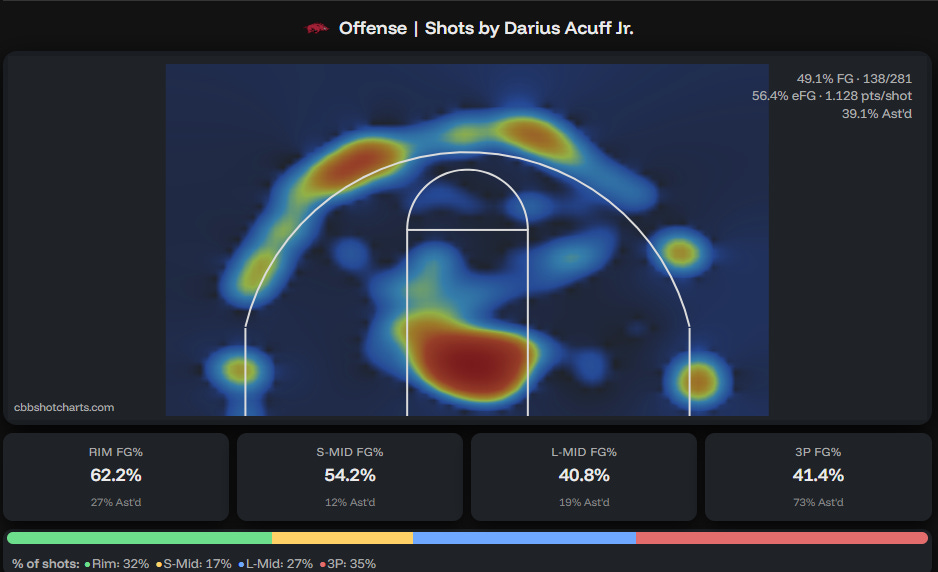
This chart is from cbbshotcharts.com—an awesome resource, by the way. This is Acuff’s “Heat Map” for the season, which shows where Darius has favored taking his shots. Notice how balanced Darius is at taking shots at multiple levels. Darius is taking about 32% of his shots at the rim. This is just 1% fewer than Kingston Flemings, but ahead of Mikel Brown Jr. (24% of shots at the rim), Christian Anderson (20%), and Bennett Stirtz (28%).
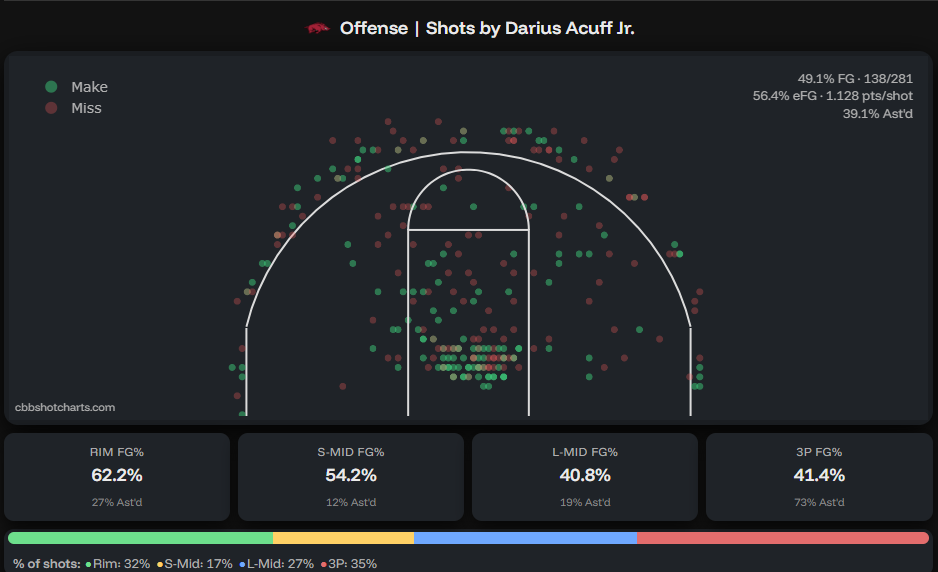
Not only is Darius getting shots up at the rim, but he is also connecting on over 62% of his shots there. He is only assisted on 27% of his at-rim shots. Synergy ranks Darius in the 64th percentile in at-rim finishing—which is impressive given his usage and role on the team.
One of the things about Acuff’s game that stands out the most is that he can get to his spots without needing a screen. Now, you could argue that this could be irrelevant in the NBA, given how pick-and-roll-heavy the league is. However, let’s not simply gloss over the natural gifts Darius possesses.
Kingston Flemings (#5 in black) is considered by most to be the best among this position group—in large past due to his defensive acumen. This slip shows Darius bringing up the rock and being picked up by Flemings. This is just old-fashioned one-on-one right here.
After a couple of dribble moves, Acuff crosses hard to the right after seeing Kingston had the wrong foot on top. Seeing Kingston’s left foot up top on the crossover, our guy drives hard—forcing his man to flip his hips and be at a disadvantage. Darius’ strength allows him to fend off the persistent Flemings, but Cedric Lath (#8) sees this and rotates over.
Darius is able to use some strong shoulder work to keep Kingston out of range from bothering the shot, but he is able to get off his layup before the help is in position to contest him. Notice how Acuff is able to twist around the defense and extend his right arm to finish in the paint. Excellent work.
Here is another example of mismatch hunting from Darius Acuff. Oftentimes, mismatch hunting is highlighted by a player blitzing through their man. We will see Acuff bring the ball along the right side of the court and go off a ghost action from Meleek Thomas (#1 in white).
Darius is defended by internet sensation, Tyler Tanner (#3 in black). Tanner has been praised for his defensive disruption despite his smaller stature. Darius is able to put his right shoulder and hip into Tanner to create separation. Once he has his man on his heels, Acuff spins off to his right, which gives him a clear alley to the hoop. You can see that Acuff may be anticipating a swipe from his man, who gets his hands out of the cookie jar quickly. Still, our guy is able to get a right-handed push shot off, getting past Tanner, and the shot over the top of the low-man rotation.
While screens aren’t required for Darius to get his shot off cleanly, he is very adept at using them—and forcing his man to be in disadvantageous positions. We go back to the Kentucky game here, as our guy gets the ball at the top of the key. Darius brings his man Oweh out on an island, with the rest of his team all deep along the baseline.
Acuff’s teammate, Nick Pringle (#23 in white), comes up to set a screen to Darius’ right. Darius waits for Pringle to be within close proximity to Oweh before he explodes to his left—away from the screen. Acuff is able to explode past his man fast enough that help isn’t remotely close to being able to contest the layup. Our guy is able to sail in and finish with the lefty lay-in.
Let’s put this out right off the top: this is the side of the ball that Darius is going to need to prove the most when it comes to translating to the NBA. In fact, Acuff’s defensive metrics and some of his defensive tape are why some are ranking prospects like Mikel Brown Jr., Kingston Flemings, and Keaton Wagler ahead of him. Is Darius Acuff that far behind on the defensive end? That’s what we’re going to address here.
Before we get into the tape, let’s take a look at some of the numbers.
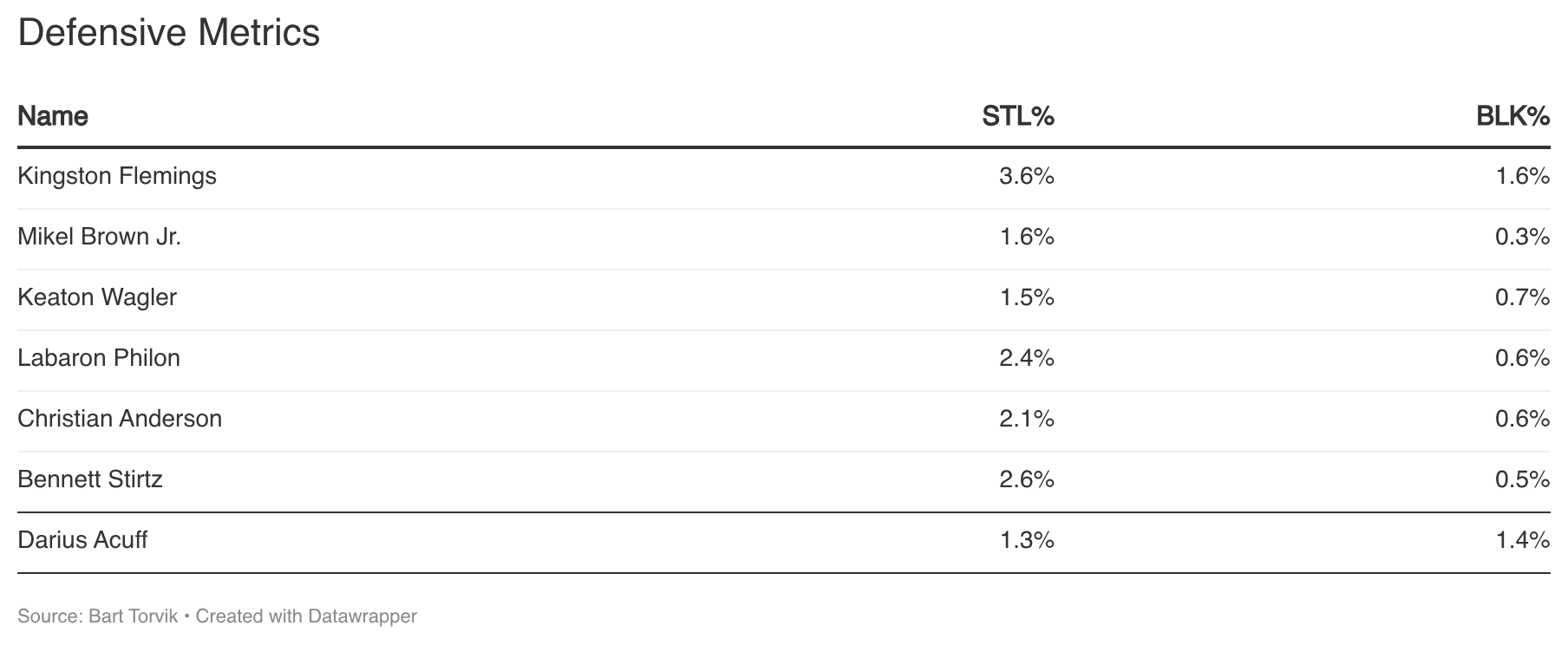
Yes, Darius Acuff Jr. ranks last among this group in Steal Percentage. Yes, that is not a good thing. However, is a 0.2% difference reason enough to be dismissive of a player? How about 0.3%? 0.8%? The margin among some of the players within the list does not provide a meaningful tier break in ability. Something noteworthy to point out here is that Darius Acuff Jr. is second in this position group in Block Percentage. Evaluators often use block percentage as an indication of both cognition and athleticism.
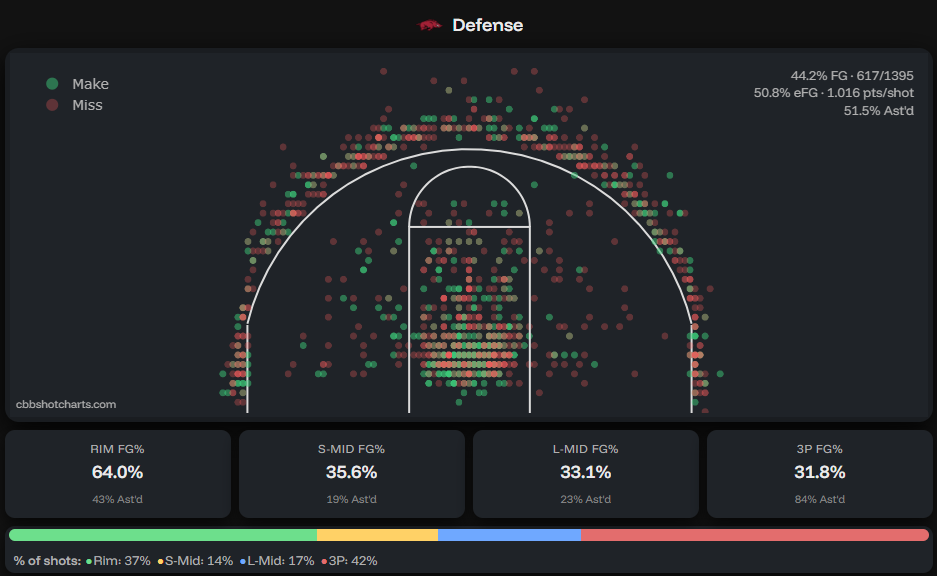
Take a look at this defensive shot chart for Darius Acuff Jr. If you aren’t one for defensive metrics being representative of a player’s defensive impact, this make/miss chart may show some defensive ability. Acuff is holding his assignments under 45% from the field altogether. Most of the shots that are taken against Acuff are from deep, and he is holding opponents below 32% from there.
Keaton Wagler is allowing 32.1% (-0.3%) from deep. Kingston Flemings is allowing 31.7% (+0.1) from deep. Mikel Brown Jr. is allowing 33.5% (-1.7%). Christian Anderson is allowing 32.8% (-1.0). Labaron Philon is allowing 31.1% (+0.7). Again, Acuff isn’t as far behind the pack as the narrative has led us to believe.
Let’s get into the film.
When you look at some of the defensive stuff from Acuff, a lot of it simply comes down to effort. Let’s take a look at a play where Darius is in the vicinity to make a play on defense, but there is a little bit of “let off” at the end of it.
Tyler Tanner is going to bring the ball up the right side of the floor to start this clip, with Darius as his defender. Acuff has a screen set to his left, which Tanner uses to attack on the drive. Before anything, I would recommend pausing this clip immediately following the screen set for Darius. Many guards will give up on the screen, but our guy is able to fight around it—something he does more often than not. Tanner then goes to explode along the right elbow and into the paint. Acuff is right there on his shoulder—in position to recover. Darius goes for a reach-around poke-out here, instead of being textbook or fundamental. Tanner feels this and then goes for a floater that drops in.
The defensive lapses that Acuff has on film are mostly engagement-bases, not tool-based. This is an important distinction for how Darius projects in his development.
I think clip, our guy is going to defend Dedan Thomas (#11 in purple) of LSU. Dedan is going to run Darius over to the right wing to start this clip. He goes into a quick back dribble to get separation from Acuff Jr. Michael Nwoko (#1 in purple) gets into position to set a screen on our guy to his right. Thomas fakes to go into the screen, and ends up rejecting it, driving to the right.
Dedan gets Darius on his left shoulder to create some space. Look at where Darius is in relation to his man—pretty similar to where we saw Darius on Tanner in the previous clip. Instead of going for a swipe or poke-out, Darius goes stride-for-stride with Thomas, elevates, and shows off his underrated athleticism to throw Dedan’s shot into the bleachers.
Again, Darius has the tools: bounce, length, strength, and IQ. Sometimes it’s just…not even hard, but it shouldn’t be expected for the team’s offensive identity to be a defensive stalwart on every possession—especially at Darius’s position.
In this clip, we’ll see Darius defending Xzayvier Brown (#1 in white) from Oklahoma. Brown gets to Darius at the top of the key, and gets into a few dribble moves. After a sharp cross to the right. Brown is able to put his shoulder into Darius, who does a good job of absorbing the contact. Xzayvier gets up into his mid-range shot quickly and is able to elevate to get into his shot. Darius gets up to contest, but is just a half-beat behind Brown’s jumper.
Darius has also only given up five shots when he has been isolated against, per our friends at Synergy. In this clip, Darius is manned up against Ilias Kamardine (#6 in white) of Ole Miss—who is listed at 6’5” and played professional basketball in France prior to this season.
Kamardine opts to go one-on-one against Darius on this play, after a quick screen that really did nothing of consequence. After dribbling to the right wing, Ilias crosses hard to his left and goes to the left elbow. Kamardine goes for a pull-up mid-range shot, but it’s contested very well by our guy, who bothers the shot and forces the miss from Kamardine.
Look, I get that Darius Acuff Jr. doesn’t have the sickest statistical profile. I understand that some other guards have lit up databases, models, and queries. But, he doesn’t have a poor model by any means. We looked at how balanced his scoring profile actually is—not how some are discussing it. We’ve taken a look at how Acuff came into the season with some legitimate concerns based on the high school film, and he has shown several more layers to his game than the consensus initially thought.
What should give teams, fans, and evaluators encouragement is his growth. The consistency on his jumper should empower folks to buy into his ability to get to his shot off of his own ability, while also spacing the floor for others. His playmaking and the way that he looks to get others involved give Darius the latitude to initiate offense at the next level. He is strong, which increases the likelihood that he can contribute more in a practical way as opposed to a hypothetical manner. He can shift gears and get into the paint without a screen due to his handle, strength, and flexibility. Is he the best defender at his position in this class? No. Does he have a path to become solid on that end? Yes. Should the defensive metrics negate the fact that he is the Alpha and the Omega for this Razorback team? Absolutely not.
In an NBA that prioritizes scalable shot creation and decision-making, Darius Acuff checks the two biggest boxes. Point made.
Follow me on Twitter: StephenGHoops
Catch me on BlueSky: StephenGHoops
Catch the Draft Sickos show LIVE on the No Ceilings NBA channel: