
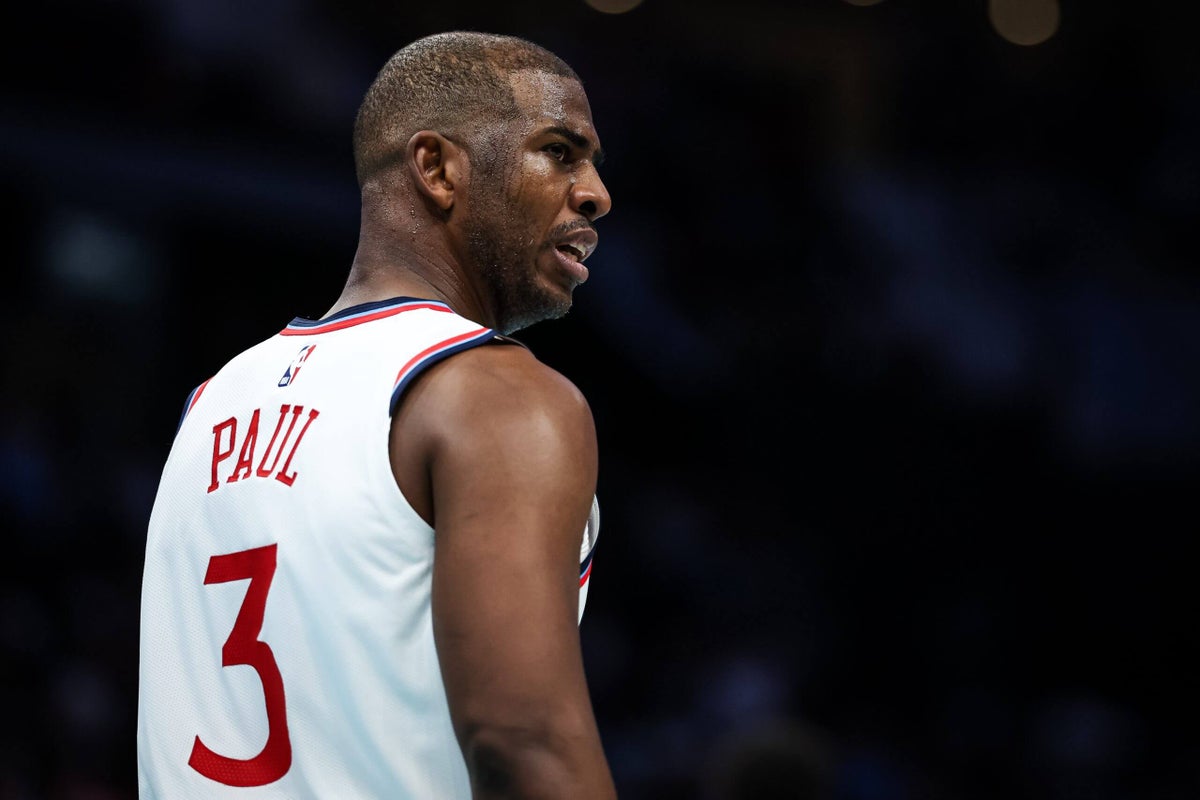
For two decades, one man appeared clairvoyant.
Dribble right, cross over to the other hand, and his palm would be there, as if he knew the move was coming. He’d toss a pass toward three defenders but would somehow manipulate them into veering the wrong way. Not since Matilda, the heroine of the Roald Dahl book, had anyone so effectively paired mind control with studiousness. Check into a game with the back of your jersey pouring over your shorts, and he’d spot it before the officials could, reminding the referees that an untucked uniform requires a technical foul.
Actually, forget about Matilda. This was Larry David with world-class hand-eye coordination and a jumper.
But no one, not even Chris Paul, could have anticipated that one of the NBA’s great careers would have ended like this.
Paul officially announced his retirement Friday. Twenty-one years after his professional career started, his final employer is technically the Toronto Raptors, the franchise that traded for the future first-ballot Hall of Famer earlier this week as part of a salary-cutting move, then released him. The transaction came only months after the LA Clippers, the organization he once carried from irrelevance to contention, banished him from the team because of personality differences during a disappointing 6-21 start to this season.
Mere months before that, Paul seemed destined for the finale that basketball legends (and Paul is in that category, whether you consider him one of the three, five, or seven greatest point guards ever) tend to receive. He had returned to the Clippers, the team with whom he was most associated. He had contemplated retirement for years. As he bounced from the Phoenix Suns to the Golden State Warriors to the San Antonio Spurs late in his career, his family stayed in Los Angeles. Being away from them was becoming too difficult for Paul.
This past summer, he returned to L.A., joining an organization that should one day retire his number. He announced early in the season that this one would be his last.
But he didn’t get his retirement tour.
It’s a reminder that none of us, not even those who obsess over details enough to convince the world they can see into the future, get to write our own stories.
Paul tried. Heck, if there is one piece of Paul’s career to remember, it’s that trying — whether that meant poring over scouting reports, perfecting his jump-shot form, giving up his favorite foods to sustain his body into his 40s or pestering Hall of Famers twice his size — was his brand.
Throughout his career, wherever Paul went, winning tended to follow. The New Orleans Hornets drafted him fourth in 2005, then won 56 games only two seasons later, when Paul finished second in MVP voting. He flipped the Clippers from 50 losses the year before he arrived to a 50-win pace in his first season there. It was, to that moment, the most promising team in franchise history. His Houston Rockets came the closest of any group to taking down the healthy Kevin Durant Warriors. The Oklahoma City Thunder had to delay their rebuild a year before Paul ensured they couldn’t lose enough as long as he was present.
Denver Nuggets forward Cam Johnson tells a story about the time he realized Paul operated on a higher level than anyone else around him. The two were teammates with the Phoenix Suns, another organization that Paul propelled from the bottom to the top.
Paul, a 6-footer who led the league in steals six times in seven years and deservedly forced his way onto nine all-defensive teams, was guarding fellow perennial All-Star Damian Lillard. Lillard went into a pick-and-roll with his center, Jusuf Nurkić. That’s when Paul deviated from the coverage Johnson expected.
The 12-time All-Star has always taken issue with what many refer to as “gambling” on defense, gunning for a steal that could put his four teammates at risk if he doesn’t end up with the ball. Some defenders are playing blackjack, Paul once told me. Paul is playing poker. He understands the probabilities before his feet move.
He stepped up on Lillard, who attempted to bounce a pass to Nurkić, but Paul’s hand was in the way. He deflected the ball, dove onto the ground to cradle it and called a timeout as he screamed in celebration.
This was Paul’s aura with the Suns, reminding anyone who would listen that, as Branch Rickey once said, luck is the residue of design. He is a basketball fiend, a viewer of the entire NBA slate every off-night. One game is on the television. Another goes on the iPad. He files away observations on players’ tendencies, able to absorb details from multiple games at once.
In this case, he knew a bounce pass was coming. When Lillard headed in that direction, a coy flip to the pocket was his most common move. Paul had noticed the habit and left his hand in Lillard’s go-to path.
These are the moments that will — or, at least, should — define Paul’s legacy.
Not the unceremonious way his career ended.
Not the lame “never won a ring” argument.
Not the extreme reactions, sometimes negative and sometimes inspired, he could rip out of the people around him. Paul doesn’t keep opinions to himself, enough so that this season’s Clippers kicked him off the team without taking away his paycheck. And then there are the people, such as reigning MVP Shai Gilgeous-Alexander, who credit their development to Paul’s presence. There are the ones who elected him the president of the players’ association.
“He’s flawed like all of us, but he’s probably tenacious enough to beat you anyway,” one of his former coaches told me.
Such is the defining characteristic of Paul’s career.
Not the gargantuan numbers.
Not the fact that he’s second on the all-time assist list and second all-time in steals.
Not that he was a pass-first basketball genius who could also drop 30 on you, especially early in his career, before the knee injuries, when he had more bounce than the younger generation probably realizes.
Not for the year-after-year efficiency. For someone whose approach was the opposite of shoot-first, Paul is surrounded by elite bucket-getters in the all-time scoring leaders, wedged between Lillard, Clyde Drexler, Elgin Baylor and Dwyane Wade.
The legacy of Paul shouldn’t even be plays like the one when he swiped the ball away from Lillard. It should be what happened in the moments after. He lay on the ground, holding the basketball tight enough that no one could rob him of it, shouting to no one in particular, “You gotta watch! That’s why you gotta watch!”
Johnson still remembers the line. How could he forget a player who was celebrating the reason for a steal more than the steal itself?
That’s quintessential Paul, a thinker, a schemer, a master of minuscule advantages who figured out the answers to the test before any of his counterparts could.