
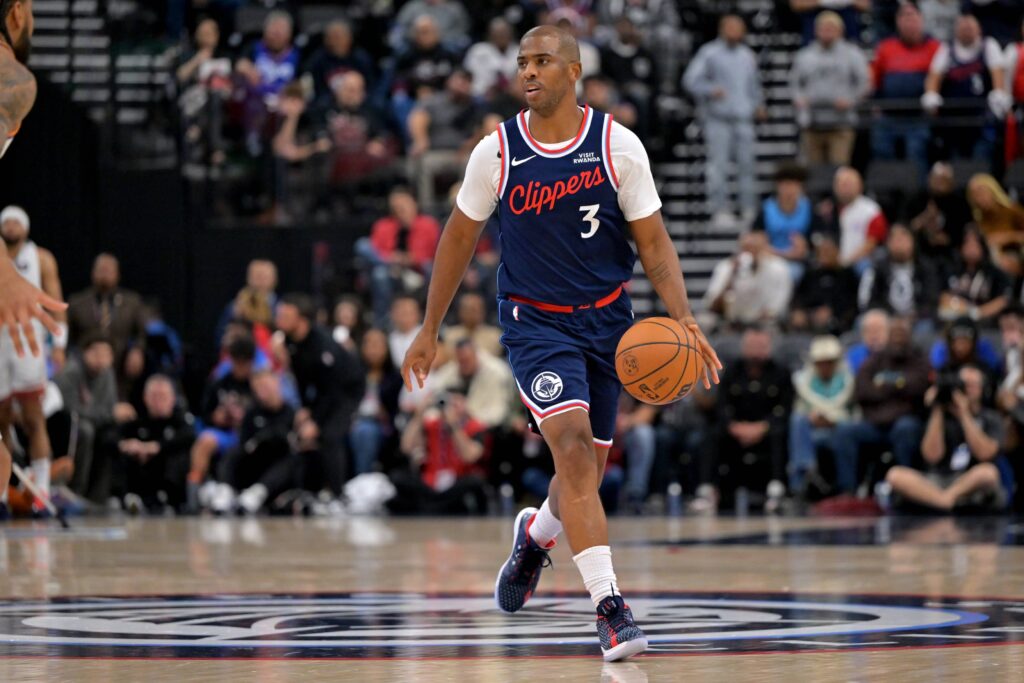
After 21 seasons of complete command of the hardwood from the point guard position, Chris Paul has officially called it a career. The 12-time All-Star steps away as one of the most decorated and respected floor generals in NBA history – a player who built his legacy not on athleticism, but on basketball IQ, discipline, and leadership.
From New Orleans to Los Angeles, Houston to Oklahoma City, Phoenix to Golden State, and San Antonio, Paul left every franchise better than he found it. He elevated young stars, steadied playoff hopefuls, and kept contenders organized in the tensest moments.
Nicknamed the “Point God” for his leadership on offense and stout defense, Paul retires with a resume that must be honored. Without further ado, here are 10 achievements that define his future Hall of Fame career.
1. 12-Time NBA All-Star
Chris Paul earned 12 All-Star selections across three different decades, a remarkable testament to both his peak and his longevity. From 2008 through 2016 (nine straight seasons), he was a fixture in the Western Conference backcourt, routinely going toe-to-toe with generational talent and holding his ground.
What made those appearances meaningful wasn’t just the honor; it was the consistency behind them. Paul averaged at least 16 points and 8 assists in 15 different seasons, proving year after year that elite floor leadership never went out of style, even as the league evolved around him.
All-Star selections are indicative of how dominant a player was over a span of time, and Paul is only one of 28 players who have at least 12. We have to start the list of impressive accolades with this one.
2. 11-Time All-NBA Selection
Paul’s 11 All-NBA selections, including four First Team nods, cement his place among the greatest guards ever. During his prime, he wasn’t simply an All-Star; he was in legitimate MVP conversations, finishing as high as second in voting in 2008 but ultimately lost out to Kobe Bryant.
He competed for positional supremacy during the same era as Stephen Curry, yet their styles couldn’t have been more different. Where Curry stretched defenses beyond imagination, Paul dissected them, possession by possession. He is only one of 22 players to have at least 11 All-NBA selections.
3. 9-Time All-Defensive Team Selection
At just 6 feet tall, Paul built one of the most impressive defensive resumes ever for a point guard. He earned nine All-Defensive Team selections, relying on anticipation, balance, and perfect timing rather than athleticism.
His defensive presence changed games in subtle ways. Whether it was stripping a big man in the post or jumping a passing lane in crunch time, Paul understood angles and tendencies at a level few guards ever have. He ranks 6th all-time with the most All-Defensive selections behind only Tim Duncan, Kobe Bryant, Kevin Garnett, Kareem Abdul-Jabbar, and Scottie Pippen.
4. NBA Rookie Of The Year
Drafted No. 4 overall in 2005 by the New Orleans franchise, Paul wasted no time announcing himself. He averaged 16.1 points, 7.8 assists, and 5.1 rebounds as a rookie, capturing Rookie of the Year honors with authority.
More than the numbers, it was the confidence that stood out. He played with the confidence of a veteran, controlling tempo and demanding accountability from teammates despite being just 20 years old. Very few point guards were as controlled and dominant as Paul was at such a young age. That is indicative of his natural talent.
5. Second All-Time In Career Assists
Paul retires second all-time in career assists, trailing only John Stockton. Finishing with 12,552 career assists, he built a legacy rooted in precision passing and supreme decision-making.
Even more impressive was how cleanly he played. Paul consistently posted one of the best assist-to-turnover ratios in league history, proving that creativity and care can coexist at the highest level.
6. Second All-Time In Career Steals
With 2,728 career steals, Paul ranks second in NBA history in that category. Once again, his name sits near Stockton’s, a reflection of how intelligence can age just as well as athleticism.
He didn’t gamble recklessly for highlights. His steals came from preparation – hours of film study, memorizing opponent tendencies, and striking at exactly the right moment. Paul also finished his career with an impressive average of 2.0 SPG and has led the league in steals six times.
7. Transforming The Clippers Into Contenders
When Paul was traded to the Clippers in 2011, the franchise’s identity shifted overnight. Paired with Blake Griffin and DeAndre Jordan, he spearheaded the “Lob City” era and delivered six straight playoff appearances.
But beyond the high-flying highlights, Paul instilled structure. He demanded execution in late-game situations and turned a historically overlooked franchise into a perennial contender in the Western Conference.
8. 2021 NBA Finals Appearance With Phoenix
At age 36, Paul delivered one of the most impressive late-career runs in modern NBA history. He guided the Phoenix Suns to the 2021 NBA Finals, their first appearance in nearly three decades.
During that postseason, he averaged 19.2 points and 8.6 assists, including a 41-point masterpiece in the Western Conference Finals clincher. It was a reminder that elite basketball IQ doesn’t decline; it sharpens. Even if Paul never won an NBA Title, his Finals run was one to remember.
9. Member Of The 20,000-Point, 12,000-Assist Club
Paul became one of the three players in league history to surpass both 20,000 career points and 12,000 assists, joining John Stockton and Jason Kidd. That statistical pairing places him in an exclusive club reserved for the most complete offensive guards ever.
He could dominate games with his patented midrange jumper, but he never chased scoring titles. His priority was always control, ensuring every possession had purpose.
10. President of the NBPA And League Leader
Off the court, Paul served nearly a decade as President of the National Basketball Players Association. In that role, he became one of the league’s most influential voices during collective bargaining negotiations and moments of social change.
Leadership followed him everywhere. Teammates respected him. Opponents trusted him. Executives listened to him. Long after the final assist is recorded, that influence will remain part of his enduring legacy.