
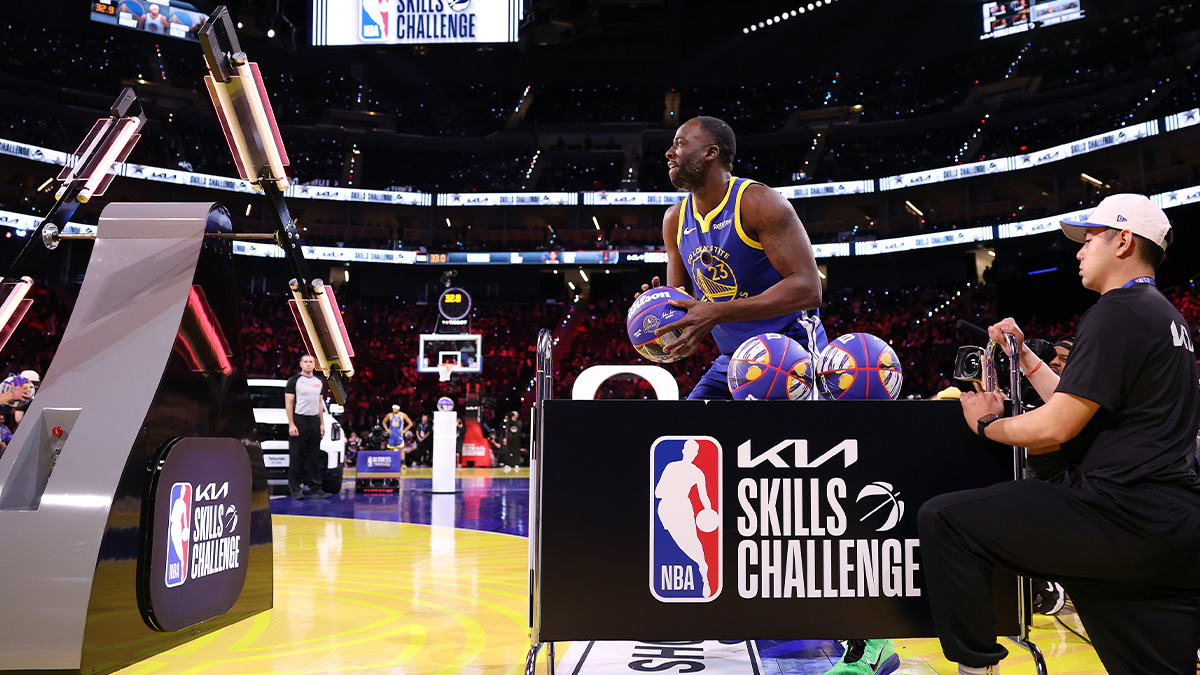
The NBA All-Star Game has faced growing criticism in recent years for its lack of competitiveness — and Draymond Green believes the league itself is partly to blame.
Speaking on Friday’s episode of “The Draymond Green Show,” the Warriors forward offered an in-depth explanation for why the exhibition has lost its edge, pointing not to player disinterest alone, but to how All-Star Weekend is structured.
Green compared injury risk in the NBA All-Star Game to other leagues’ showcase events, noting that physical danger isn’t necessarily what holds players back.
“I don’t know when the last time I watched an NFL game and no one got hurt,” Green said. “Usually, at least two to three people get hurt in an NFL game on a given day … so I could understand it more from the Pro Bowl standpoint.”
Basketball, he explained, carries a different mentality.
“As basketball players, we never go out on the court thinking this is the time I get hurt,” Green added. “You go out on the court, you participate in the game. You played the game, you go back to the locker room.”
Instead, Green believes preparation — or the lack of it — plays a far bigger role.
By the time players reach Sunday’s All-Star Game, they’ve already spent days fulfilling league and sponsor obligations: Community events, brand appearances, media sessions, photoshoots and more.
“I’ve been at this community thing, I’ve been at this event, I’ve been at this this sneaker deal thing, I’ve been at this this podcast thing,” Green explained. “By the time you get to the game … oh, I get 20 minutes to shoot the basketball.”
That rushed buildup, he added, is a stark contrast from a normal game day routine — especially for veteran players.
Green described his typical preparation as a full-day process: morning activation workouts, cardio, treatment, hot tub recovery, weight room sessions, shooting routines, team meetings and taping before tipoff.
“It’s an entire process,” Green noted.
Because that process is disrupted during All-Star Weekend, players are less physically ready to compete at full speed — increasing both injury risk and reluctance to play hard.
“I’m going to go out here and play hard in this game that I prepared for, for 20 minutes?” Green said. “That played a big part.”
Green also pointed to the evolution of sports science and body maintenance — and the influence of stars like LeBron James — as reasons modern players are more cautious.
“We know so much more about the body through the science,” Green explained, crediting James for having “a huge impact” on longevity and recovery routines across the league.
With that knowledge, players prioritize preservation over exhibition intensity.
“If I know better about my body, then I’m going to do better about my body,” Green shared.
To fix the issue, Green suggested structural changes — including shifting more weekend obligations away from All-Stars and onto other notable NBA players so the league’s biggest names can focus on the game itself.
“You can bring in prominent NBA names that’s not All-Stars … so the All-Stars can actually focus on the All-Star Game,” Green said.
He also criticized the league’s recent format experiments — from team drafts to international themes — arguing that gimmicks can’t replace genuine competition.
“The gimmicks of the All-Star Game … works when the game is good,” Green said. “How do you get these guys to compete? Until you can do that, I don’t think the gimmicks work.”
For Green, the solution isn’t cosmetic changes — it’s restoring the conditions that once made the game meaningful.
Until then, he doesn’t expect the intensity fans remember to return.
“I don’t think you’re going to have a good game,” Green concluded. “I just don’t see it.”
Download and follow the Dubs Talk Podcast