
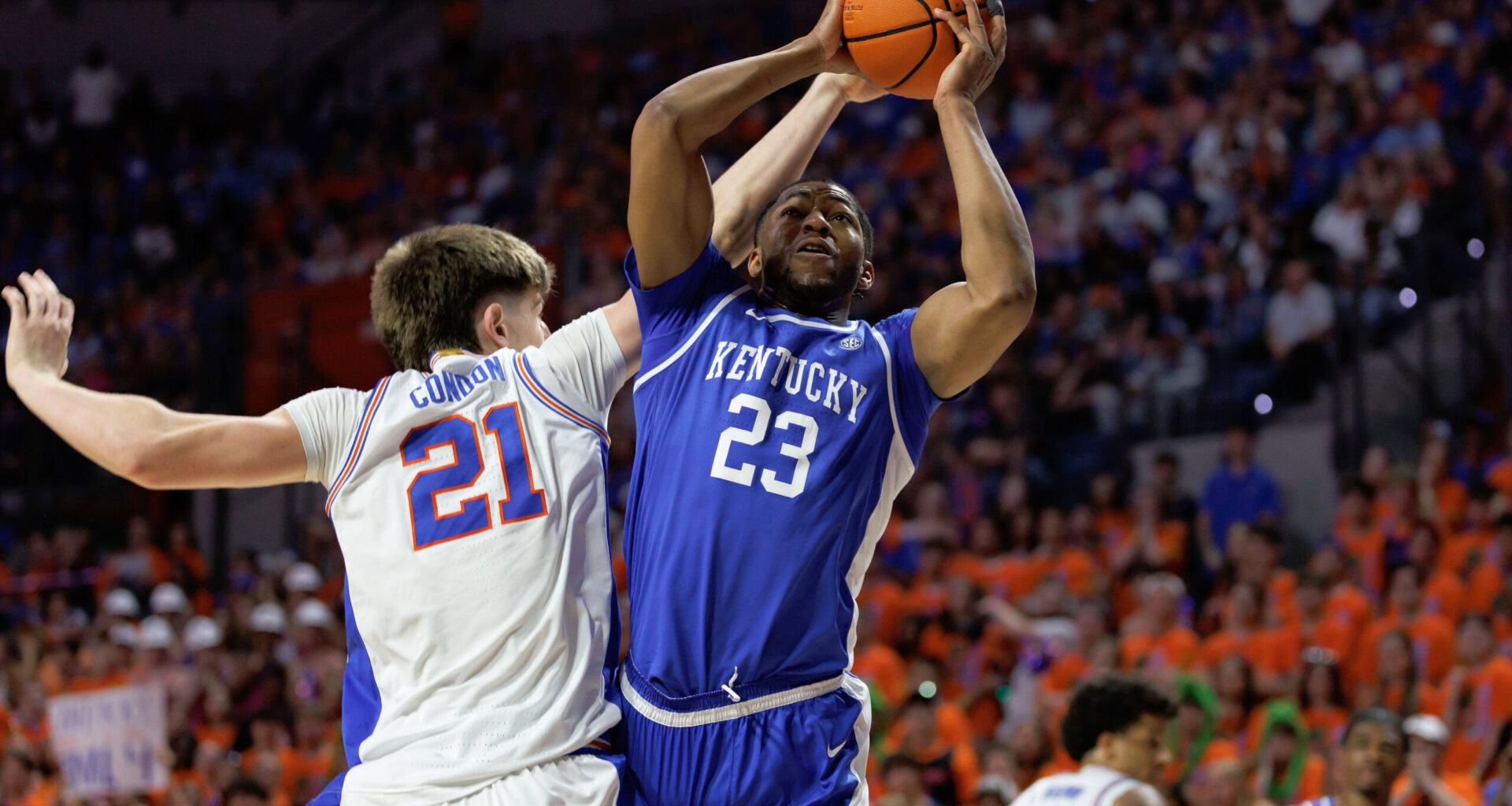
Layups are supposedly so easy that the term is used outside of basketball to refer to anything simple. The first question on the test was so basic, it was a layup. Showing up for work on time is a layup. Not falling down by double digits in the first half every game should be a layup. You get the idea.
However, like so many other things this season, layups for this Kentucky team have been far from automatic. Against Florida, Kentucky missed 15 layups, and while it felt like the Gators were the dominant team from tip to final buzzer, converting a handful of these close-range buckets could have drastically changed the outcome of the game.
To be fair, Florida forces more missed layups than anyone in the country. Their size and length underneath make finishing tough for anyone, but Kentucky has struggled at the rim throughout conference play. Let’s look at the numbers.
Kentucky has been subpar in the paint
Part of the challenge of producing consistent data on layup conversion is how each analytics site categorizes the term “layup.” According to Synergy, Kentucky is shooting 55.4 percent at layups this season. This ranks them in the middle of the pack nationally and leaves a lot of room for improvement.
CBB Analytics doesn’t go as far as defining the world “layup,” but breaks down shot selections into complex zones. In conference play, Kentucky is shooting 129 out of 192 (67.2 percent) on shots “at the rim” within 4.5 feet of the basket. This is slightly above the nation’s average, but they are shooting just 67 out of 170 (39.4 percent) on other shots in the paint. This is several percentage points below the nation’s average and puts them in the 30th percentile of Division 1. Not great.
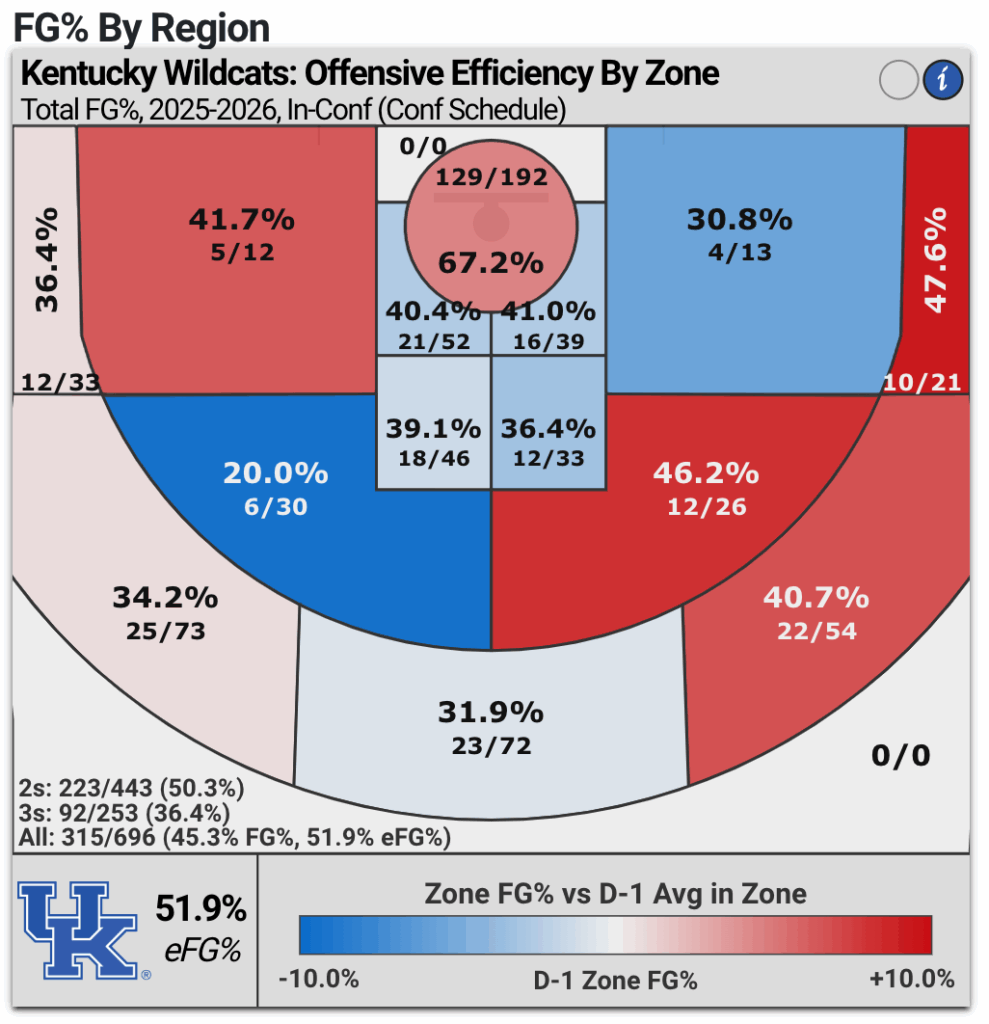 via CBB Analytics
Kentucky must be more aggressive around the basket
You don’t usually think of the term “settling” when shooting in the paint, but that seems to be the case here. The Cats are shooting 16 shots per game at the rim, and, as stated earlier, this is the region where they have shot a respectable 67.2 percent in conference play. However, taking only 16 field goal attempts per game at the rim ranks near the bottom of Division 1 teams; the 29th percentile, to be exact.
For other shots in the paint, however, the Cats are shooting 14.2 shots per game. Attempting that number of shots in the paint, but not at the rim, ranks Kentucky closer to the 90th percentile in all of college basketball.
To translate all these statistics to English, Kentucky is getting up fewer shots than average at the rim and making them slightly better than most. However, they are shooting far more shots just outside of the rim than most teams, and converting at a very low rate.
The simple answer to this problem seems to be for players to be more aggressive at getting all the way to the rim and finishing with authority. Stats and the anecdotal memory rolodex show that far too often, Kentucky falls away on shots in the paint, rather than going toward the basket and attacking the basket with strength.
If and when these close-range shots start to fall, Kentucky’s ceiling will be much, much higher.