
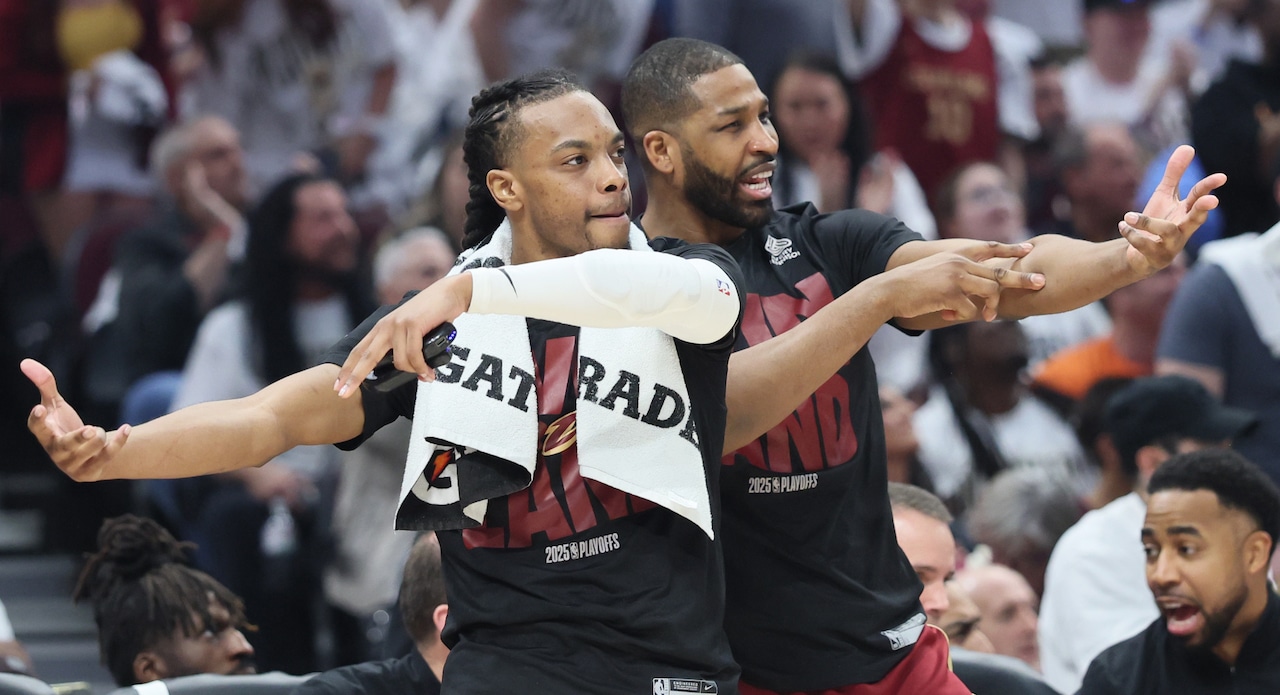
INDEPENDENCE, Ohio — Sour grapes? The usual end of series blather? A veiled attack in support of his chastised teammate? A morsel of truth?
In the aftermath of Cleveland’s four-game sweep over Miami in the first round of the 2025 NBA playoffs, Heat reserve Kyle Anderson was asked what changed in the final two games — back-to-back Cavaliers blowouts by a combined 92 points, making it the most lopsided playoff series in history.
Anderson pointed to Garland’s absence.
“You want my honest answer? I don’t mean to throw shots at anybody. … But they look like a better team without Garland on the floor,” Anderson told reporters. “Now I don’t know the numbers or anything but I think it played more into their favor once Garland wasn’t on the floor. They were able to dictate the tempo and get more stops on defense, it’s harder for us to score.”
“I don’t listen to that,” Cavs coach Kenny Atkinson said following Thursday’s practice in preparation for the Eastern Conference semifinals with Indiana. “I think we’re better with our All-Star point guard, personally.”
It wasn’t the first time a Miami player singled out Garland, who started the war of words following the Cavs’ Game 2 win by saying the team’s strategy, in part, was to “pick on” defensive weak link Tyler Herro and some of the other less formidable Heat defenders.
That comment caused Herro — and center Bam Adebayo — to fire back, citing Garland’s own defensive limitations.
Technically, all parties have some case in this verbal spat.
Cleveland did play better without Garland — for two games. Game 4 was one of the largest point differentials ever in the playoffs. But that’s not entirely a reflection of Garland. Nor does it speak to his importance. It’s more about the team’s talent, depth, skill and balance — the formula that led to 64 wins and the East’s top seed. These Cavs have never been about one player. Or two. Or three. It’s been a collective. The back-to-back romps also show how overmatched and answerless eighth-seeded Miami was.
With Garland sidelined the final two games because of a sprained big toe that has bothered him since the last week of the regular season, key reserves Ty Jerome and De’Andre Hunter stepped up, Max Strus took on a bigger offensive role, Jarrett Allen dominated inside, Evan Mobley continued to show his two-way evolution and Donovan Mitchell led, like usual.
Seven players, including Garland, finished in double figures over the course of the non-competitive series.
“It shows our depth,” Hunter explained. “We have a lot of guys that could play, even dudes that don’t play at all, and they can come in and contribute. D.G. is a big part of this team and obviously you can’t make up what he does with just one player, so we had to come together as a team and try to pick up that slack.”
The Cavs also stifled Miami on the defensive end, limiting them to just 170 total points in games three and four.
And that’s where Anderson’s comments start to sound slightly less outlandish.
The Cavs entered this playoff run knowing opponents would target Garland, especially following switches. Miami found success, going 12 of 18 from the field with him as the primary defender, according to NBA.com matchup data. And every metric says the Cavs were better — significantly — on defense without Garland.
In 63 minutes with him on the court, Cleveland had a flimsy 119.8 defensive rating. In 129 minutes without him, it suffocated the Heat, boasting a 93.3 defensive rating.
There’s nuance to those numbers, including a few smart stylistic adjustments the Cavs made following Game 2 and the growing understanding of an opponent that often manifests itself during a postseason series.
“I think we started figuring some things out,” Atkinson explained. “Remember earlier we were having a problem with Davion Mitchell getting downhill. We kind of adjusted to putting a bigger player on him. How we were playing Bam in the pick-and-roll. That was another one. Started to jam him more so he didn’t get that pocket pass.”
“I think as you go through a series, you learn more and more about tendencies,” Mitchell added. “You saw last year, the same way we played in Game 1 was not the same way we played in Game 7 because at that point, you know everything they’re running, you know where they want to go. As the series progresses, naturally you’re going to be better just because you’ve seen the same team.”
The Cavs — and Garland — will likely get a chance to squash this growing narrative.
Garland practiced Thursday — albeit without any contact — and Atkinson characterized him as “day to day.”
“The toe’s a tough one,” Atkinson said. “There’s pain and all that. But the good thing when we watch him shooting right now, he’s moving well.”
So, will Garland be ready for Sunday’s series opener?
“I’m not going to make a judgment either way,” Atkinson said. “There’s some concern there. I could see it go either way. I think it’s something he’s going to have to deal with probably the rest of the playoffs.”
Atkinson said the Cavs haven’t made a decision on who would replace Garland in the starting lineup — if he can’t play.
In both games against the Heat, sharpshooter Sam Merrill stepped into that quintet. Atkinson likes how the offense can flow, utilizing less pick and roll and more off-ball screening actions. But every matchup is different and every series calls for something unique. Maybe even a more reliable point-of-attack pest to contain two-time All-Star Tyrese Haliburton.
That decision is — perhaps — for another day.
Either way, despite Miami’s commentary, Cleveland is hopeful Garland can suit up. It’s not buying into the chatter about not needing him to win at the highest level.
“He’s huge,” Hunter said of Garland. “He scores. He facilitates. I think he stepped it up on the defensive end from what I watched this year as well. He’s a leader on this team. He’s a vocal guy. I love playing with him.
“We need him back for sure.”