
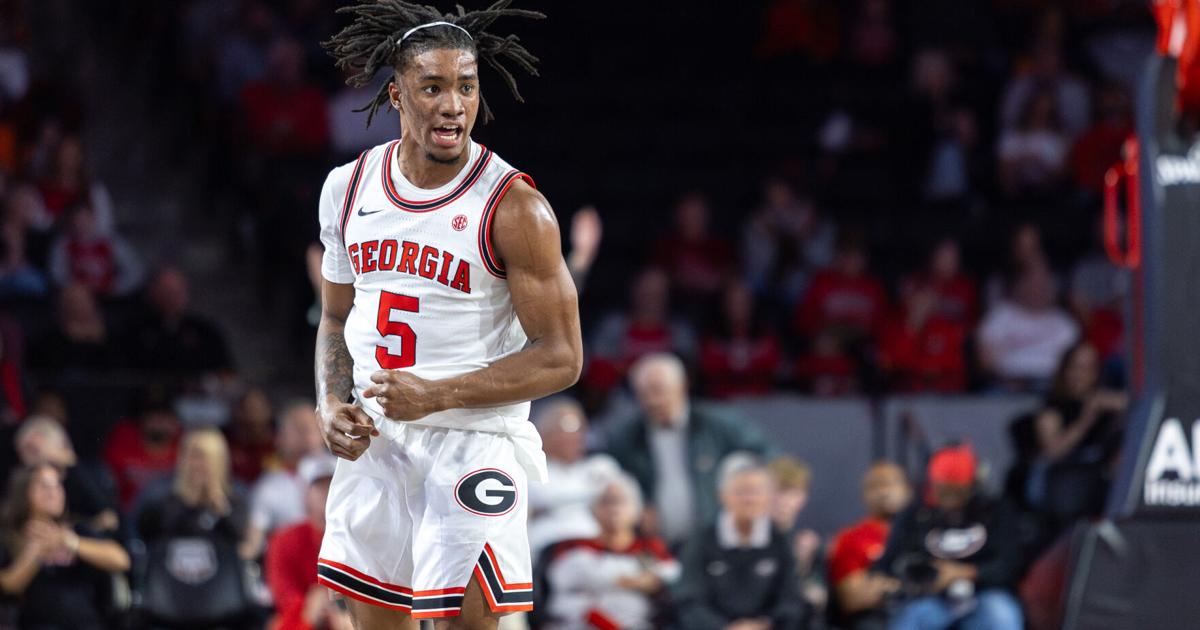
For a program that spent nearly a decade outside the NCAA Tournament conversation, it is strange how quickly the expectations have shifted.
Somewhere between Georgia climbing to No. 18 in the Week 9 AP Poll, its highest ranking in more than two decades, and last season’s return to March Madness for the first time since 2015, the bar moved. Now, a 17-8 team sitting 10th in the SEC at 5-7 is being dissected, and its five losses in six games have people asking bigger questions. Where exactly did the expectation that Georgia should roll through elite competition come from?
Because this team, when you zoom out, is still a tournament team.
Georgia averages 90.3 points per game, seventh in the nation. The Bulldogs lead the country in blocks at 6.6 per game. That is not empty production. That is a team that plays with pace, scores in transition and protects the rim at an elite rate. Jeremiah Wilkinson is averaging 17.1 points per game, and his two-game absence has been a detriment. Without him, the offense has lacked a reliable late-clock option, and the rebounding issues have been magnified. For whatever reason, Georgia has struggled to finish possessions on the defensive glass.
Blue Cain has steadied the perimeter. After opening SEC play 0-for-15 from 3-point range, he has hit two or more 3-pointers in four straight games. Marcus “Smurf” Millender is averaging 12 points and nearly four assists off the bench, giving Georgia a guard who can change tempo and keep the ball moving.
Georgia is 3-6 in Quad 1 games, meaning three wins against top-tier competition based on NET ranking and location. Those are the wins that the selection committee weighs most heavily. The victory over then-No. 17 Arkansas at home is not just a highlight; it is a defining result that proves Georgia can handle a tournament-caliber opponent. The Bulldogs are also 5-1 in Quad 2, with the only loss coming to a Texas A&M team that led the SEC standings for months under a new head coach and offensive system. Those eight wins across the top two quadrants are what put teams in the field. And yet, there is chatter about making a coaching change.
Head coach Mike White was recently extended to stay in Athens long term. He has won multiple NCAA Tournament games in his career at Florida. He took Georgia to March Madness last season for the first time since 2015, where the Bulldogs fell 89-68 to No. 8 seed Gonzaga in the first round. It was not a breakthrough, but it was progress. These past two Georgia teams have been the most skilled and competitive the program has fielded in more than 20 years.
On the other hand, Georgia is 5-7 in conference play. It has dropped five of its last six. Obviously, if the Bulldogs continue to lose in conference play, their tournament chances will continue to dissipate. The rebounding has been inconsistent, especially with Somto Cyril often battling foul trouble and Justin Abson asked to carry too much of the load against some of the SEC’s most physical centers. Wilkinson is battling injuries, the shots aren’t seeming to fall when they need them to, and if you cannot control the glass in this league, you pay for it.
Cyril has to be more physical and attack the boards with purpose. As the lone true center White can rely on, staying on the floor is not optional. Competing with top-tier SEC bigs means avoiding early fouls, carving out space and finishing possessions. Georgia cannot afford stretches where its only rim protector is watching from the bench.
The rotation also has to be tightened in the right way. Jordan Ross needs to be steadier when his number is called. Dylan James has flashed as an energy presence off the bench, and that has to be consistent down the stretch, not occasional. Freshmen Kareem Stagg and Jake Wilkins need to see the floor more often, especially if they can provide defensive length and rebounding punch in short bursts.
The reality that many need to come to is that this team is not similar to last year’s tournament team. In many ways, this team is more skilled than the previous team. Slumps happen, shots aren’t gonna fall, those loose balls aren’t always going to go Georgia’s way. But when they do, will the praise be as loud as the criticism?
Tournament selection is based on an entire resume, not on a rough two-week stretch. The committee studies Quad 1 and Quad 2 wins, overall metrics and how a team performs against high-level competition. Georgia has delivered in those areas. It has beaten elite opponents. It has handled lower-tier opponents. It has produced like a top-10 offense nationally and protected the rim better than almost anyone in the country. And barring an abysmal end to the season, the Bulldogs should make the tournament as a No. 10 or No. 11 seed.
Georgia is not a blue-blood basketball program and it never claimed to be. With a strong finish to the season, the Bulldogs could even sneak into the No. 8 or No. 9 seed conversation. But the reality is that the ceiling of this team might be a first-round win, and while that shouldn’t be the golden standard for future Georgia basketball teams, it should be enough for a program that hasn’t won a tournament game since 2002.
Expectations rose because Georgia showed it can compete with high-level opponents. That should not be used against it now. On paper, on metrics and on substance, the Bulldogs have done enough.
Despite the noise, Georgia is still a worthy tournament team.