
The NBA trade deadline has passed. All-Star weekend is over. Now, it’s time to focus on basketball.
Well, mostly. The tanking conversation is still the biggest story in the league, one that could be supplanted by the penalty the NBA hands the LA Clippers over the Aspiration scandal, assuming that ever happens. However, with only about a third of the regular season left, what happens on the court will take up more of the spotlight.
Which teams need to excel over the next two months? Which award races are most fascinating? And even when the games have no impact on anything but lottery balls, which players deserve a closer look? The Athletic’s Christian Clark, Fred Katz and Hunter Patterson discussed the season’s stretch run, which starts with 10 games on Thursday and nine games on Friday.
Which player has the most at stake for the rest of the regular season?
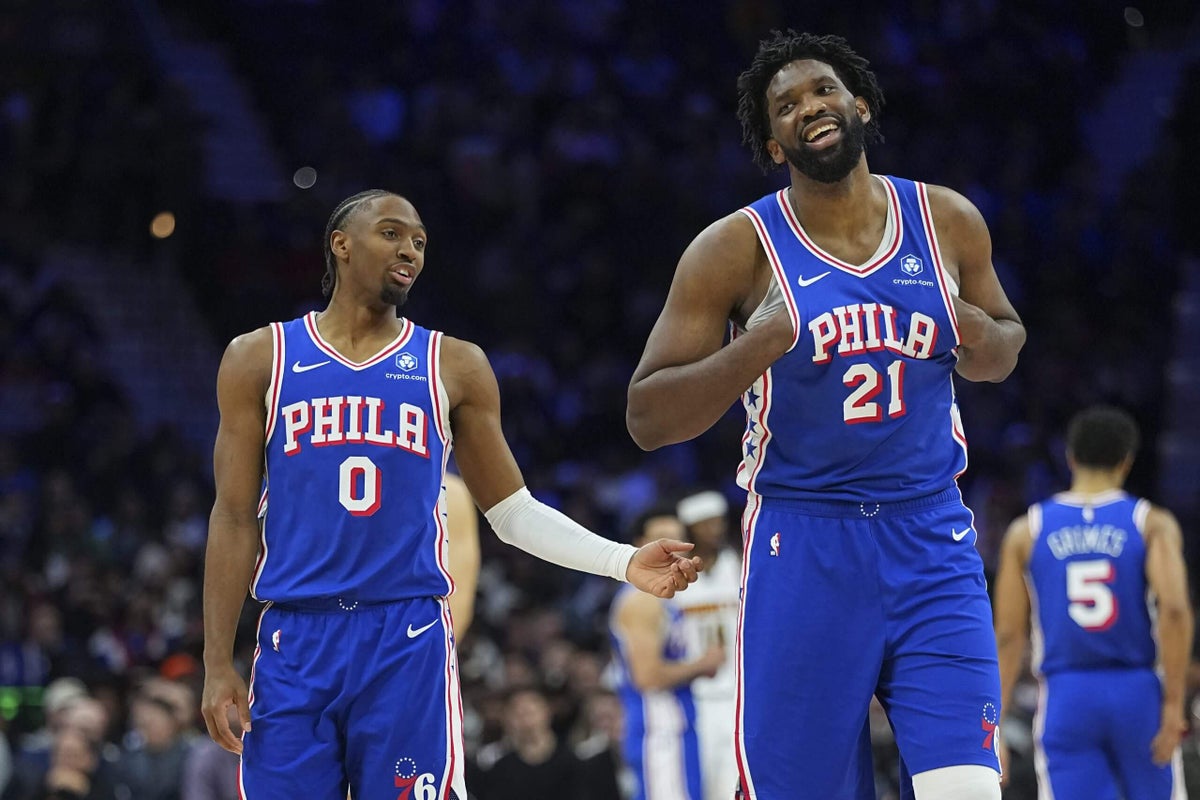
Clark: The key words here are “regular season.” If this included the playoffs, I’d go with Joel Embiid, who has a chance to reach the conference final for the first time in his career this spring if he’s able to stay healthy alongside the Philadelphia 76ers’ collection of dynamic guards. For the rest of the regular season, though, my choice is Paolo Banchero, whose Orlando Magic enter the All-Star break in Play-In Tournament territory and have been perhaps the biggest disappointment in the NBA.
Banchero has been one of the least efficient high-usage players in the NBA. Among the 42 players averaging at least 20 points per game, he ranks 38th in true shooting percentage, which factors in the extra importance of 3s and free-throw attempts. Banchero’s max contract extension will kick in next season. If the Magic can’t turn things around in the stretch run, they have some difficult questions to answer.
Katz: Embiid. Embiid finally started to look like himself over the past month. He was dunking again, something he refused to do earlier in the season. He was scoring aplenty. The jumper had caught fire. He’s averaged 33.1 points over his past 10 games played.
And if Embiid is the MVP version of himself, which is no guarantee, the 76ers become a scarier matchup for any Eastern Conference team.
But then the story went how it often goes. Embiid missed the last couple of games before the break with knee soreness. The Sixers don’t seem too concerned, but any knee problem for Embiid would make his supporters anxious, given his history. He has fought back to rediscover the elite version of himself. He doesn’t need to play every night, but if he can sustain this level of dominance, then he’s made a grand return to the NBA’s biggest difference-makers.
Patterson: In the interest of not doubling up on names here, I’ll go with Ja Morant. He hasn’t played more than six games in a row this season, and his effective field goal percentage (44.2) and 3-point percentage (23.5) are both career lows.
Per Cleaning the Glass, Morant’s percentage from 3 in the second percentile for point guards. He was expected to be re-evaluated for his UCL sprain in his left elbow last Saturday, but the Grizzlies have yet to give an update on his status. Memphis is currently six games behind the LA Clippers for the final Play-In spot in the West and has severely underachieved this year.
His fall from grace has been a blemish on his own legacy, but the NBA is just more fun when Morant is healthy and at the height of his game. Hopefully he can return to form sooner than later.
Not including teams trying to make/avoid the Play-In Tournament, which team is under the most pressure to secure favorable seeding?
Clark: The New York Knicks, who were my preseason pick to come out of the East. The Knicks are six games back of the first-place Detroit Pistons, so catching up to Cade Cunningham and company is unlikely. But the Knicks need to do everything in their power to get the second seed, so they can have home-court advantage against the Boston Celtics or the Cleveland Cavaliers in a potential second-round series.
The Knicks are 21-7 at Madison Square Garden and 13-13 on the road this season. They’ve collected some impressive road wins lately, including blowout wins over the Celtics and 76ers, but I’d feel more confident in them to make the finals if they could at least guarantee themselves home-court advantage in the first two rounds.
Katz: The Denver Nuggets — and I make this claim despite their bizarre home-road splits, which show way more success in other arenas than in their own. The Nuggets may have the experience and moxie to handle intensity outside of Denver, but the seeding conversation around them shouldn’t be about home-court advantage. It’s about the matchups.
The Nuggets own the Western Conference’s third-best record. Close but, at times, sloppy losses recently have placed them four back in the loss column for second. But they should be looking in the other direction, too, where they are tied in the loss column with the fourth-place Houston Rockets. For the Nuggets’ sake, Houston can’t pass them.
This is about lining up playoff matchups. If the Nuggets stay in the top three — or climb to second, avoiding the Western Conference’s six juggernauts in the first round — they put off facing the defending-champion Oklahoma City Thunder until the conference finals, assuming OKC gets there. Denver, set up better than anyone to challenge Oklahoma City, boasts championship aspirations. The Nuggets don’t want that series to come in the second round instead of two weeks later.
Patterson: The Cleveland Cavaliers. They’re the only team that made a blockbuster deal ahead of the trade deadline with intentions of competing for a title. A James Harden and Donovan Mitchell-led squad should be doing everything in its power to secure a top-four seed to ensure the best chance of advancing to at least the conference finals.
Harden is averaging 19.7 points on 42.4 percent from the field during his last five postseason appearances since leaving the Clippers. And as gaudy as Mitchell’s playoff numbers are, he, like Harden, has yet to reach the conference final.
The Cavs are seven games behind the first-seed Pistons and 3 1/2 games up on the sixth-seed Sixers. This has to be the year Cleveland capitalizes on its potential to reach at least the conference final, and securing favorable seeding would be the first step in doing that.
Which award race do you find most compelling?
Clark: Rookie of the Year. I was fortunate to watch the duel between Cooper Flagg and Kon Knueppel on Jan. 29, when the former Duke teammates combined to score 83 points. Flagg is already good at everything on the basketball court except outside shooting, which is Knueppel’s best skill. Knueppel is having an absurd 3-point shooting season. He’s knocking down 43.1 percent of his 3s on almost eight attempts per game. He’s second among all NBA players in 3-point makes at the break. The Hornets are surging, too. I’d vote Flagg because I think he’s been the better player and, through no fault of his own, is on a dysfunctional team, but there’s an argument to be made for Knueppel.
Katz: Most Improved Player. Whoever you believe deserves it probably says more about you than it does about them. Deni Avdija has broken out, though he did that at the end of last season, too. Should his production down the stretch of spring 2025 for a losing team count against him in the 2026 MIP race?
This is why Most Improved is a flawed award. Arguments for one guy over another often turn into, “OK, we both agree this player is awesome, but my candidate used to suck way more than your candidate did.” It’s the only award conversation in which you can debate your way to success by insulting your candidate.
Quirks aside, there are tons of great options this season.
Avdija is now an All-Star, as is Jalen Duren. Jalen Johnson, also a first-time All-Star, is facilitating better than ever. Collin Gillespie went from little-used to one of the league’s better backup point guards. Ryan Rollins went from the waiver wire to starting. Nickeil Alexander-Walker upped his usage and hasn’t tripped a wire. Keyonte George looks like a building block. Anthony Black is forcing the Magic to recalibrate their future. Neemias Queta was a supposed weak point who is responsible for much of the Celtics’ surprising success on the glass. And then there are the second-year players, who no one ever wants to vote for because you should improve as a sophomore but who have gotten better in impressive ways this season: Alexandre Sarr, Ajay Mitchell, Reed Sheppard, Jaylon Tyson.
Filling out this ballot will make my head spin.
Patterson: Most Valuable Player. The 65-game rule has turned each of the regular-season awards into a math problem, but there are myriad cases worth arguing for here.
Should Shai Gilgeous-Alexander go back to back for being the catalyst of the Thunder’s success once again? Maybe it should be Nikola Jokić, who’s averaging a triple-double for the second consecutive season while leading the league in assists and rebounds per game, all while sitting at seventh in points per game. I can’t forget about Cade Cunningham, who I’ve had the privilege of watching spearhead the Pistons’ turnaround from the laughingstock of the league to arguably the best team in the NBA. Even Jaylen Brown has an argument, as evidenced by his career-high scoring numbers and the Celtics sitting at second in the East.
It’s an award that’s usually difficult to decide on, but this season feels ripe with deserving candidates who have compelling cases.
Which title contender most needs to find itself before the regular season is done?
Clark: The Houston Rockets. Mauling opponents on the offensive glass has been central to their identity, but their ability to bludgeon other teams took a hit when Steven Adams went down with a season-ending left ankle injury in January. I’m concerned about the Rockets’ offense come playoff time. Since Jan. 1, Houston ranks 26th in points scored per 100 possessions. Reed Sheppard provides much-needed shotmaking ability off the bench, but he can be exploited defensively. The Rockets need to find a way to generate cleaner looks in important moments.
Katz: The Cavaliers. And it appears they are doing so. Cleveland has won 12 of its last 14 and all three since Harden arrived, though Harden hasn’t faced the staunchest competition: the league-worst Sacramento Kings, the injured Denver Nuggets and the tanking Washington Wizards.
The Cavs, given their 22-19 start to the season, along with the addition of Harden, who changes their identity, would be the answer to this question if those were the only two elements of the situation. This team won 64 games last season, best in the East. It entered this one as the Vegas favorite to win the conference. And then it floundered. And then just as it started to go on a run, the front office shook up the roster.
It’s not just that Harden is new. Darius Garland, the long-time reliable (save for his health) point guard, is out. De’Andre Hunter is gone, a luxury that comes with the breakout of Tyson. Dennis Schröder and Keon Ellis are in, too.
Cleveland renovated its identity midway through a season in which it’s trying to win at least three playoff series, which means over the next two months, it has to find what makes this new version of the team click.
Patterson: The Knicks. It appears they are making positive steps, winning eight of their last 10 heading into the All-Star break. But they’re the only East team in the top six not above .500 away from home.
Plus, at 16-14 against teams above .500, the Knicks also have the lowest win percentage in that category among the East’s top three teams.
New York boasts arguably the most talent, from top to bottom, of any Eastern Conference contender. And its owner, James Dolan, publicly stated his team “should win the finals.” The expectations for the Knicks are lofty to say the least, and they’re currently 5 1/2 games behind the East-leading Pistons.
The pressure is on for New York to finish the regular season strong if it hopes to hoist the Larry O’Brien trophy in June.
Not including Cooper Flagg, which player on a lottery-bound team are you watching most closely?
Clark: Trey Murphy. I love his game. All he does is make 30-foot 3s and throw down sick dunks. He’s averaging 22.1 points while shooting 47.6 percent from the field, 37.8 percent from 3 and 89.2 percent from the free-throw line. I wouldn’t be surprised if he joins the 50/40/90 club one day.
The New Orleans Pelicans chose not to move him at this year’s trade deadline. The word in NBA circles is that it would have taken a Desmond Bane-type offer to get something done. I’m curious if the Pelicans’ stance changes this offseason. They don’t have a first-round pick in this year’s draft and are 26 games below .500.
Katz: Am I totally and completely lame if I write Giannis Antetokounmpo? Does he need to play for even one second to be the proper answer to this question? (Editors’ note: Yes, no.)
The Bucks did not trade Antetokounmpo before February’s trade leadline, but holding onto him for the rest of this season does not put talks about their future to rest. Milwaukee can offer him an extension in October. (Assume they’ll find a way to talk about it without really talking about it before then.) If he says yes, then he sticks. If not, then the Bucks’ decision on the two-time MVP may be made for them.
So I’m watching this couple: Antetokounmpo on the bench, how he interacts with teammates, what he says after games. I’m watching how the Bucks do without him. Could they play poorly enough to luck into a high draft pick? And if they do, would that make them more likely to start from scratch and trade Antetokounmpo or the opposite, trading a valuable pick for a win-now piece and appeasing him?
Based on this season’s will they-won’t they, I won’t pretend to know the answer. But I’ll be monitoring to see how this saga concludes.
Patterson: It was Kyshawn George before the Wizards’ tank job including limiting his minutes down the stretch. But thankfully, fellow USC Trojan, Isaiah Collier, has me covered. The Utah Jazz’s aggressive tanking rotations have thrust Collier into back-to-back games playing 48 minutes and career-best production in the process.
Collier’s 11.7 assists per game in February lead the league, and his 16 steals this month are tied for the second most in the association. While the Jazz are 3-7 over their last 10 and apparently actively trying to lose games, Collier has been a bright spot and very much worth the watch. Utah hasn’t had a player dish out 22 assists in a game since Hall of Famer John Stockton.
Now Collier’s 3-point shooting will definitely need some work during the offseason, but this stretch has hopefully earned him more minutes heading into next season. He could prove to be a valuable second-unit facilitator and point-of-attack defender moving forward.