
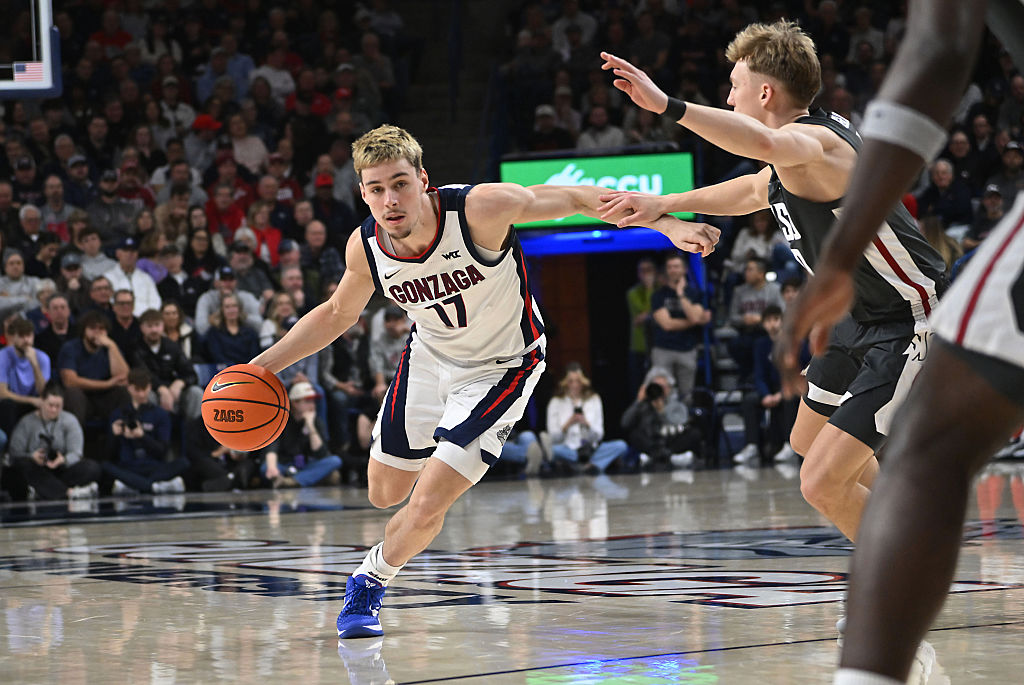
Dan Johnson takes you through his preview, prediction, and pick for tonight’s college basketball game between the San Francisco Dons and the Gonzaga Bulldogs.
Gonzaga are chasing the top line in the WCC and still treating February like a seeding laboratory, at 25-2 overall and 13-1 in league play. San Francisco are 15-13 and 7-8, playing for posture and pride, and the swing game tonight is the building. This is Chase Center again, not the Hilltop, with a late 11:00 p.m. Eastern tip that reads like a made-for-TV stage. The first meeting here ended 68-66 Gonzaga, and it landed that low while the Dons hit 14 threes on 28 attempts. Below is my preview, prediction, and pick for tonight’s college basketball game between the San Francisco Dons and the Gonzaga Bulldogs.
Here’s how I’ll play it. I’ll be pumping out these predictions for individual games all season, with plenty of coverage here on DraftKings Network. Follow my handle @dansby_edits for more betting plays.
The numbers say Gonzaga can win games in two different ways, and the efficient way is the one that matters for a total. Their offense is 123.4 per 100 with a 59.4% true shooting and a 56.6% eFG, and the ball security pops at 11.6% turnovers. The defense is stout: 94.7 per 100 allowed, and opponents sit at 67.2 points per game on 40.0% shooting. Gonzaga also don’t need volume threes to score, with a 29.7 3FG tendency and a heavy rim posture that travels. San Francisco live in a different math shape: 111.8 per 100 on offense, 108.9 per 100 allowed, and a 66.0 pace that invites games into the high-60s for possessions. The Dons’ identity is perimeter-forward, with a 45.6 3FG tendency and a bigger FT rate (38.4) than Gonzaga’s, which is how they stay afloat when the jumpers wobble. But their efficiency base is thinner, at 55.5% true shooting and 51.2% eFG, which is exactly the profile that can get capped by a top-shelf defense. The clean recent snapshot supports it: Gonzaga just won 94-86 at Santa Clara while going 3-for-18 from three and still scoring 66 paint points. San Francisco just won 92-79 at San Diego with a second-half avalanche and 22 fast-break points, but that runway doesn’t automatically show up against Gonzaga’s transition discipline.
This game is going to be decided by who controls the easiest shots, and that starts with Graham Ike. He leads Gonzaga at 19.8 points and 8.7 rebounds per game, and his usage is 27.1%, which tells the truth about where possessions end. He just dropped 21 points with 15 boards on 10-for-15 shooting at Santa Clara, and that’s the exact “total suppressor” kind of dominance, because it’s two-point efficiency without chaos. Adam Miller and Tyon Grant-Foster keep Gonzaga’s scoring from getting single-threaded, combining for 41 points in that same road win while the threes stayed cold. The important part is how those points arrived: paint touches, free throws, and clean kickouts.
San Francisco’s counters are there, but they run through shot-making and a few creators playing above their baseline. Vukasin Masic just hung 22 with four threes at San Diego, and Legend Smiley hit three more triples while living at the stripe. David Fuchs gives the Dons a true interior presence with 21 points, 13 rebounds, and 10 free-throw attempts in that win, which is their clearest free points pathway. Ryan Beasley only scored seven there, but nine assists matters, because it’s the difference between a clean look and a late-clock bailout. The January game is the loud reminder of how thin the Dons’ inside margin can be: they hit 14 threes and still scored only 12 paint points.
Gonzaga vs. San Francisco pick, best bet
this total is priced in the high-140s because Gonzaga can score 90 on a neutral floor, and San Francisco are willing to launch. If the Dons’ threes stack early, the game gets dragged into transition, and late fouls become gasoline. The rebuttal lives in the same film everyone watched in January: Gonzaga won that game while going 3-for-18 from three and missing 11 free throws. Gonzaga created 17 points off turnovers and 17 fast-break points in the first meeting, and that type of edge can build a lead without lifting the total. The rotation context also leans toward structure: Braden Huff remains out with an ankle injury, which trims easy bench offense and tilts more possessions toward Ike’s controlled diet. The market is still asking for an 81.5-67.0 type of script, and that demands San Francisco score efficiently against a defense that rarely gifts clean twos.
Chase Center is the stage again, and that matters because it plays more like a neutral theater than a campus pressure cooker. That setting usually smooths the game into “run offense, take the shot” possessions, which is friendly to an under when one team owns the defensive baseline. Gonzaga just stayed in Northern California after Santa Clara, which is a soft travel spot in February. Fresh legs tend to show up most on defense and rebounding, not necessarily in random three-point variance. San Francisco are coming off a road win at San Diego, and the Dons’ second-half burst there leaned on transition and foul-line living. Against Gonzaga, those runouts are harder to bank on, so the Dons usually have to win more half-court possessions, which slows the total’s heartbeat. Huff’s absence shrinks Gonzaga’s frontcourt rotation. That nudges Gonzaga toward longer Ike possessions and fewer instant offense bench minutes, which is under-friendly even if the Bulldogs’ efficiency stays elite.
The best bet is under 148.5, playable to 146.5. The pace blend points to a high-60s possession game, and the matchup history already showed a 134-point finish even with a 14-three night from San Francisco. Gonzaga’s path to winning is paint scoring and defense; that’s exactly how a favorite can control a game while the total stays grounded.
Projected score: Gonzaga 80, San Francisco 64.
Best bet: San Francisco vs. Gonzaga u148.5 total points (-110)
Tail it with me in the DKN Betting Group here!