
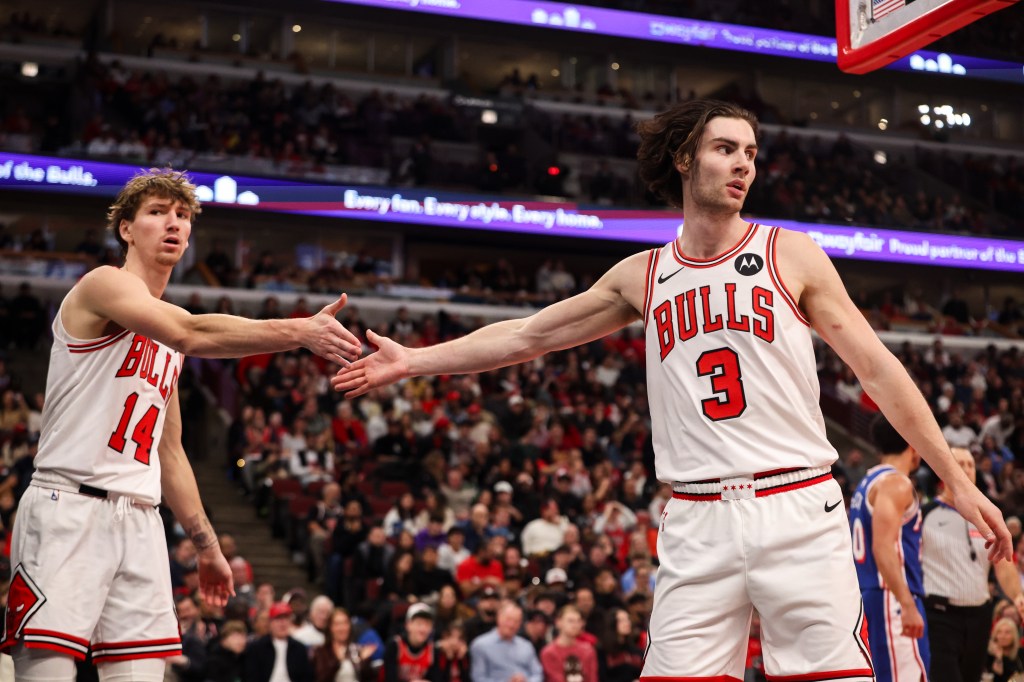
The final countdown is on for the end of the NBA regular season. But this year looks different for the Chicago Bulls.
After skidding into the All-Star break on a six-game losing streak — and losing nine of their last 10 games — the Bulls have taken a sharp turn in strategy to close the 2025-26 season. The front office finally has traded the play-in tournament for the draft lottery.
But just because a team is embracing losses doesn’t mean there aren’t important assignments to monitor while playing out the string. Here are five questions the Bulls need to answer over the next 27 games.
1. Will Josh Giddey return to the rotation?
Giddey missed 19 of the last 23 games with a hamstring strain, and the Bulls went 6-13 without him.
This is a question of strategy as much as health and wellness. After returning at the end of January to average 13.5 points and 7.3 assists over a four-game stretch, Giddey missed the final eight games before the break. The Bulls benefited, in a roundabout way, from his absence as they cratered into that losing streak.
Giddey has been fairly hardy throughout his young NBA career, notably bouncing back in a week from an ankle sprain last season. But the Bulls have no reason to be reckless with him over the next eight weeks, which could mean a more conservative approach. Whether they continue to hold out Giddey might reflect their overall stomach for tanking, which often requires the sidelining of a top player to be fully effective.
Similarly, the Bulls held guard Tre Jones out of the final 11 games before the break, also with a hamstring injury. The front office and coaching staff consider Jones a “winning” player, and while injury prevention is the focus, every game he misses can help the Bulls achieve their bigger-picture goal of losing in the short term.
Both guards participated in parts of practice Tuesday and Wednesday, and Giddey said he plans to be available for Thursday’s game against the Toronto Raptors. But assistant coach Wes Unseld Jr. — who will stand in for Billy Donovan for at least one game while the Bulls coach spends time with family after the death of his father — warned that both Jones and Giddey will be held under minutes restrictions when they do return.
2. Which of the new players should stay?
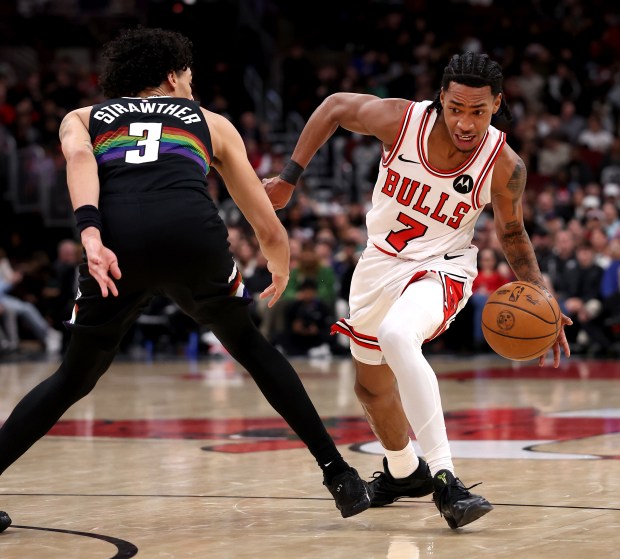 Bulls guard Rob Dillingham makes a move on Nuggets guard Julian Strawther on Feb. 7, 2026, at the United Center. (Chris Sweda/Chicago Tribune)
Only a handful of the seven players acquired at the trade deadline are being considered for a long-term stay in Chicago. Five of them will hit some form of free agency this summer. Guerschon Yabusele might not even play in the NBA next year. So who’s worth extending?
The Bulls are committed to Rob Dillingham’s contract through next season, and they have until Oct. 31 to exercise a club option for 2027-28. The second-year guard showed flashes of promise in his first few games with the Bulls — and will be able to show more with extended playing time after riding the bench in Minnesota — but his size and defense draw a fair amount of concern.
The only other new player under contract past this season is Leonard Miller, a cheap ($2.4 million a year) end-of-bench option who isn’t expected to play into future roster plans.
The remaining four — Jaden Ivey, Collin Sexton, Anfernee Simons and Nick Richards — have more to prove over the final stretch. Ivey will be a restricted free agent whom the Bulls currently hope to re-sign. Richards will have time to make his case as the backup center for a team seriously lacking size. But Sexton and Simons will be fighting for oxygen in a cluttered backcourt, especially when Giddey and Jones return.
3. Can the Bulls tank hard enough to get a high lottery pick?
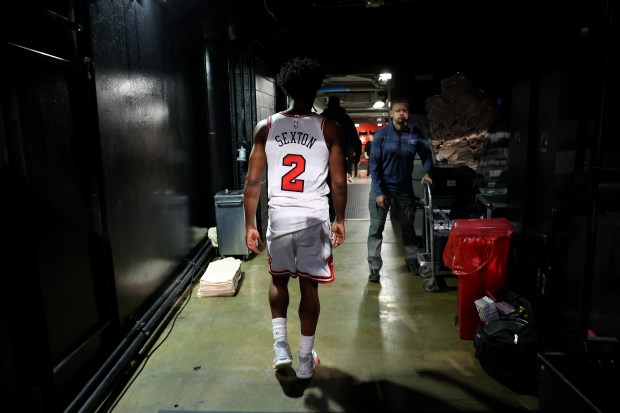 Bulls guard Collin Sexton walks to the locker room after a 136-120 loss to the Nuggets on Feb. 7, 2026, at the United Center. (Chris Sweda/Chicago Tribune)
The Bulls already have achieved the most important step toward improving their potential draft position — dropping out of the top 10 in the Eastern Conference so they can avoid the play-in tournament and ensure they’re part of the lottery. Coming out of the break, they’re two games behind the ninth-place Charlotte Hornets and 1½ behind the 10th-place Atlanta Hawks, cushions that should grow over the coming weeks.
The Bulls (24-31) are percentage points ahead of the Milwaukee Bucks (23-30), but dropping below the Bucks — who are expected to get Giannis Antetokounmpo back this week — is relatively doable. The rest is harder. The other eight teams currently below the Bulls include some of the most egregious tankers in the league, teams such as the Utah Jazz that are happy to swallow six-figure fines if it means benching their stars in the fourth quarter to pick up valuable losses.
Strength of schedule offers some relief. The Bulls have the fourth-hardest schedule in the league over the final stretch, with two games apiece against the Oklahoma City Thunder and New York Knicks plus games against the Houston Rockets, Denver Nuggets and San Antonio Spurs. But even with that helping hand, it’s difficult to lose more games than teams that are willing to flout league rules in order to protect their lottery position. Ninth or 10th in the lottery order might be the best the Bulls can manage.
4. Will the Portland Trail Blazers’ pick convey to the Bulls?
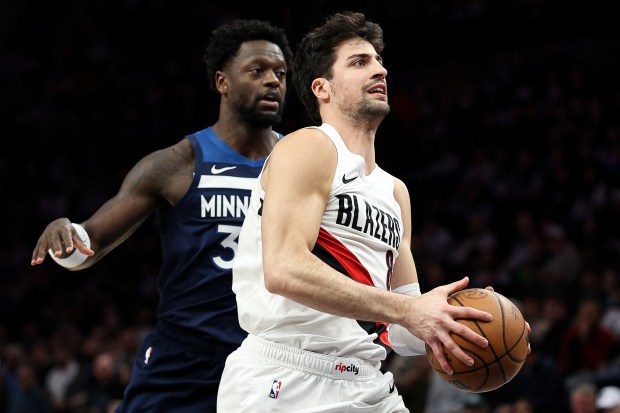 Trail Blazers forward Deni Avdija drives toward the basket as Timberwolves forward Julius Randle defends Feb. 11, 2026, in Minneapolis. (AP Photo/Matt Krohn)
Besides their own, the Bulls have another first-round pick to monitor in the final weeks — that of the Trail Blazers, who owe the Bulls a protected pick that would convey this year if they make it to the Western Conference playoffs.
The Blazers are making a strong playoff push, currently ninth in the West and projected for the play-in tournament — though they’re seven games out of sixth place and an outright playoff spot.
Strength of schedule is again on the side of the Bulls. Portland plays the league’s easiest schedule over the remainder of the season, with a handful of matchups against tankers such as the Jazz and Sacramento Kings.
This likely will come down to the play-in tournament. But if the Blazers can make it to a first-round series, the Bulls would go into this draft process with two first-rounders in hand.
5. What are the top needs this summer?
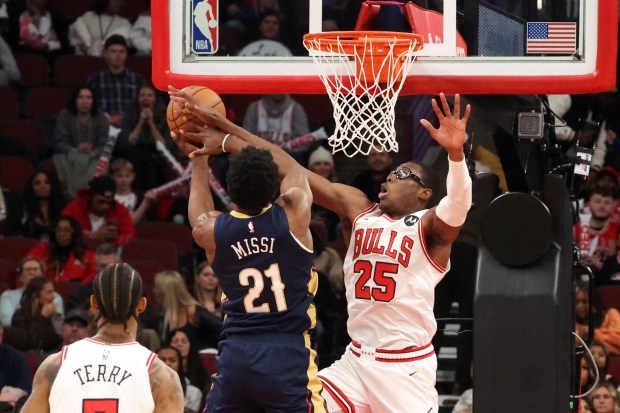 Pelicans center Yves Missi puts up a shot as Bulls center Jalen Smith defends Dec. 31, 2025, at the United Center. (Terrence Antonio James/Chicago Tribune)
One thing is clear: The Bulls need to get bigger.
The current roster is almost laughably undersized, especially when Jalen Smith has been out of the rotation because of injury — or just needs a breather because he can’t play every minute. Smith is the only big under a full contract past this season, so the Bulls need significant maneuvering to rebuild the frontcourt over the summer.
What’s less clear is how the Bulls want to achieve this goal. They could add size through the draft, which should offer solid options at power forward and center — such as Washington’s Hannes Steinbach or Michigan’s Yaxel Lendeborg — in the general area of their projected draft pick. And if they have multiple first-rounders courtesy of Portland, the Bulls could stock up on a couple of big prospects and begin investing long term in the frontcourt.
Free agency is another option. The Bulls have struggled to land big-time free agents, but that doesn’t mean they can’t take a swing to bring in a mid-tier big. The issue is this free-agency class lacks any notable centers who don’t have serious injury or health concerns.
Age is also key here — the Bulls wouldn’t help themselves by picking up a big who’s already in his late 20s, aging him out of the current plan focused around 21-year-old Matas Buzelis. If the Bulls don’t use the draft to shore up the frontcourt, they likely would need to trade for reinforcements, which would be harder to do with few reasonable trade assets left on the roster.