
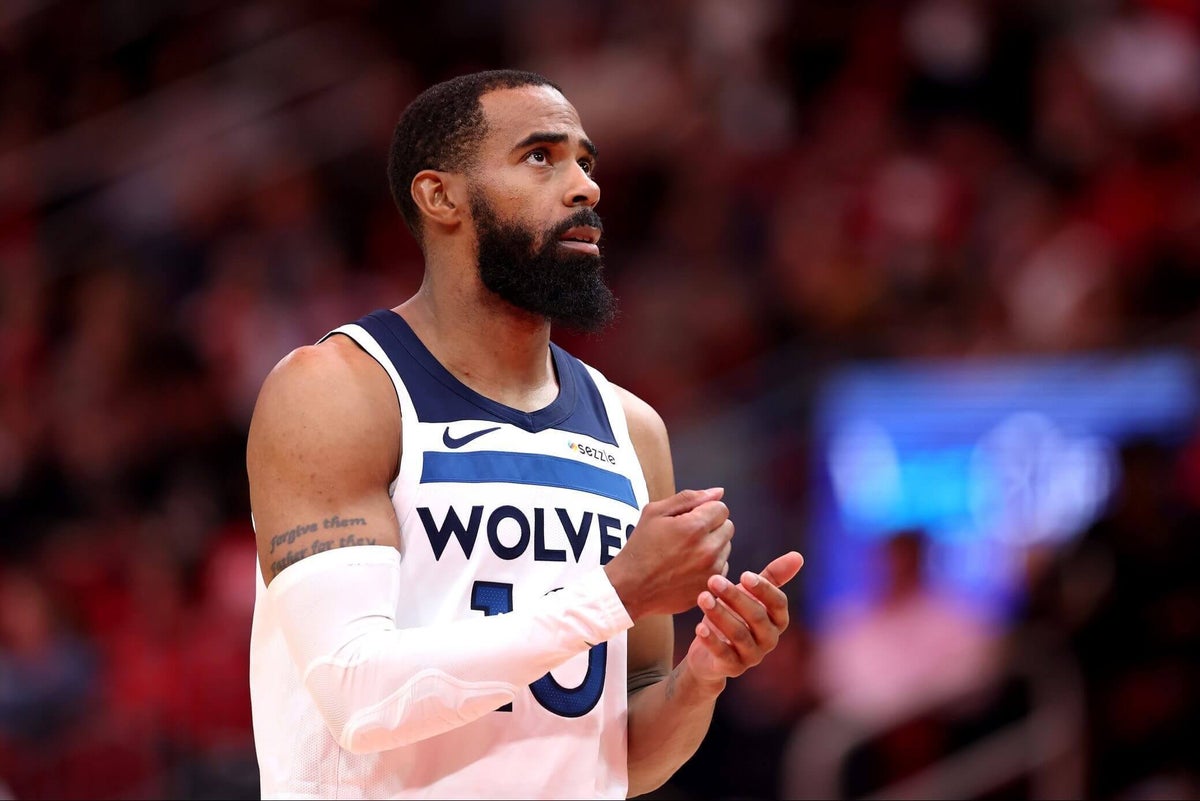
Of all of the people surprised to see Mike Conley back in a Minnesota Timberwolves uniform and at practice on Thursday, Conley might be at the top of that list.
Two weeks ago, the Wolves traded their veteran point guard to the Chicago Bulls in a cost-cutting move. Just like that, Conley thought his highly influential run in Minnesota was over. He left one of the team group chats, said goodbye to his teammates and worried about leaving his wife and children behind for a few months as he finished the season elsewhere.
Players from around the league were calling Conley to see if he had interest in joining their teams should the Bulls buy him out. His head was spinning. One of the nicest guys in the league admitted to being “a little salty” in the immediate aftermath of being dealt so late in his career.
“It’s always something that you think you’re ready for,” Conley said. “You’re expecting something, or whether you’re not expecting it and you’re trying to prepare your mind for it. But when it happens, you’re shocked.”
If he only knew what was in store for him in the 48 hours after he was traded, opening an almost-never-used loophole to get him back home. Conley would travel some 2,300 miles without moving a muscle.
After he was traded from Minnesota to Chicago, the Bulls flipped him to the Charlotte Hornets. That second trade allowed Conley to get around a rule in the collective bargaining agreement that prevents a player from rejoining the team that just traded him. When the Hornets agreed to buy out Conley’s contract, it meant he didn’t have to leave Minnesota. He just got a two-week paid vacation.
“The first two days off, it wasn’t so great. It was a lot of, I call it stress, but it’s a little crazy,” Conley said. “But after that, once I heard that I’d be bought out and be a free agent, I was like, ‘Man, I won’t have to come to work. Like, I don’t have to do a dang thing.’ ”
So many things could have happened to prevent Conley from getting back to the Wolves. The Bulls could have kept him to mentor a group of very young guards, including Rob Dillingham, Minnesota’s former lottery pick and Conley’s protege, who was traded to Chicago in a separate transaction. Or they could have just bought him out of his contract themselves, which would have removed the option for Conley to return to Minnesota.
The 38-year-old was looking around at rosters of playoff-caliber teams to see if they might need a veteran point guard. However, the Bulls traded him and Coby White to Charlotte for Collin Sexton, Ousmane Dieng and three second-round picks.
That is when Conley “started reading all the stuff about, hey, you could end up back in Minnesota.”
The Hornets could have also kept Conley. They are a young team that has caught fire of late and is pushing for a playoff berth. Having a leader like Conley, who has been to the last two Western Conference finals and was integral in shaping the Timberwolves into a contender, could have been a perfect pillar in the locker room for LaMelo Ball, Brandon Miller and Kon Knueppel.
When it became clear that the Hornets were open to the buyout, Timberwolves president of basketball operations Tim Connelly reached out to Conley to tell him he wanted him back in Minnesota. It was a short conversation.
“Just happy that somehow this all worked and I didn’t have to move the family,” Conley said. “I think the best-case scenario for all of us was to be here and finish out the year with what we started and don’t have to uproot everybody and can keep everybody happy.”
The Minnesota team he is returning to is fundamentally different from the one he “left.” Trading Conley helped the Timberwolves save nearly $20 million in luxury-tax penalties. It also helped them pull off another deal with the Bulls, landing coveted guard Ayo Dosunmu to bolster their bench.
One of the reasons they felt compelled to make that deal was because Conley has shown his age this season. He was moved from the starting lineup to the bench at the start of the season, and it has been a difficult adjustment for him. Conley is averaging just 4.4 points per game and is shooting 32 percent from the field and 32 percent from 3-point range.
Coach Chris Finch has never lost trust in him, still playing him over 18 minutes per game. The coach relies on Conley to organize the offense and provide consistent perimeter defense, particularly when chasing movement shooters around screens.
“He’s meant so much to us,” Finch said. “We don’t have the success that we’ve had without him. It’s great to have him back for all the reasons — the leadership and the maturity and the experience that he brings.”
All of that said, everyone understands the landscape now. Dosunmu is 26. He is bigger, faster and is shooting 45 percent from 3-point range this season. The transition from Chicago to Minnesota has been seamless, and he is firmly in the top seven of the rotation.
Bones Hyland has also played well this season, showing a much higher offensive ceiling than Conley at this point in his career. Hyland had back-to-back 20-point games against the New Orleans Pelicans and Toronto Raptors before the All-Star break, providing crucial bench scoring to complement Naz Reid.
With all of that in mind, it is hard to find a significant chunk of minutes for Conley. Not surprisingly, he is fully on board.
“I honestly don’t expect to be running out there playing a ton of minutes,” Conley said. “I don’t expect to be out there 20 minutes or anything like that. Ayo, Bones, all these guys have earned their time and minutes on the court to get their opportunities and do what they do.
“I’m going to be ready and be prepared for whatever role that is, whether it’s in the rotation or spotty, whatever it is.”
Ever the professional, Conley said he does not want to get in the way of Hyland or Dosunmu. Conley is not saying his time is over. However, he cannot deny what he sees in the young guards who are blossoming as the playoffs approach.
“I’m getting older, man. That’s one thing,” Conley said. “But I just really think that it’s their opportunity more than it is mine, you know what I mean? They’re at the stage of life where they’re right before their prime or in their prime, and they should be getting these runs, and it should be getting these big minutes and big moments, and learning on these big games and big situations.”
That perspective is exactly why Connelly wanted Conley back in the Wolves’ locker room. On a team that can ride an emotional roller coaster, Conley is the metronome that keeps everyone on time.
Finch said there is no set plan just yet for how the rotation will shake out over the final 26 games of the regular season, starting on Friday night against the Dallas Mavericks. The Timberwolves (34-22) are in sixth in the West, just one game behind the third-seeded Houston Rockets (34-20), and only two games ahead of the seventh-seeded Phoenix Suns (32-24).
“Those two guys, Ayo and Bones, have been great, no doubt about it,” Finch said. “They’re a nice little combination, too. So we’ll just kind of take it day by day as we move forward. Don’t have anything pre-scripted, really, right now.”
Conley and Finch are well aware of how quickly things can change. Injuries, inconsistency, anything can happen to require a change of course. One thing Finch knows is that Conley will be ready if needed.
“I can be the stopgap here and there, or pinch hitter when you need me, or whatever you need,” Conley said. “But I’m prepared for that. I’m prepared for that role, I’m prepared for whatever that brings. But if somebody gets hurt or something happens, like, I’ll play 20 minutes, you know, 30, whatever you need me to do.”
Chicago Mike? Charlotte Mike? Nah, that doesn’t have the same ring to it. He is Minnesota Mike, and he is here to stay.